Connect with us

Search by keyword

Computers

AI Helps Songwriters Transform Images and Text into Music

A new AI tool called Amuse helps songwriters turn images, text, or sound into music, boosting creativity and making the songwriting process easier.

AI Helps Songwriters Transform Images and Text into Music 1024x576

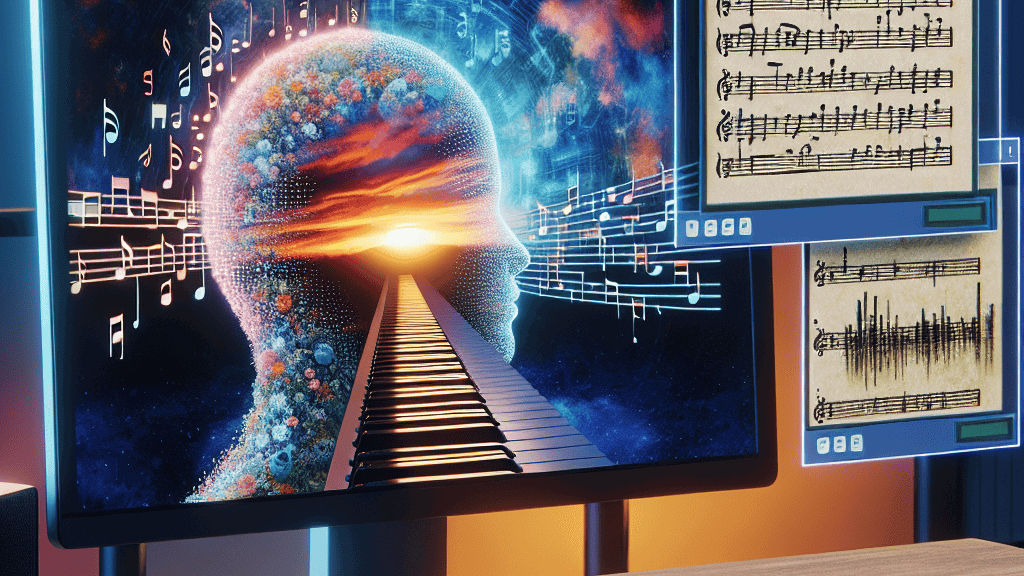
Imagine taking a photo of a stunning sunset or reading a captivating story, and instantly creating a piece of music inspired by it. That’s exactly what the new AI tool Amuse promises to do for songwriters. By transforming images, text, or audio into music, Amuse is opening up a whole new world of creativity.

The innovative part about Amuse is how it interprets these different forms of input and translates them into chord progressions for music. By using powerful large language models, it makes initial guesses at what these inputs might sound like in a musical form. Then, it refines these guesses using a specialized chord model to ensure they’re music-ready. This process helps songwriters seamlessly incorporate unique inspirations into their work, without needing a specific database to find matching examples.

Picture a songwriter using Amuse on their next project. They could snap a photo of a colorful cityscape, and Amuse would help them generate harmonies and melodies that echo its vibrancy and spirit. This isn’t just a technical advance—it’s a new way for artists to play with ideas and elevate their creative process, making what seems impossible possible.

Amuse can turn a simple image into a harmonious chord progression, even if there’s no existing music associated with it.

FAQs

How does Amuse help songwriters?

Amuse transforms images, text, or audio into music by turning them into chord progressions, making it easier for songwriters to connect various forms of inspiration to their music.

What makes Amuse unique?

Amuse uses advanced large language models to suggest chords from multimodal inputs and refines these suggestions to be musically coherent without needing a specific database of examples.

Who can benefit from using Amuse?

Songwriters looking to enhance their creative process with innovative tools can find Amuse especially useful, as it opens new ways to incorporate diverse inspirations into their music.

Can Amuse work with images alone?

Yes, Amuse can take an image and generate meaningful chord progressions that reflect the image’s mood or theme.

Is musical experience required to use Amuse?

No, even those without musical experience can use Amuse to explore and create music-inspired outputs from their creative inputs.

Background

At its core, Amuse uses multimodal large language models to interpret various inputs—like images and text—and convert them into musical suggestions. These models are trained to understand and generate language (or music, in this case) based on a wide range of data. The system also includes a specialized unimodal chord model that filters these suggestions, ensuring they make musical sense and are cohesive.

History

Traditionally, music creation tools focused on providing musical templates or helping with editing existing tracks. However, these systems often limited creativity to a single medium, like audio. Recent advancements in AI, particularly with large language models, have enabled a shift towards more versatile tools that can process and integrate diverse types of input, such as images and text, into music composition.

Based on “Amuse: Human-AI Collaborative Songwriting with Multimodal Inspirations” by Yewon Kim, Sung-Ju Lee, Chris Donahue, available on arXiv (arxiv.org/abs/2412.18940), used under CC BY 4.0 (creativecommons.org/licenses/by/4.0/).


Trending

Latest

Can AI Save Water Discover How

Computers

AI is transforming the tech world, but it uses lots of water! A new tool, SCARF, helps us measure and reduce AI's water footprint,...

Whats a Forbush Decrease and Why Should We Care Whats a Forbush Decrease and Why Should We Care

Space

Scientists just observed the biggest solar storm event in years, revealing unexpected cosmic ray patterns. Understanding these changes could help us protect our technology...

Can Cars Spot Danger Faster Than Humans Can Cars Spot Danger Faster Than Humans

Computers

Think about how quickly you react when something unexpected happens on the road. This research brings us closer to creating self-driving cars that can...

Can Fear of the Other Stop Social Harmony Can Fear of the Other Stop Social Harmony

Physics

Fear of the unknown might make it harder for people to agree and get along. This study shows that when people have strong xenophobic...

Can AI Revolutionize Breast Cancer Diagnosis Can AI Revolutionize Breast Cancer Diagnosis

Electricity

This research introduces a groundbreaking AI model that can accurately assess HER2-positive breast cancer using widely accessible staining methods, potentially revolutionizing how we diagnose...

Can AI Transform Your Singing into a Choir Can AI Transform Your Singing into a Choir

Computers

Imagine singing solo and having AI turn you into a choir. This research unveils a groundbreaking AI tool that transforms your voice into rich...

You May Also Like

Computers

AI is transforming the tech world, but it uses lots of water! A new tool, SCARF, helps us measure and reduce AI's water footprint,...

Computers

Think about how quickly you react when something unexpected happens on the road. This research brings us closer to creating self-driving cars that can...

Electricity

This research introduces a groundbreaking AI model that can accurately assess HER2-positive breast cancer using widely accessible staining methods, potentially revolutionizing how we diagnose...

Computers

Imagine a machine capable of reading ancient books, deciphering complex pages with precision! This research is paving the way for AI to unlock the...

Economics

Discover how AI models can unknowingly favor certain races in mortgage decisions and how new methods could dramatically reduce these biases, fostering a fairer...

Computers

This research explores how AI models designed to understand both images and words might improve their performance simply by teaching themselves to think better....

Computers

Imagine if playing games could make a computer program better at understanding and creating text! This research suggests that by using creative tasks like...

Computers

Dive into the world of AI mistrust, where computers don't always know when they're wrong! Discover how teaching AI to see like us might...

Computers

What if talking to a robot could feel as comforting as a therapy session? This research uncovers the striking similarities between human therapists and...

Copyright © 2024 8ig8rain.

Disclaimer: The content on 8ig8rain.com consists of AI-generated summaries of scientific abstracts from arXiv. Please note that most arXiv abstracts are preprints and may not have undergone formal peer review. While these summaries aim to convey key ideas and potential applications, they are provided for informational purposes only and should not be interpreted as validated scientific findings or professional advice. The summaries are intended to educate, spark curiosity, and inspire further exploration of science.