**What if we told you that scientists are using small, controlled experiments to mimic the conditions around black holes?** While real black holes are light-years away and incredibly intense, researchers have found clever ways to explore their mysterious properties right from a lab bench. This is made possible through what’s known as analog gravity experiments, which help scientists recreate the powerful phenomena that typically occur near these cosmic giants. It’s like having a black hole backyard experiment, where you can explore unseen realms and untangle the secrets of the universe.
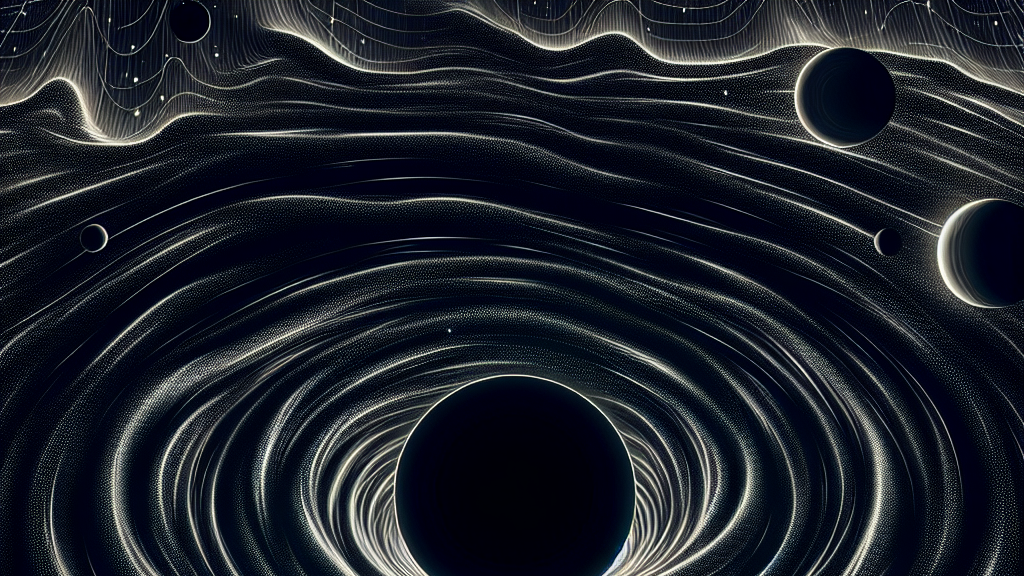
In these fascinating setups, scientists use various materials to create extreme conditions, such as an acoustic vortex—a spiraling sound wave within a fluid—that imitates the forces at work in the swirling environment around a black hole. By tweaking certain parameters, researchers can simulate different spacetime scenarios, like having or not having a sonic horizon, which mimics the event horizon of a black hole. These controlled environments reveal exciting new insights into both classical and quantum aspects of black holes, allowing us to understand them better without needing to travel to the depths of space.
This cutting-edge research has practical implications beyond just satisfying our curiosity. Understanding black hole physics on a small scale can shed light on many cosmic phenomena, potentially leading to breakthroughs in how we harness energy or even how we understand time itself. Imagine one day having energy systems inspired by the physics of black holes, or a deeper understanding of the universe’s structure from the comfort of Earth. This research is not just about cosmic wonders; it might very well change our tomorrow.
Did you know that scientists can simulate the powerful gravitational effects of black holes using sound waves in a lab?
FAQs
How can scientists simulate black holes in a laboratory?
Scientists simulate black holes using analog gravity experiments with tabletop setups that replicate black hole conditions through materials like acoustic vortices.
What are acoustic vortices, and how do they relate to black holes?
Acoustic vortices are swirling sound waves in a fluid, and they emulate the gravitational effects around black holes, allowing scientists to study similar phenomena safely on Earth.
Why is analog gravity research important for our future?
Analog gravity research helps us understand black hole physics, offering insights into cosmic mysteries and potential breakthroughs in energy systems and our understanding of time.
How do these experiments mimic the event horizon of a black hole?
The experiments use adjustable parameters to simulate a sonic horizon, similar to a black hole’s event horizon, allowing for observation of black hole-like effects in a controlled environment.
What materials are used in these analog gravity experiments?
Materials like superfluid Helium are often used due to their properties that mimic the dynamic behaviors found in space, allowing for effective simulation of black hole conditions.
Background
Analog gravity experiments involve creating controlled conditions in the laboratory that mimic the intense gravitational effects found near black holes. By using materials that can simulate the spacetime environment around these cosmic objects, researchers can explore both classical and quantum phenomena in a safe and accessible way. This is achieved using technologies like acoustic metrics, where sound waves in fluids form patterns that imitate black hole conditions.
History
The concept of analog gravity isn’t entirely new but has seen significant advancements in recent years. Initially, physicists developed the idea of using fluids and waves to explore gravitational theories in simpler systems. Over time, this approach has evolved to employ advanced materials like superfluid Helium, enabling more accurate emulation of black hole behaviors. These advances build on decades of theoretical work in black hole physics, bringing once purely theoretical concepts into tangible experimental realms.
Based on “Eye of the vortex: bound spectra in tunable horizonless rotational analogs” by H. S. Vieira, Kyriakos Destounis, available on arXiv (arxiv.org/abs/2506.03451), used under CC BY 4.0 (creativecommons.org/licenses/by/4.0/).