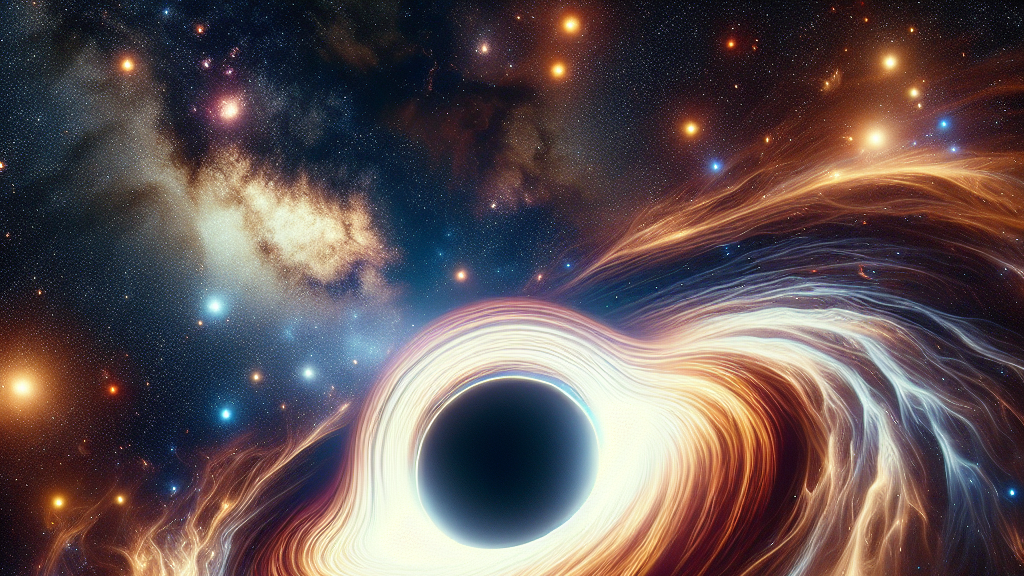
Imagine a giant cosmic whirlpool sucking in everything around it, even light itself! That’s a black hole, one of the most mysterious objects in the universe. Recently, scientists have used waves generated by colliding black holes to support an idea known as the Hawking Area Theorem, which helps us understand how these cosmic giants behave. But here’s the twist: they also found hints pointing towards something far-out called dark matter.
These discoveries stem from combining two ways of looking at black holes: one that doesn’t depend on space as we see it, and another that does. Researchers found that when these approaches meet, they reveal new layers to the puzzle of the universe. These layers could be linked to dark matter—an invisible substance thought to make up most of the universe, but which we still haven’t directly detected. By examining black holes in this new light, scientists are a step closer to understanding whether dark matter exists in forms we haven’t seen yet.
So, why should you care? Well, these insights may open the door to new technology or even help us discover unknown particles that could change energy sources as we know them. Imagine using insights derived from black holes to power our world sustainably. It might sound like science fiction, but that’s the magic of science—turning the impossible into the possible!
Black holes are so powerful that they can warp time and space around them!
FAQs
What are gravitational waves?
Gravitational waves are ripples in space-time caused by massive cosmic events like colliding black holes, and they provide an intriguing way to study the universe’s most mysterious objects.
How do black holes relate to dark matter?
The study of black holes through gravitational waves has hinted at the existence of unknown particles, which might form dark matter—an elusive substance making up most of the universe’s mass.
What is the significance of this research on black hole entropy?
This research combines two theoretical approaches to better understand black hole behavior, potentially revealing new constraints on particles that might help explain dark matter.
What is the Hawking Area Theorem?
The Hawking Area Theorem states that the total area of a black hole’s event horizon can never decrease, shedding light on the nature and behavior of black holes.
How can these findings impact everyday life?
Understanding black holes and dark matter could lead to technological advances, such as new energy sources, by revealing fundamental particles and forces of nature.
Background
Understanding black holes requires a blend of different scientific theories. The Hawking Area Theorem, named after Stephen Hawking, posits that black holes can only grow larger, not smaller. This ties into the Bekenstein-Hawking Area Formula, which calculates the entropy—or disorder—of a black hole’s surface area. Recently, gravitational waves, which are ripples in space-time produced by astronomical events like merging black holes, have validated this theory. These foundational concepts allow scientists to study black holes as potential keyholders to the mysteries of the universe, including dark matter.
History
The study of black holes has a long and storied history, beginning with Albert Einstein’s theory of general relativity, which predicted the existence of these cosmic phenomena. In the 1970s, Stephen Hawking introduced his groundbreaking Hawking Area Theorem, which revolutionized our understanding of black holes. Since then, the field has advanced significantly, with the detection of gravitational waves in 2015 providing new opportunities to verify Einstein’s theories. This latest research builds upon these foundations by proposing a hybrid approach that combines different theories of quantum gravity to study black hole entropy and its potential implications for dark matter.
Based on “Can Gravitational Wave Data Shed Light on Dark Matter Particles?” by Parthasarathi Majumdar, available on arXiv (arxiv.org/abs/2506.04905), used under CC BY 4.0 (creativecommons.org/licenses/by/4.0/).