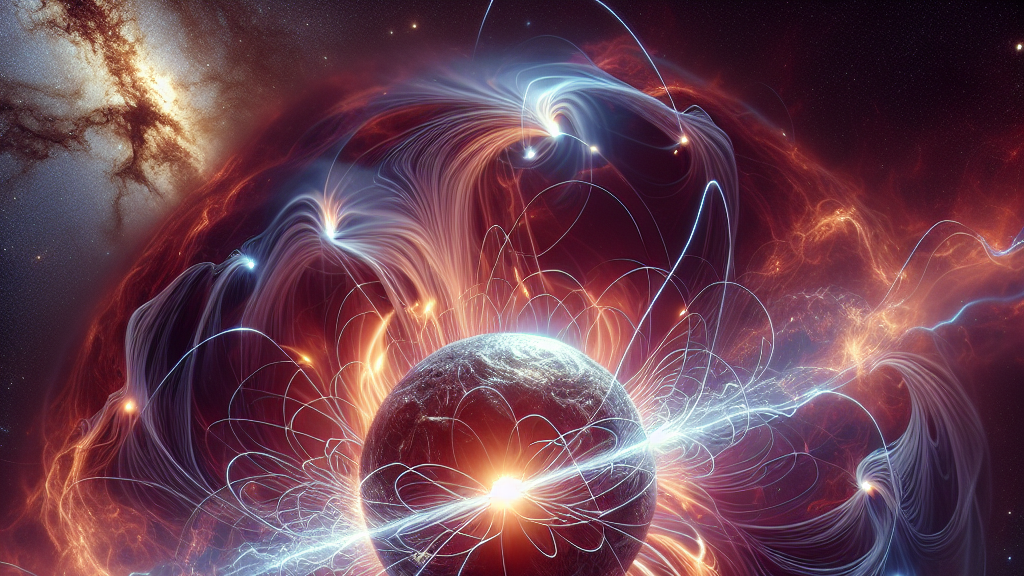
Imagine if your favorite mystery novel had a plot twist that no one saw coming. That’s how scientists feel about the inner workings of neutron stars right now. These cosmic heavyweights might be hiding an amazing secret in their cores: a phase transition—like water turning into ice or steam, but on a much grander scale!
By using a bunch of smart statistical tricks and astrophysical insights, researchers have explored how neutron-star matter might change phases deep within. They used something called Gaussian processes to model these transitions in a completely open-minded way. Think of it as running thousands of different mystery endings to see which one fits best with the cosmic clues we have so far. The result? We still can’t say for sure if there’s a dramatic change like a first-order phase transition, but there’s a good chance something intriguing is happening inside these stars.
One day, this kind of research could totally change how we see the universe. If we understand these phase transitions better, we could unlock new insights about the extreme conditions of matter in space. Imagine using this knowledge to power new forms of technology or even predict cosmic events more accurately. Who knew stars could hold such epic secrets waiting to be uncovered?
Did you know? Neutron stars can pack the mass of several suns into a space just 20 kilometers across!
FAQs
What are phase transitions in neutron-star matter?
Phase transitions in neutron-star matter refer to changes in the state of matter inside a neutron star, much like how water turns into ice or steam. Scientists think these transitions could reveal new insights about the dense conditions inside neutron stars.
How do Gaussian processes help in studying neutron stars?
Gaussian processes are statistical methods that allow researchers to test various scenarios about neutron star interiors without being biased towards one specific outcome. They help in predicting how matter might behave under the extreme conditions found in these stars.
Why can’t scientists distinguish between a smooth crossover and a first-order phase transition in neutron stars?
Current data is not precise enough to clearly differentiate between a smooth transition and a first-order phase transition inside neutron stars. However, ongoing research aims to refine these observations for clearer insights.
How does this study impact our understanding of the universe?
This research could significantly enhance our understanding of cosmic structures and the extreme states of matter that exist only in the vastness of space, potentially leading to technological advancements and improved predictive models for astrophysical events.
Could neutron stars reveal more cosmic secrets in the future?
Absolutely! Neutron stars are incredibly dense and energetic, making them prime candidates for uncovering mysteries about matter and energy in the universe, which could revolutionize many scientific fields.
Background
Neutron stars are incredibly dense remnants of exploded stars, offering unique conditions to study matter at densities much higher than we can create on Earth. Understanding phase transitions in this context is crucial because it helps scientists learn how matter behaves under extreme pressure and density. Gaussian processes are statistical tools used to predict outcomes based on available data, allowing researchers to explore different scenarios without predefined assumptions.
History
The study of neutron stars and their interiors has been a focus of astrophysics since their discovery in the 1960s. Initial theories predicted these stars could contain exotic states of matter. Over the years, advancements in computational models and simulation techniques, like Gaussian processes, have allowed for more complex investigations into what happens within these stellar objects. This study builds on these decades of research by applying sophisticated statistical methods to probe the mysteries within.
Based on “First-order phase transitions in the cores of neutron stars” by Oleg Komoltsev, available on arXiv (arxiv.org/abs/2404.05637), used under CC BY 4.0 (creativecommons.org/licenses/by/4.0/).