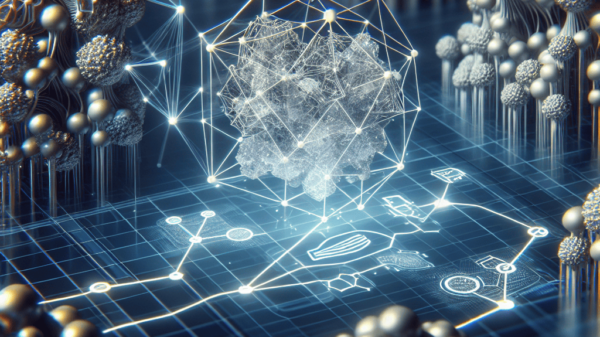
Have you ever wondered how online platforms seem to magically recommend the perfect song or product just for you? Behind the scenes, these platforms use graph-based data magic to make connections that seem almost human. But the battle to find the best method to uncover hidden patterns is heating up, with Probabilistic Graphical Models and Graph Neural Networks emerging as the champions of the field.
Research delves into how these two approaches, PGMs and GNNs, perform when tasked with predicting connections in data networks—a vital skill for everything from social media suggestions to traffic predictions. PGMs come out on top when dealing with noisy or simpler data, showing resilience when data points don’t always play nice. GNNs, while powerful, struggle when the input data is too minimal or cluttered, shedding light on when they might stumble in real-world applications.
So, what does this mean for the future? Picture a world where transportation systems predict and adapt to congestion in real time, or social platforms that more accurately recommend content without overshooting your tastes. As we refine our tools and pick the right champion for the task, the way we connect, travel, and consume content could be smarter and more intuitive than ever before. Both PGMs and GNNs offer different strengths, setting the stage for smarter predictions and enhanced data-driven decisions.
Did you know? Some graph models can predict social media trends just like a fortune teller predicting the future!
FAQs
What makes graph-based models like PGMs and GNNs important for predicting trends?
Graph-based models can capture complex relationships and patterns within data, making them uniquely capable of predicting trends in areas like social media, transportation, and consumer behavior.
How do PGMs outperform GNNs when data features are noisy or simple?
PGMs do not require complex input features, allowing them to perform better when data is noisy or less detailed, whereas GNNs need richer information to excel.
Can GNNs still be useful if they struggle with noisy data?
Yes, GNNs have strengths in analyzing richly detailed datasets, meaning they can be very effective in situations where detailed node information is available, such as in healthcare or detailed consumer data analysis.
What does this research mean for everyday technology users?
This research implies that technology can become more intuitive and accurate, improving everything from online recommendations to traffic management, resulting in a smoother, more personalized user experience.
Background
Graphs are a type of data structure that represents relationships or connections between elements, often visualized as nodes (points) and edges (lines) connecting them. They are used in various applications, from social media networks to transportation systems. Probabilistic Graphical Models (PGMs) and Graph Neural Networks (GNNs) both utilize these structures to make predictions and extract insights, but they operate differently. PGMs rely on probabilities and statistical methods, whereas GNNs use neural networks to process graph data.
History
Initially, graph theory was mainly used in mathematics and computer science to solve problems like the shortest path in navigation. Over time, researchers recognized the potential of graph models to solve more complex problems involving networks, leading to the development of PGMs and GNNs. PGMs have been around longer, focusing on statistical relationships, while GNNs emerged more recently, leveraging advancements in neural network technology to analyze graphs with richer data.
Based on “How do Probabilistic Graphical Models and Graph Neural Networks Look at Network Data?” by Michela Lapenna, Caterina De Bacco, available on arXiv (arxiv.org/abs/2506.11869), used under CC BY 4.0 (creativecommons.org/licenses/by/4.0/).