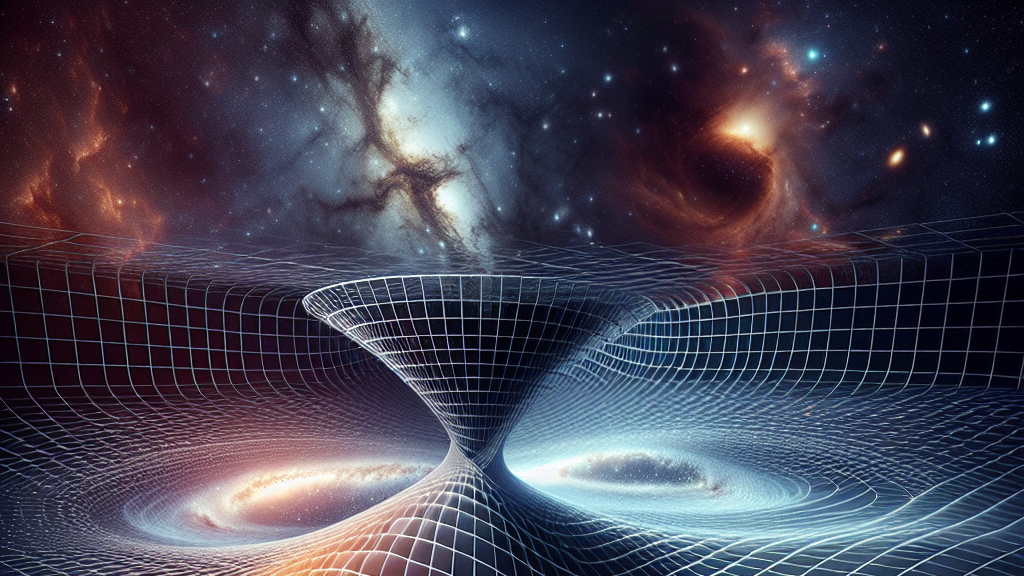
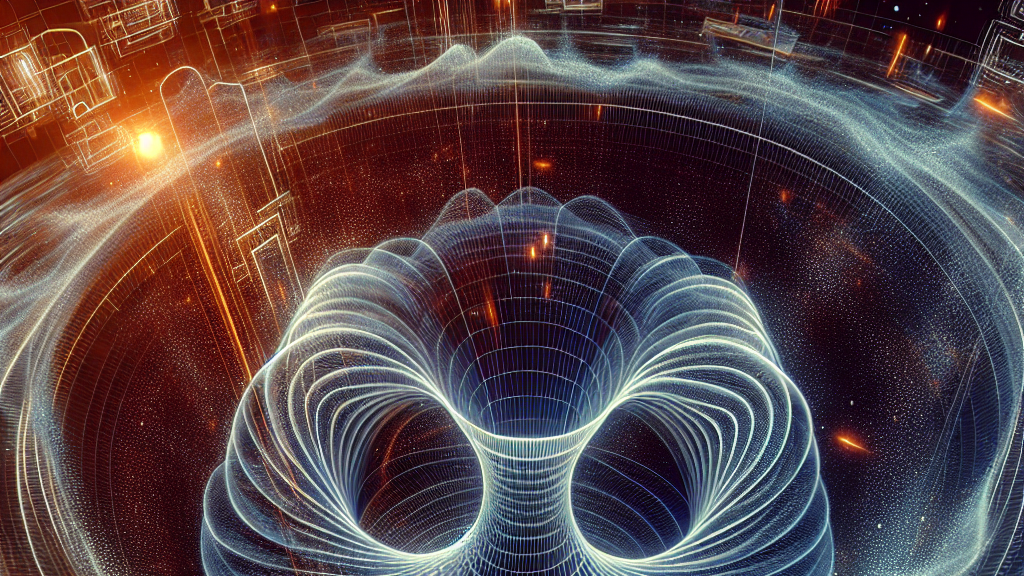
Imagine if the rules that govern our universe weren’t as rock solid as we believed. A recent study delved into how gravitational waves—ripples in spacetime caused by massive objects like black holes—could reveal hidden quirks in the cosmos. These intricacies might even hinted at the breaking of a fundamental rule called Lorentz invariance, which insists that the laws of physics are the same for everyone, everywhere, at all times. Big, right?
The scientists used a sophisticated approach to analyze these space-time ripples. By solving wave equations with a method that combines advanced math and physics, they were able to see if these ripples played by the same rules when affected by a Lorentz-violating extension of General Relativity. It’s almost like reshuffling the universe’s rulebook to see what happens. This involved sophisticated calculations to compare how these mysterious ripples behave under slightly adjusted universal laws.
So why does this matter to you? Imagine a future where our understanding of the universe allows for new technologies, like advanced space travel or more precise GPS systems. If these gravity waves hint that the universe’s laws can bend or break, it could lead to innovations we haven’t even dreamed of yet. Essentially, this research is like taking the first step towards discovering new frontiers, both in our minds and in outer space.
Did you know? Gravitational waves were first predicted over a century ago by Albert Einstein, yet directly detected only in 2015!
FAQs
What is Lorentz invariance and why does this research challenge it?
Lorentz invariance is the principle that the laws of physics are the same for all observers, regardless of their relative motion. This research challenges Lorentz invariance by studying how gravitational waves behave when this principle is possibly violated, providing insights into the fundamental nature of the universe.
How do gravitational waves relate to General Relativity?
General Relativity, proposed by Einstein, predicts gravitational waves as ripples in spacetime caused by massive celestial events. This research explores modifications of these predictions to test the robustness of gravitational and spacetime theories.
What role does the Multipolar Post-Minkowskian method play in this study?
The Multipolar Post-Minkowskian method is used to solve complex equations related to gravitational waves. This approach helps scientists understand the possible effects of modified gravity laws on these waves, offering deeper insights into the fabric of the universe.
Why are new gravitational wave detectors important for this research?
New detectors like LISA are crucial because they can capture more precise gravitational wave data, allowing scientists to test fundamental physics theories under a broader range of conditions. This enhances our understanding of the universe’s underlying principles.
How could these findings impact future technologies?
If proven, the findings could lead to advanced technology developments, such as improved space travel methods and more accurate navigation systems, by uncovering new physical principles that govern our universe.
Background
Gravitational waves are ripples in space-time caused by massive objects like black holes colliding. The Multipolar Post-Minkowskian method is used for solving complex equations that describe the behavior of these waves. Lorentz invariance is a key principle in physics that states the laws of physics are the same for all observers, regardless of their constant velocity motion—which is a cornerstone of Einstein’s theories of relativity. This study tweaks this principle to see what happens, potentially guiding us toward a deeper understanding of the cosmos.
History
Gravitational waves were first predicted by Einstein in the early 20th century, but only confirmed by observations in 2015. Since then, scientists have been probing these waves to understand the universe more intimately. This research builds on such work by examining how these ripples behave when the fundamental principles of relativity are slightly altered. It represents a novel approach in a field traditionally governed by Einstein’s firmly established theories.
Based on “Gravitational-wave generation in the presence of Lorentz invariance violation” by Samy Aoulad Lafkih, Marie-Christine Angonin, Christophe Le Poncin-Lafitte, Nils Albin Nilsson, available on arXiv (arxiv.org/abs/2506.08859), used under CC BY 4.0 (creativecommons.org/licenses/by/4.0/).