Connect with us

Search by keyword

Physics

Can Fear of the ‘Other’ Stop Social Harmony?

Fear of the unknown might make it harder for people to agree and get along. This study shows that when people have strong xenophobic tendencies, it can stop the natural process of everyone coming to an agreement. Understanding this could help us create friendlier communities.

Can Fear of the Other Stop Social Harmony
✨Researched by humans. Explained by robots. Learn more.

**Have you ever wondered why it’s so hard for people to agree sometimes?** You might blame opposing viewpoints or personal interests, but what if there’s a deeper reason? New research highlights how fear and distrust of those who are different, or xenophobia, can actually stop people from reaching a common understanding. It’s like trying to build a bridge with missing pieces; no matter how hard you try, something crucial is missing that keeps the sides from connecting.

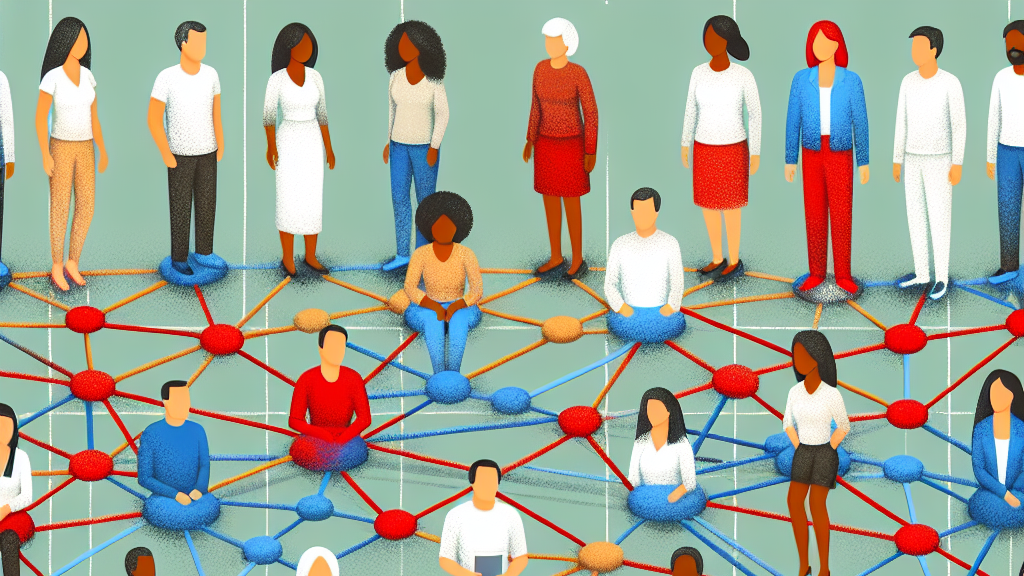
**This intriguing study used complex simulations and math to see how fear affects group discussions.** By using a method called belief propagation and Monte Carlo simulations on special tree-like graphs, researchers found that too much fear of others can stop people from agreeing on a topic completely. Normally, as you talk more about a subject, people start to agree. However, if there’s strong xenophobia, instead of smoothly reaching an understanding, people’s opinions might drastically shift without warning, and reaching agreement becomes a game of chance.

**Imagine how this might change the way we approach social harmony on larger scales.** Suppose communities could identify and address xenophobic tendencies early on, maybe through education or community programs. This could help pave the way to more diplomatic, understanding discussions, even on heated topics. Think about how many conflicts could be avoided if people learned to trust and understand each other, creating communities where everyone’s voice could be heard and valued.

Did you know that xenophobia can stop people from agreeing on even the most popular topics?

FAQs

What is a phase transition in social networks?

In social networks, a phase transition refers to a significant change in the collective state of the network, like a sudden shift from disagreement to agreement on a particular topic.

How do xenophobic interactions affect social balance?

Xenophobic interactions, or fear of those who are different, can disrupt the natural balance in social networks by creating barriers to consensus and causing abrupt shifts in group opinions.

Can reducing xenophobia help in opinion formation?

Yes! Lowering xenophobia could smooth out the process of opinion formation, making it easier for groups to reach a consensus.

Background

The research focuses on how opinion dynamics in social networks are influenced by interactions among individuals. Xenophobic interactions are those driven by a fear or distrust of people perceived as different. The study explores how these interactions can hinder consensus, using advanced mathematical techniques like belief propagation, which is a way to analyze how beliefs or opinions spread in a network, and Monte Carlo simulations, which are computer-based techniques to model the probability of different outcomes in a process that is complex and uncertain.

History

The study builds on decades of research on social networks and opinion dynamics, including how groups form opinions and the kind of interactions that influence these processes. In the past, most research focused on homophily, the tendency of individuals to associate and bond with similar others. This new research adds an important dimension by focusing on xenophobia, a less understood but equally crucial factor in social dynamics.

Based on “Xenophobia based on a few attributes can impede society’s cohesiveness” by Alejandro Castro, Tuan Minh Pham, Ernesto Ortega, David Machado, available on arXiv (arxiv.org/abs/2506.18513), used under CC BY 4.0 (creativecommons.org/licenses/by/4.0/).

Trending

Latest

Can AI Save Water Discover How

Computers

AI is transforming the tech world, but it uses lots of water! A new tool, SCARF, helps us measure and reduce AI's water footprint,...

Whats a Forbush Decrease and Why Should We Care Whats a Forbush Decrease and Why Should We Care

Space

Scientists just observed the biggest solar storm event in years, revealing unexpected cosmic ray patterns. Understanding these changes could help us protect our technology...

Can Cars Spot Danger Faster Than Humans Can Cars Spot Danger Faster Than Humans

Computers

Think about how quickly you react when something unexpected happens on the road. This research brings us closer to creating self-driving cars that can...

Can Fear of the Other Stop Social Harmony Can Fear of the Other Stop Social Harmony

Physics

Fear of the unknown might make it harder for people to agree and get along. This study shows that when people have strong xenophobic...

Can AI Revolutionize Breast Cancer Diagnosis Can AI Revolutionize Breast Cancer Diagnosis

Electricity

This research introduces a groundbreaking AI model that can accurately assess HER2-positive breast cancer using widely accessible staining methods, potentially revolutionizing how we diagnose...

Can AI Transform Your Singing into a Choir Can AI Transform Your Singing into a Choir

Computers

Imagine singing solo and having AI turn you into a choir. This research unveils a groundbreaking AI tool that transforms your voice into rich...

You May Also Like

Statistics

Imagine how a simple health tip can change who you trust and talk to every day! This research shows how providing health information in...

Quantum Biology

This research reveals how the cost of maintaining friendships can shift our willingness to work together. By understanding these dynamics, we could better design...

Space

AI is helping scientists unlock the mysteries of cosmic rays from outer space. By using advanced networks called Transformers, researchers are learning more about...

Physics

This study reveals how the tiny bumps on a surface can dramatically change the way fluids, like air or water, flow past an object....

Physics

This research uncovers how opinions change in society using new models that show surprising patterns of behavior influenced by noise and nonlinearity. By understanding...

Materials

This study reveals how tiny moving pieces can form bubbles in thicker areas by switching active and passive bits. It highlights how differences in...

Space

Scientists have developed a wild new way to simulate how dark matter interacts with regular particles, potentially unlocking secrets of our universe's formation.

Computers

Our views are influenced by the groups we belong to, and understanding this can help bridge differences and unite diverse opinions. By studying and...

Math

Exploring how the 'everyone is more popular than me' feeling is explained by math, showing us that our perception of popularity in social networks...

Copyright © 2024 8ig8rain.

Disclaimer: The content on 8ig8rain.com consists of AI-generated summaries of scientific abstracts from arXiv. Please note that most arXiv abstracts are preprints and may not have undergone formal peer review. While these summaries aim to convey key ideas and potential applications, they are provided for informational purposes only and should not be interpreted as validated scientific findings or professional advice. The summaries are intended to educate, spark curiosity, and inspire further exploration of science.