Imagine a universe on the brink of collapse or expansion—a cosmic see-saw teetering between a chaotic Big Bang-like singularity and a serene, empty void. That’s what a new study is hinting at! Researchers have taken a closer look at the structure of our universe, applying sophisticated math to predict its potential fate. It’s like a sci-fi movie but on a cosmic scale, where the universe could either implode dramatically or expand into nothingness.
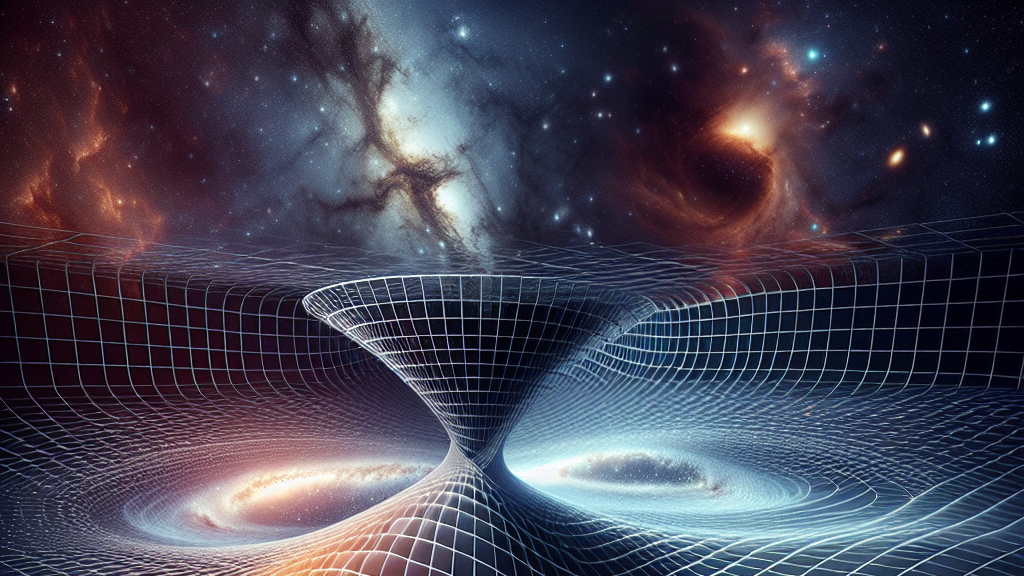
The study uses a complicated setup called the Einstein scalar-field system, testing how certain mathematical conditions affect the universe’s evolution. By modeling the universe as a three-dimensional space with a specific kind of geometry, the researchers found that the universe could collapse into a massive singularity—the end of all things. But hold on, it could also expand indefinitely, becoming a tranquil, empty expanse. This fascinating dance hinges on certain mathematical properties, which also help verify a hypothesis called the Strong Cosmic Censorship conjecture.
Why does this matter? Picture our universe as a balloon; the study is checking whether it will pop or keep inflating forever. Such findings could revolutionize our understanding of cosmic phenomena like black holes and space-time itself. As we dive deeper into these questions, we’re not just peering into the universe’s future—we’re uncovering the mysteries of its very beginning.
Did you know that the universe can be modeled with math as a three-dimensional space, changing how scientists perceive its vastness and fate?
FAQs
What is the Einstein scalar-field system?
The Einstein scalar-field system is a mathematical framework that allows scientists to study how the universe evolves over time, particularly in relation to geometric and gravitational properties.
How does this research affect our understanding of the Big Bang?
This study suggests that the universe could either collapse into a Big Bang-like singularity or expand infinitely, reshaping our understanding of how cosmic events unfold and how the universe might have begun.
What is the Strong Cosmic Censorship conjecture?
The Strong Cosmic Censorship conjecture is a hypothesis proposing that the universe’s physics remains predictable and well-behaved, even under extreme conditions like those leading to singularities. This research supports this idea by showing that certain mathematical conditions can lead to either a cosmic collapse or endless expansion.
How do these findings relate to black holes?
The study’s insights into singularities deepen our understanding of black holes, potentially revealing how these mysterious cosmic entities could behave in different scenarios.
Why is the universe’s spatial geometry important?
The universe’s spatial geometry impacts its gravitational properties and evolution, influencing whether it might collapse into a singularity or expand into infinite space.
Background
The study involves a complex interaction of geometry and matter within the universe. The Einstein scalar-field system is a set of equations that describe how gravity works on a cosmic scale, influenced by factors like matter distribution and geometric properties. Researchers used these equations to simulate different scenarios of the universe’s evolution.
History
Cosmologists have long been interested in the universe’s fate. The discovery of the universe’s expansion led to the Big Bang theory, which explains how the universe began. Over time, scientists explored various models to predict the universe’s ultimate fate, testing the boundaries of theories like General Relativity and hypotheses like the Cosmic Censorship conjecture.
Based on “Cosmic Censorship near FLRW spacetimes with negative spatial curvature” by David Fajman, Liam Urban, available on arXiv (arxiv.org/abs/2211.08052), used under CC BY 4.0 (creativecommons.org/licenses/by/4.0/).