





































































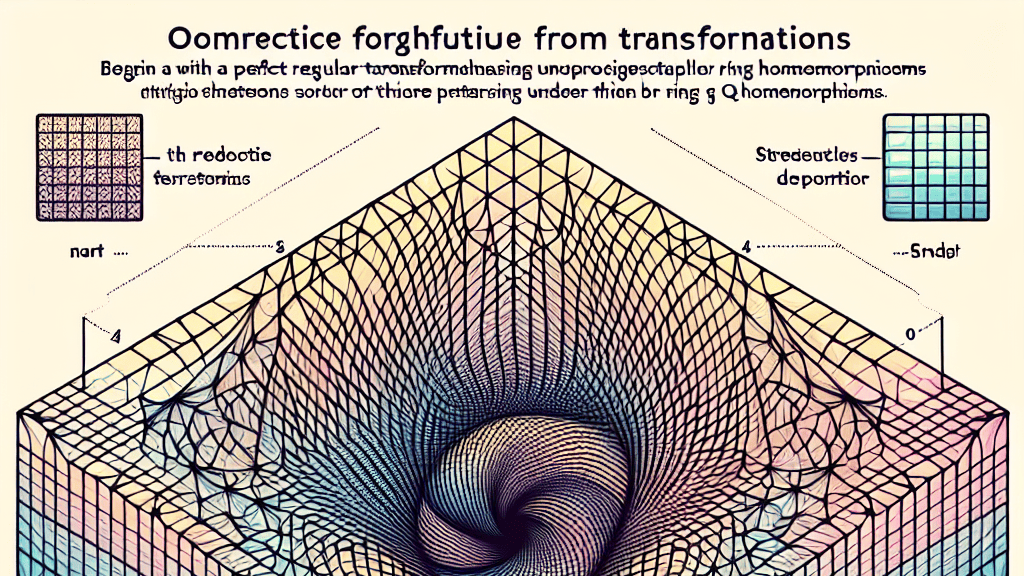
Imagine you’re drawing a map of a city, and every line you draw distorts slightly—a little longer here, a bit twisted there. This is similar to how ring Q-homeomorphisms work, distorting distances in space but in a predictable way. These mathematical mappings are crucial for understanding complex space transformations, which can impact how we model physical realities like air flow over a wing or data flow in computers.
The research delves into the behavior of ring Q-homeomorphisms with respect to something known as the p-modulus. It’s like setting rules for how much the map can distort, ensuring the distortion happens within expected limits. By studying the limits of these distortions, scientists can predict how the inverse of such mappings behaves, particularly highlighting a concept called Holder’s continuity near the origin.
Why should we care? Well, the insights gained from studying these distortions have real-world applications. For instance, ensuring precise mapping in computer graphics can lead to more realistic animations or simulations. Similarly, in engineering, understanding these distortions can help design better structures by accurately predicting how forces are distributed across materials. So next time you watch a flawless CGI movie or marvel at a modern architectural marvel, remember that these mathematical principles are quietly at work behind the scenes.
Ring Q-homeomorphisms help mathematicians understand how space can be ‘stretched’ without tearing or gluing it together.
FAQs
What is a ring Q-homeomorphism?
A ring Q-homeomorphism is a specific kind of mathematical function used to understand how different shapes in space can stretch and distort without tearing or overlapping.
Why is the p-modulus important?
The p-modulus sets boundaries on how much distortion can occur, helping ensure that transformations remain within predictable and manageable limits.
How does this research impact everyday technology?
It improves our understanding of mathematical models used in technology, potentially refining simulations, animations, and even the design of physical structures.
What is Holder’s continuity?
Holder’s continuity is a mathematical concept that describes how variations in a function remain bounded and smooth, offering stability to transformations.
How does this affect CGI movies?
Understanding these mathematical principles can lead to more precise and realistic computer-generated imagery by ensuring that how objects transform on screen mimics real-world physics accurately.
Background
In mathematics, homeomorphisms are functions that allow one shape to be stretched and reshaped into another without cutting or gluing. The ‘ring’ in ring Q-homeomorphisms adds another layer of structure, concerned with the transformation of circular or spherical sections of space. The p-modulus is a numerical measure that constrains the degree to which these transformations can stretch or compress space.
History
The study of homeomorphisms has been pivotal in topology and geometry, tracing back to classical mathematics. As mathematicians sought to understand the properties of shapes and spaces, they developed these complex mappings to better model and predict spatial transformations. This research builds upon these foundational principles by exploring the boundaries of distortion in ways not previously detailed.
Based on “On asymptotics of ring Q-homeomorphisms with respect to p-modulus near the origin” by Ruslan Salimov, Bogdan Klishchuk, available on arXiv (arxiv.org/abs/2501.01459), used under CC BY 4.0 (creativecommons.org/licenses/by/4.0/).
