





































































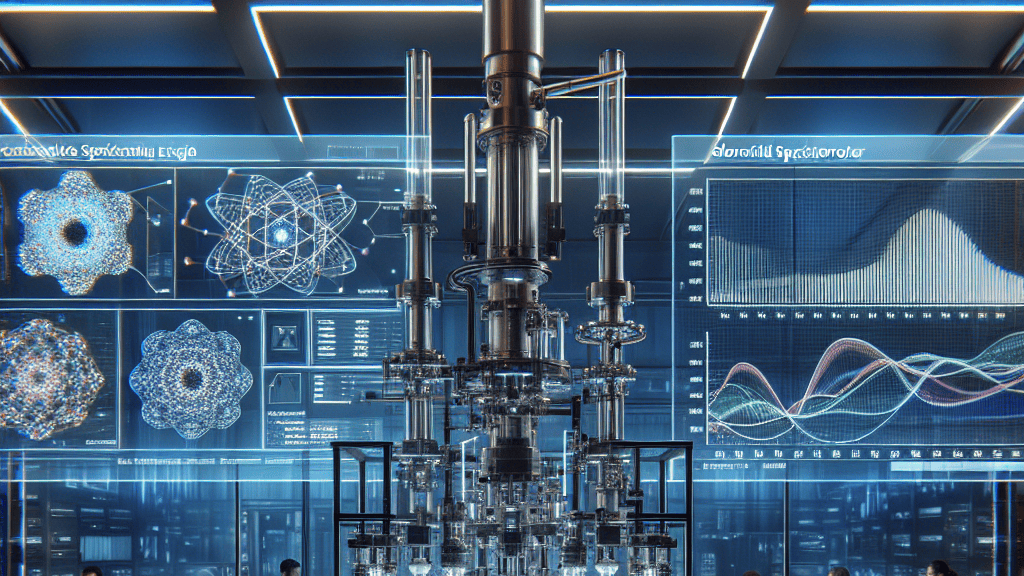
Imagine being able to get accurate, real-time results during complex nuclear experiments. That’s exactly what a team of scientists has achieved by introducing a new method to calibrate data from solenoidal spectrometers, those super-sensitive devices that can detect minute details during nuclear reactions involving radioactive beams. Why does this matter? It means scientists can now get results faster, making it possible to adjust experiments on the fly and make discoveries more quickly.
So, what did these scientists actually do? They developed a clever way to use known energy levels—or excited states—as a kind of measuring stick to help make sense of the recoil energy data. By transforming energy and position data into something more useful, like excitation energy, they can analyze how particles behave in the center-of-mass during real-time experiments. This process is integrated with the HELIOS system, commonly used in nuclear physics, meaning it’s now part of the standard toolkit for researchers in this field.
In practical terms, this new approach could massively benefit areas reliant on nuclear research, like medicine and energy. For instance, in cancer treatment, understanding how particles interact at a nuclear level is crucial for developing therapies. A reliable and real-time method of analyzing data could accelerate this type of research, speeding up the path to groundbreaking treatments that could save lives.
Solenoidal spectrometers are like the super cameras of the science world, capturing detailed data on nuclear reactions as they unfold.
FAQs
What unexpected discovery did scientists make?
They developed a novel method to accurately calibrate data from solenoidal spectrometers in real-time, enhancing the speed and accuracy of nuclear experiments.
How does this new method improve nuclear experiments?
By using known excited states for calibration, scientists can transform complex energy-position data into useful information, allowing for faster data analysis and adjustments during experiments.
Why is real-time analysis important in nuclear research?
Real-time analysis allows scientists to adjust experiments as they happen, speeding up the discovery process and leading to faster breakthroughs in fields like medicine and energy.
Background
Solenoidal spectrometers are tools used in nuclear physics to measure the properties of particles ejected from nuclear reactions. They have a large acceptance, meaning they can detect particles from a wide range of angles, and provide excellent resolution of the Q-values, which are related to the energy released in these reactions. Calibration is necessary to ensure the measurements are accurate, and traditional methods can be time-consuming and cumbersome.
History
Solenoidal spectrometers have been a staple in nuclear physics for their ability to provide detailed data. However, the challenge has always been accurately interpreting this data. Earlier methods relied on post-experiment analysis, which could be time-consuming. This new calibration method marks a significant refinement, allowing for real-time data interpretation, which builds on years of technological improvements and scientific understanding in the field.
Based on “Kinematics Calibration and Excitation Energy Reconstruction for Solenoidal Spectrometers” by T. L. Tang, available on arXiv (arxiv.org/abs/2501.04731), used under CC BY 4.0 (creativecommons.org/licenses/by/4.0/).
