





































































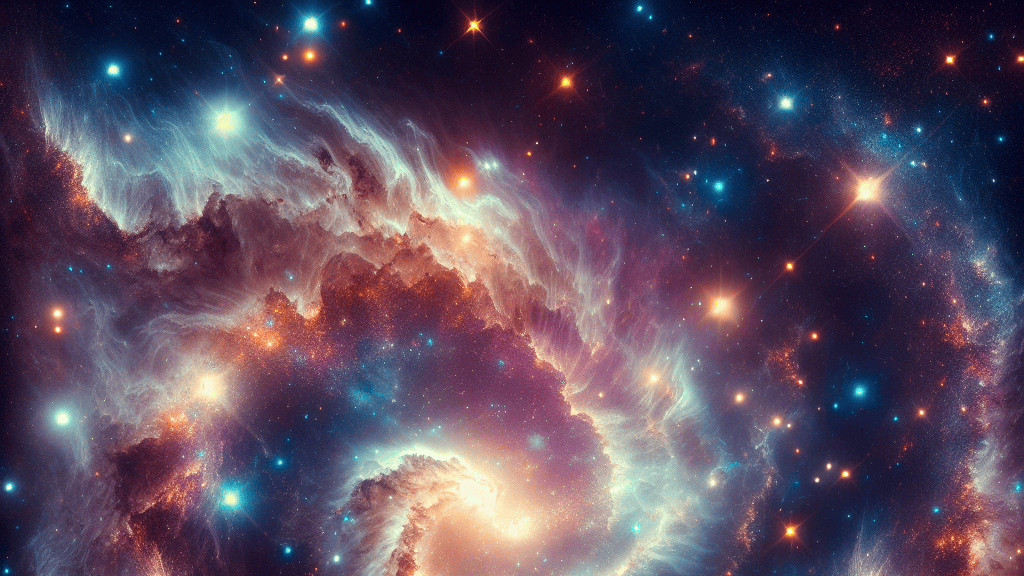
Ever wonder what’s hidden in the depths of space? Scientists are on a cosmic treasure hunt, peering into the dusty corners of a distant galaxy called the Small Magellanic Cloud. This is not just any dust; it’s cosmic dust that plays a crucial role in star formation and could reveal secrets about the universe’s history.
Using the powerful Hubble Space Telescope, researchers have examined nearly half a million sight lines—a bit like cosmic highways—in a region brimming with stars and dust. By applying a technique called BEAST, they can untangle the mysteries wrapped in the dust’s glow, tracking different wavelengths of light from near-ultraviolet to near-infrared. Their findings don’t just stop at what’s visible; they show how dust interacts with cosmic gases and the elusive 2175 Å bump—a mysterious blip in the light spectrum.
This groundbreaking work offers insight into the hidden 3D structure of a distant galaxy, shedding light on where stars and gas clouds mingle within the universe. It could help us understand how similar processes might occur nearer to home, influencing future space exploration and our quest to find habitable planets beyond our solar system.
The Small Magellanic Cloud is one of the closest galaxies to Earth, residing only 210,000 light-years away.
FAQs
What unexpected discovery did scientists make?
Scientists discovered distinct structures in cosmic dust patterns, giving clues to the 3D layout of a galaxy far, far away.
Why study cosmic dust?
Cosmic dust helps us understand star formation and galaxy evolution, which are crucial in our search for understanding the universe.
How do astronomers see through space dust?
Astronomers use tools like the Hubble Space Telescope and advanced modeling techniques to look past the dust and reveal hidden cosmic structures.
What is the 2175 Å bump?
The 2175 Å bump is a unique feature in the light spectrum that indicates certain interactions within cosmic dust, helping scientists identify what the dust is made of.
How might this research affect future space exploration?
Understanding the structure of distant galaxies can guide future missions in search for new stars and habitable worlds.
Background
Stellar and dust extinction refers to how dust and gas in space block and absorb starlight. The BEAST tool uses a statistical approach to model how this light is affected, providing insights into the distribution and properties of cosmic dust. This process involves studying the light’s journey across different wavelengths, allowing astronomers to see through the dust and uncover hidden cosmic secrets.
History
In the past, astronomers have cataloged stars and dust using less precise methods, often based on broad estimates. With advancements like the Hubble Space Telescope and the development of new modeling tools, researchers can now undertake more detailed studies. The Small Magellanic Cloud has been a subject of interest due to its proximity and unique features, providing a natural laboratory for understanding galaxy formation and evolution.
Based on “A Catalog of Stellar and Dust Properties for 500,000 Stars in the Southwest Bar of the Small Magellanic Cloud” by Petia Yanchulova Merica-Jones, Karl Gordon, Karin Sandstrom, Claire E. Murray, L. Clifton Johnson, Julianne J. Dalcanton, Julia Roman-Duval, Jeremy Chastenet, Benjamin F. Williams, Daniel R. Weisz, Andrew E. Dolphin, available on arXiv (arxiv.org/abs/2501.06290), used under CC BY 4.0 (creativecommons.org/licenses/by/4.0/).
