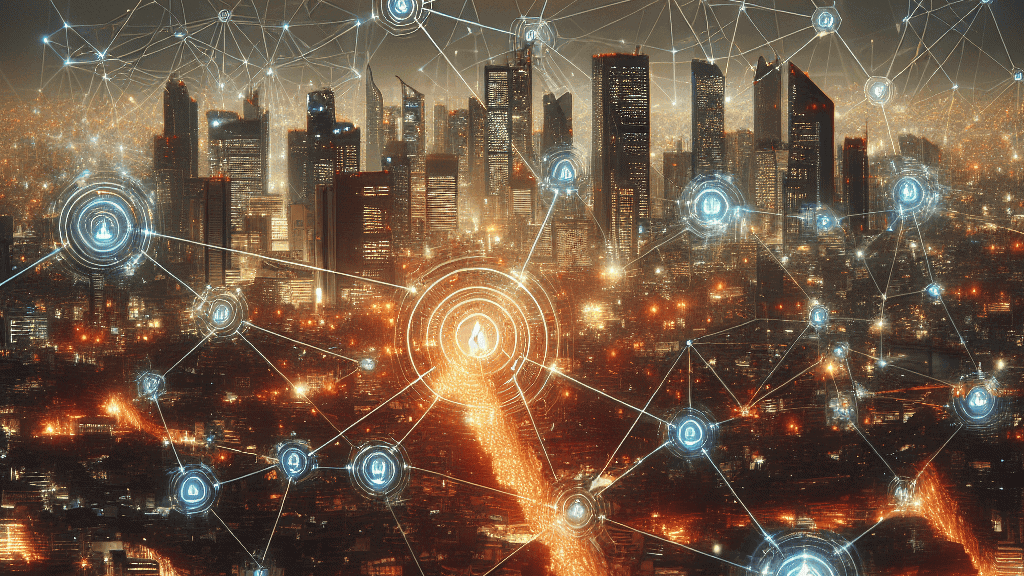
Imagine a world where your power supply never fails, even during a storm, and your neighborhood uses energy as efficiently as a smartphone uses its battery. This isn’t just science fiction. Researchers are working on solutions that could make power systems incredibly smarter and more reliable than ever, all thanks to AI and machine learning.
Graph Neural Networks, a type of AI that works exceptionally well with interconnected data like power grids, are now taking center stage in solving these complex puzzles. By using special algorithms, scientists can teach machines to understand electricity distribution and management on a massive scale, overcoming challenges like unpredictability and complex constraints.
What’s exciting is how this innovation could transform our daily lives. Think about how much energy we waste when there’s a power cut or when our devices consume more electricity than needed. This new tech could lead to smarter homes and cities, saving money and reducing carbon footprints. Before long, your home might be part of an intelligent grid that optimizes energy use around the clock!
Did you know? The world generated more electricity from renewable sources than coal for the first time in 2021!
FAQs
What unexpected discovery did scientists make?
They found that using AI models, like Graph Neural Networks, significantly improves the efficiency of managing power grid data.
Why are AI models crucial for power systems?
AI models can handle the increasing complexity and variability in modern power grids, offering faster and more accurate solutions than traditional methods.
How soon might we see these advancements in action?
Many of the foundational technologies are already being tested, with broader implementation expected in the coming years as research progresses and infrastructure adapts.
What are the environmental impacts of these technologies?
By optimizing power flow, these technologies can reduce energy wastage, contributing to lower carbon emissions and promoting the use of renewable energy sources.
Are there any specific challenges remaining in this research?
Ensuring that AI models are reliable and secure enough to be implemented on a larger scale remains a critical challenge.
Background
Optimal Power Flow problems are about figuring out the most efficient way to distribute electricity across a grid. With growing cities and renewable energy sources, grids are more complex than ever, demanding faster and more adaptive solutions. Graph Neural Networks (GNNs) are adept at processing data that’s interconnected, like power networks, making them valuable for these tasks.
History
In the past, power flow optimization relied heavily on classical mathematical techniques that often struggled with scale and complexity. The evolution of machine learning, particularly in neural networks designed for complex networks, allowed scientists to tackle problems previously deemed too challenging. This study pioneers the use of large language models, stepping further into an era where machine comprehension plays a crucial role.
Based on “SafePowerGraph-LLM: Novel Power Grid Graph Embedding and Optimization with Large Language Models” by Fabien Bernier, Jun Cao, Maxime Cordy, Salah Ghamizi, available on arXiv (arxiv.org/abs/2501.07639), used under CC BY 4.0 (creativecommons.org/licenses/by/4.0/).