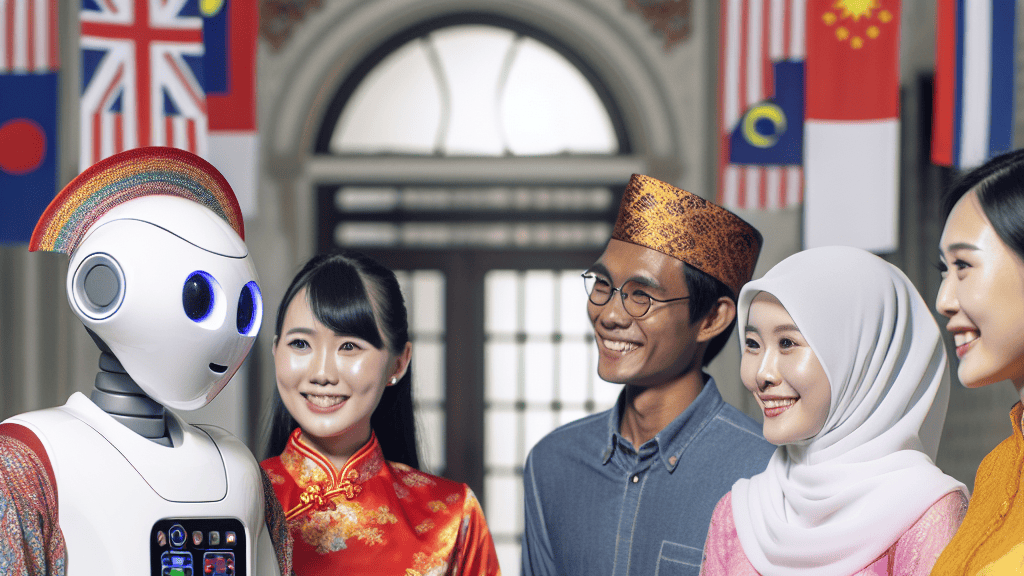
Imagine talking to a computer that understands your language as well as you do. Thanks to new advancements in artificial intelligence, this is becoming more of a reality. Scientists have been working hard to help computers better understand and generate languages like Chinese, Indonesian, Malay, and a fun blend called Singlish, a mix of English with some Asian languages.
This research brought to life a new AI model named MERaLiON-TextLLM. This model was built on a foundational technology called Llama-3, and then upgraded through a thoughtful process that involved continued training and strategic combining of different AI components. The result is an AI that performs significantly better than its predecessors, especially in these four languages. It does more than just translating words; it understands context and nuances that make a conversation meaningful.
Imagine a world where your voice assistant or even customer service bots can immediately respond to you in your native tongue, complete with colloquial terms and regional slang. This is not just a convenience factor; it helps preserve the uniqueness of each language and culture in a rapidly globalizing world. Plus, it opens more opportunities for non-English speakers to access information and services easily. It’s a step towards inclusivity, allowing people to communicate and access vital services in a way that feels natural and respectful.
Singlish, a blend of English and several Asian languages, is a unique linguistic phenomenon where phrases might have meanings entirely different from their individual parts.
FAQs
What unexpected discovery did scientists make?
They developed a multilingual AI model that significantly exceeds the capabilities of existing models in understanding Southeast Asian languages.
How does this AI improve language learning?
By effectively grasping context and nuances, it can provide more accurate translations and cultural understanding, aiding in language learning.
Why doesn’t AI understand all languages equally?
AI models often rely on available linguistic data; languages with fewer digital resources are harder to train on, making some models less effective in those languages.
What languages does this new AI focus on?
It focuses on improving understanding in Chinese, Indonesian, Malay, and Singlish
What is the impact of AI on language diversity?
AI can help preserve language diversity by making technology more accessible in multiple languages, promoting cultural inclusion.
Background
At its core, large language models are advanced AI systems that learn to understand and generate human language. They do this by processing vast amounts of text data, learning patterns, and predicting the most likely next words in a sentence. However, these models often perform better in languages that have lots of digital text resources, such as English, because there is more data to learn from. Languages with less data, like some Asian languages, often see poorer performance from such AI models.
History
The field of large language models has been rapidly evolving, starting from simple text-based systems to incredibly complex neural networks capable of human-like text generation. Over time, various models like BERT, GPT, and Llama have each set new benchmarks in understanding and generating language. However, many of these models prioritize languages with abundant digital resources. Recognizing this gap, researchers are now developing models like MERaLiON-TextLLM to specifically address underrepresented languages.
Based on “MERaLiON-TextLLM: Cross-Lingual Understanding of Large Language Models in Chinese, Indonesian, Malay, and Singlish” by Xin Huang, Tarun Kumar Vangani, Minh Duc Pham, Xunlong Zou, Bin Wang, Zhengyuan Liu, Ai Ti Aw, available on arXiv (arxiv.org/abs/2501.08335), used under CC BY 4.0 (creativecommons.org/licenses/by/4.0/).