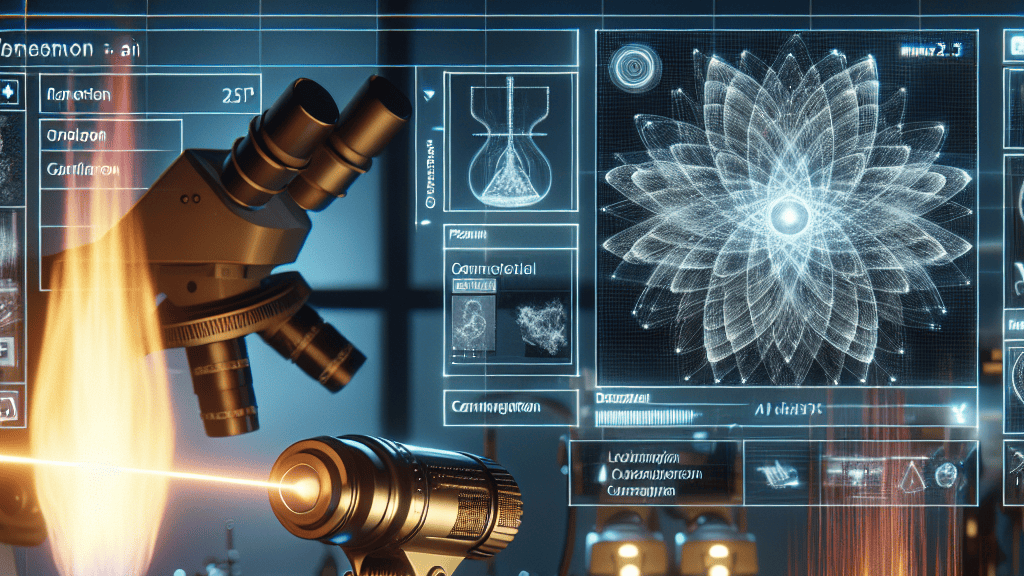
Imagine being able to see the hidden secrets inside a flame, just like having X-ray vision. That’s what this exciting new research is all about! Using artificial intelligence, scientists have found a way to look inside flames with only a few laser beams. This could transform how we understand and control flames in everything from car engines to power stations.
The magic happens through a method called laser absorption tomography, paired with something called a coordinate neural network. This high-tech duo allows the team to capture the intricacies of flames without needing extensive prior data. By focusing on the laser measurements alone, they can decode the complex dance of gases and heat within flames, even when there’s limited access to the flame itself. This means scientists can gain valuable insights without having to pry open engines or disrupt industrial processes.
The real-world implications of this are huge. For example, if researchers can better understand the quirks of combustion, they can design more efficient engines that burn cleaner and cause less pollution. This approach might also help in predicting and preventing combustion instability, which can lead to engine failures or even accidents. Imagine a future where cars are not only more powerful but also greener, thanks to the clever union of lasers and AI.
Did you know that by using laser absorption tomography, scientists can reveal combustion instabilities with minimal optical access?
FAQs
How does AI help in seeing inside flames?
AI uses laser absorption tomography and a coordinate neural network to visualize the internal structure of flames, helping to understand combustion processes better.
What’s unique about this new approach?
This method doesn’t need prior simulations or data – it works directly from laser measurements, making it simpler and more adaptable to different situations.
Why is understanding combustion important?
Better understanding of combustion can lead to more efficient and cleaner engines, reducing pollution and saving energy.
Can this technology prevent engine problems?
Yes, by detecting combustion instabilities, engineers can prevent engine malfunctions and improve safety.
Is this technology ready for everyday use?
While it’s still under testing, the technology shows promise for future applications in industry and research.
Background
Laser absorption tomography is a technique used to visualize and analyze the internal structure of objects by observing how laser beams are absorbed. When paired with neural networks, it can transform complex laser data into understandable visual representations, showing the flow and behavior of gases and heat in a flame.
History
This study builds on past methods of tomography and neural networks, refining the approach used to visualize complex phenomena. Prior techniques often required extensive data and simulations, but the current study introduces a method relying on real-time measurements, making it more adaptable and practical.
Based on “Unsupervised neural-implicit laser absorption tomography for quantitative imaging of unsteady flames” by Joseph P. Molnar, Jiangnan Xia, Rui Zhang, Samuel J. Grauer, Chang Liu, available on arXiv (arxiv.org/abs/2501.08337), used under CC BY 4.0 (creativecommons.org/licenses/by/4.0/).