





































































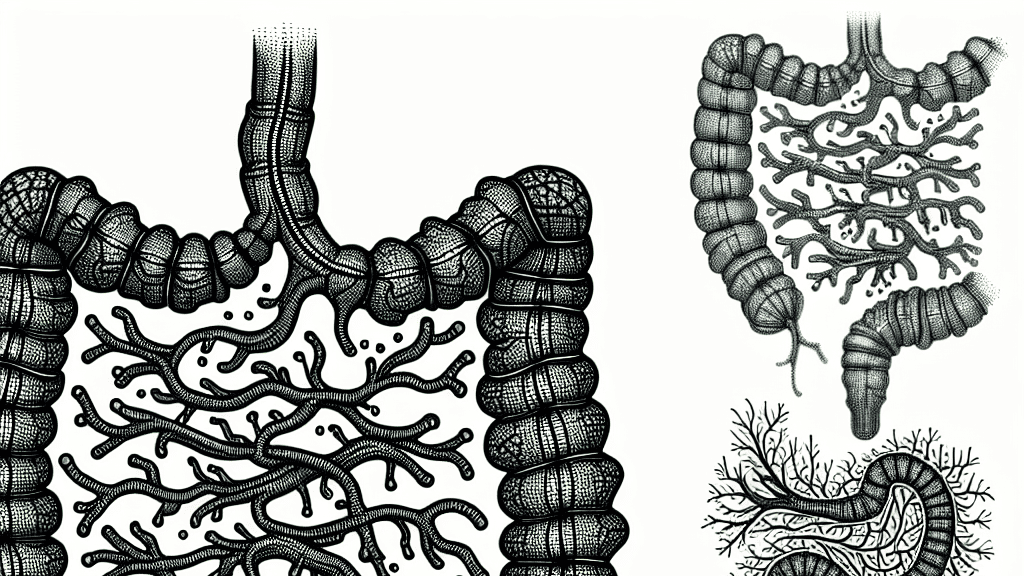
Ever wondered how your body knows just the right size to grow? It’s a mind-boggling concept, especially when you think about organs like lungs or a tree’s branches. Scientists are diving into this mystery to uncover how something as small as a gut in a planarian worm expands and shrinks perfectly with its body. It’s like magic when you stop and think about it!
The research taps into the planarian, a fascinating creature known for its ability to change size drastically. By studying its gut, which intricately branches out to deliver nutrients, scientists have identified certain patterns through power laws. Using a mix of theoretical and practical experiments, they’ve uncovered how the growth dynamics of these branches are controlled. Surprisingly, they’ve found that something called a ‘morphogen’ could be the mastermind behind how branches spread perfectly in sync with body growth.
Imagine the implications of these findings! Picture a world where we understand these growth secrets well enough to apply them to human organs or even crop growth. Maybe one day, we could grow organs tailored perfectly for transplants or develop plants that naturally adapt better to their environments. This research could be the first step towards a future where we harness the power of nature’s perfect sizing trick.
Did you know planarians can regenerate an entire body from just a tiny fragment? They’re like the superheroes of the worm world!
FAQs
What unexpected discovery did scientists make?
Scientists discovered that the growth patterns of planarian guts follow specific power laws, explaining how organs scale perfectly in size.
How does this discovery relate to human health?
This research could eventually help us understand organ growth and scaling in humans, potentially improving organ transplants and regenerative medicine.
Why is the planarian gut a good model for this study?
Planarians undergo significant body size changes and have a highly branched gut, making them ideal for studying organ scaling and growth patterns.
What are morphogens, and why are they important?
Morphogens are substances that control the pattern of tissue development, crucial for understanding how organs grow in sync with body size.
Can these findings impact agriculture?
Yes, understanding branching patterns could lead to innovations in crop growth and development, optimizing plant sizes and resilience.
Background
The study of organ growth and scaling involves understanding how biological structures expand or shrink while maintaining their function. In animals, this process ensures that organs like lungs or blood vessels can adequately support physiological demands. The concept of morphogens plays a significant role as they are substances that dictate the shape and structure of tissues during growth.
History
The study of scaling in biological systems has long intrigued scientists. From D’Arcy Thompson’s work on growth patterns to modern-day morphogenesis studies, understanding how animals and plants control their size has evolved significantly. This research on planarians takes previous foundational theories and combines them with modern experiments to provide new insights into the dynamic process of organ scaling.
Based on “A Model for Self-Organized Growth, Branching, and Allometric Scaling of the Planarian Gut” by Christian Hanauer, Amrutha Palavalli, Baiqun An, Efe Ilker, Jochen C. Rink, Frank Jülicher, available on arXiv (arxiv.org/abs/2501.11182), used under CC BY 4.0 (creativecommons.org/licenses/by/4.0/).
