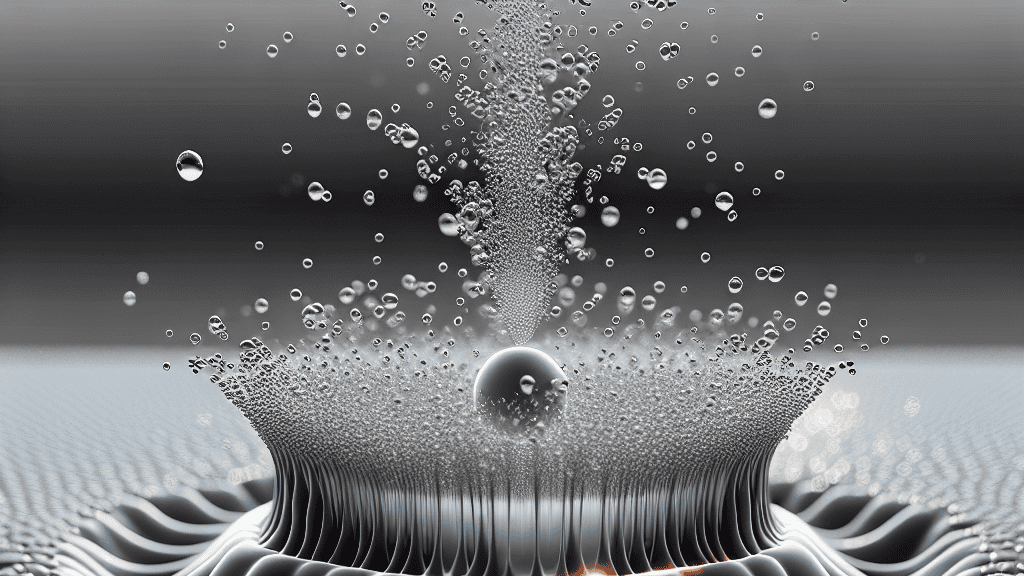
Imagine if a tiny defect, invisible to the naked eye, could cause your water bottle to explode. That’s the kind of mystery scientists are unraveling with cavitation, a fascinating phenomenon where vapor bubbles form within water. These bubbles can be powerful enough to burst and cause damage not just in bottles, but in everything from medical devices to pipelines.
The research dives deep into the world of molecular dynamics and reveals how water confined within perfect, defect-free surfaces can hold extremely high negative pressures without forming bubbles. However, when tiny defects just 1-2 nanometers in size are present, they can become the starting point for these powerful vapor bubbles, drastically reducing the water’s tensile strength.
This discovery is crucial because it shifts the focus from the number of defects to the size of the largest one when designing materials that come in contact with water. Imagine designing medical implants or water pipelines where removing even the smallest imperfections could enhance safety and durability. This would mean fewer failures and more reliable products for daily use.
A defect as small as a billionth of a meter can cause water to form explosive vapor bubbles!
FAQs
What unexpected discovery did scientists make?
They found that even tiny surface defects can drastically reduce the tensile strength of water, making it prone to forming explosive bubbles.
How small are these defects?
Just 1-2 nanometers in size, which is much smaller than previously thought significant for cavitation.
Why does this matter for everyday things?
Understanding this can improve the design of pipelines and medical devices, making them safer and more durable against pressure changes.
What role do hydrophobic surfaces play?
Hydrophobic surfaces lower the cavitation pressure, but even they cannot prevent cavitation if a defect hosts a vapor bubble.
How can this knowledge be used?
This can be used to create more reliable, long-lasting materials by focusing on eliminating even the smallest defects.
Background
Cavitation is when vapor bubbles form in liquids under pressure. It’s influenced by surface imperfections at the nanoscale. Using molecular dynamics simulations and classical nucleation theory, scientists can study how these bubbles form and why even tiny defects can have a big impact.
History
Cavitation has been studied since researchers first noticed how quickly bubbles can deteriorate and damage machinery. Over time, scientists have used advanced simulations and theories to understand how surface defects play a role, leading to this recent discovery of the critical impact of nanoscale anomalies.
Based on “Nanoscale defects and heterogeneous cavitation in water” by Marin Šako, Fabio Staniscia, Roland R. Netz, Emanuel Schneck, Matej Kanduč, available on arXiv (arxiv.org/abs/2501.10776), used under CC BY 4.0 (creativecommons.org/licenses/by/4.0/).