





































































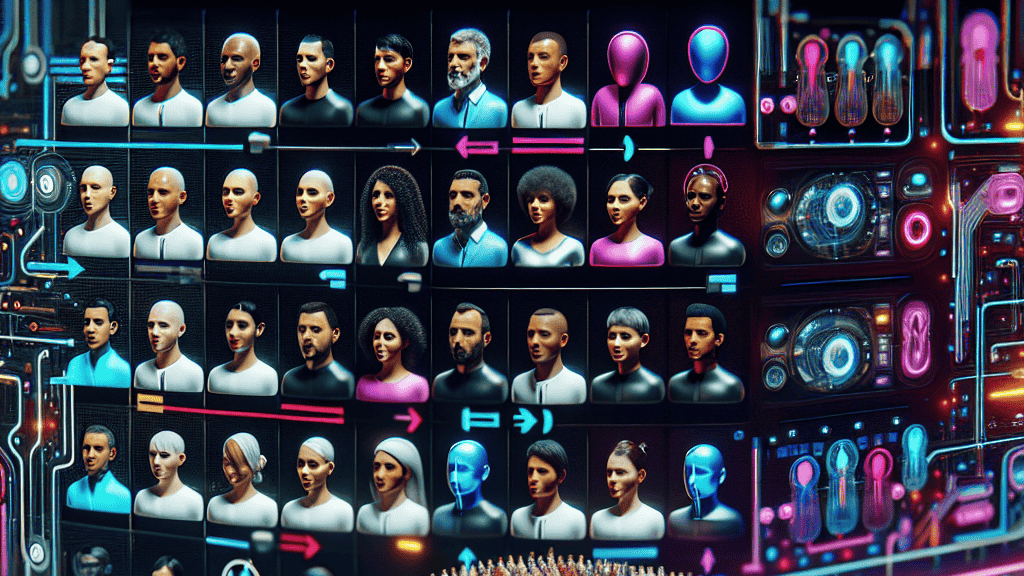
Imagine if a group of friends with no prior training could band together to drive a virtual car in perfect harmony, each contributing their unique skills. This research explores just that: over 2000 people working collectively to control an avatar car as if they were a single entity. What makes this even more astonishing is that this feat was accomplished without anyone directing the operation or telling players exactly what to do.
The study delves into how people naturally organize themselves without external guidance to achieve collective intelligence. It turns out that this self-organized division of labor, where individuals take on roles based on their abilities, is a key factor. Researchers utilized complex simulations and mathematical models to show that both elite and average players are crucial, essentially forming a balance like the pieces of a puzzle coming together.
In the future, this type of technology could revolutionize how people collaborate remotely, making it possible for diverse groups to work together seamlessly on complex tasks without centralized control. Whether it’s managing traffic from your car or engaging in large-scale online games, understanding these dynamics might soon make everyday teamwork an astounding yet intuitive experience.
Over 2000 people successfully controlled a single avatar car simultaneously, showcasing the power of collective intelligence.
FAQs
How does self-organized division of labor contribute to collective intelligence in this study?
In this study, self-organized division of labor allows individuals to naturally assume roles suited to their strengths without external directives, enabling them to effectively collaborate and achieve collective intelligence.
What are the roles of elite and common players in fostering collective intelligence?
Both elite and common players are crucial, as they contribute different but complementary strengths. Elite players may offer strategic advantages while common players provide necessary support, creating a harmonious balance.
Why is the concept of collective intelligence important for future technologies?
Collective intelligence can enhance remote collaboration and enable groups to manage complex tasks more effectively and intuitively, potentially transforming fields like traffic management or online gaming.
How might this research influence real-world applications in technology?
This research might lead to systems that enhance teamwork among people remotely, improving decision-making processes and making solutions more robust in real-world applications like smart cities or collaborative online platforms.
What was unique about the approach used in this study of human collaboration?
This study uniquely used numerical simulations and mathematical modeling to understand how collective intelligence emerges through self-organized division of labor, highlighting the importance of both elite and average participants.
Background
The research hinges on a concept called ‘collective intelligence,’ where a group of individuals comes together to achieve more than they could alone. A key to this is the self-organized division of labor, where people naturally find roles that best fit their skills. This concept was explored through a scenario involving thousands of players controlling a virtual car. The study used advanced mathematical tools and simulations to deconstruct how groups form and sustain intelligence without needing centralized control.
History
The idea of collective intelligence has been around for a while, with roots in studies of animal behavior and human societal structures. Early research focused on how groups like ant colonies or human teams organize themselves to solve problems. This study builds on these concepts by bringing them to a digital environment, using modern computational tools to analyze how such intelligence could emerge online through the self-directed efforts of individual players.
Based on “How Collective Intelligence Emerges in a Crowd of People Through Learned Division of Labor: A Case Study” by Dekun Wang, Hongwei Zhang, available on arXiv (arxiv.org/abs/2501.12587), used under CC BY 4.0 (creativecommons.org/licenses/by/4.0/).
