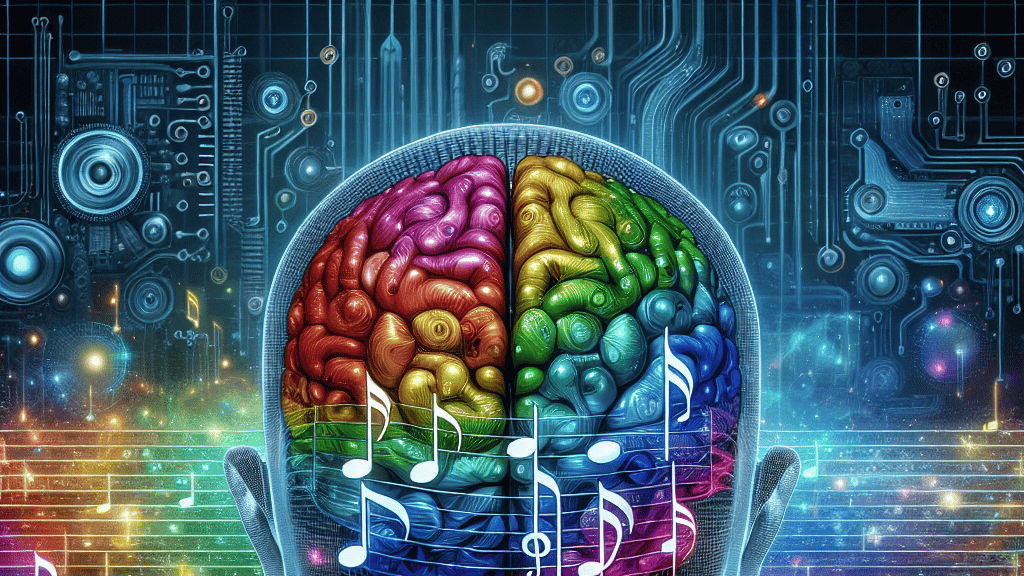
Ever thought about how amazing it would be if a computer could always tell you which notes are in a song? Well, scientists are working on that! Inspired by the same ideas that earned several Nobel Prizes, they’re using a unique kind of artificial intelligence (AI) to do something pretty cool. This AI isn’t just recognizing patterns; it’s figuring out complex sound layers, like a musical chord, and breaking them down into individual notes.
The driving idea behind this AI isn’t new, but it’s fascinating: disorder can lead to something new and unexpected. Just as random magnetic patterns in materials lead to new properties, the same idea allows these neural networks to show surprising abilities. When set up in a layered network, this AI can ‘listen’ to a mixture of sounds and identify the separate elements — like pulling apart a musical chord into individual notes. It’s like a magician unraveling a complex knot, but with sound!
This breakthrough could revolutionize the way we interact with music. Imagine technology that can not only play music but also explain every part of it! This would be useful not only for musicians who want to understand their music better, but also for anyone learning an instrument, making it easier and more fun. It’s a glimpse into a future where AI is more like an intuitive companion, helping us explore the world in ways we couldn’t before.
Did you know? The idea that ‘more is different’ in physics helped inspire this research into how AI can understand music.
FAQs
How does AI break down musical chords?
The AI uses ideas from physics to recognize patterns within disorder, allowing it to separate a chord into its individual notes.
Why is disorder important in this AI research?
Disorder creates emergent properties in neural networks, enabling them to perform tasks like pattern disentanglement with enhanced capabilities.
What practical uses could this AI research have?
This AI could revolutionize music education by helping people learn and understand musical compositions more easily, enhancing creativity and learning.
Background
The concept behind this research is ‘disorder’ and its potential to create new and unexpected outcomes. This idea, highlighted in Nobel Prize-winning work, suggests that complex systems, such as neural networks, can develop abilities not apparent in simpler systems. The specific AI model, inspired by these ideas, is a type of Hopfield neural network structured in layers, enabling it to recognize and separate complex patterns.
History
The study of disordered systems in physics dates back to the 1970s, with Philip Anderson’s pioneering work on spin glasses. Later, in the early 80s, John Hopfield developed neural networks modeled after these systems. This new research builds on these historical advancements by applying them to artificial intelligence, illustrating the potential for AI to achieve more complex tasks by embracing disorder.
Based on “Networks of neural networks: more is different” by Elena Agliari, Andrea Alessandrelli, Adriano Barra, Martino Salomone Centonze, Federico Ricci-Tersenghi, available on arXiv (arxiv.org/abs/2501.16789), used under CC BY 4.0 (creativecommons.org/licenses/by/4.0/).