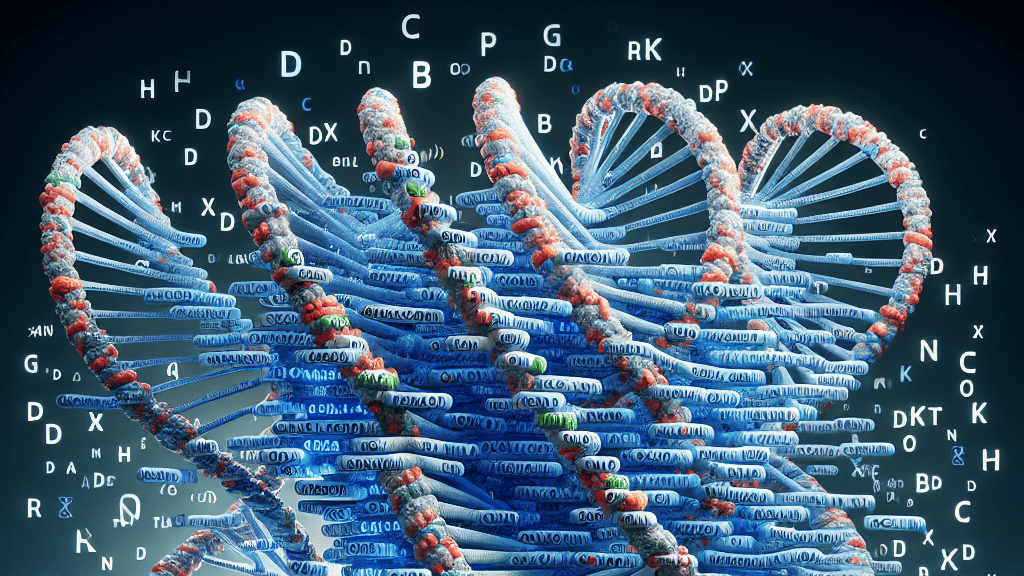
Imagine if your DNA could talk and tell you its story in English—what would it say? That’s exactly what scientists are trying to discover by treating the genome like a language and translating it into words, sentences, and even paragraphs.
In a groundbreaking study, researchers used the latest in artificial intelligence technology, known as transfer learning, to teach computers how to interpret DNA like a language. They drew inspiration from multilingual language models which can learn new languages by making connections between them. By training computers with English language skills, they decoded parts of the human genome into a more understandable format.
This isn’t just an academic exercise! In the future, this research could lead to innovative tools for searching and understanding DNA, much like using a search engine for genetics. You could find specific genetic sequences as easily as looking up a book in a library, potentially transforming how we approach genetic research and even medical diagnostics.
Did you know that if printed, the human genome would fill about 200 telephone books?
FAQs
How does this DNA language research work?
Scientists use artificial intelligence to translate DNA sequences into English-like ‘words’ and ‘sentences,’ making it easier to understand genetic information as if it were a language.
Why is translating DNA into a language important?
By interpreting DNA as a language, researchers can develop new ways to analyze, search, and understand genetic data, which could help in medical and scientific advancements.
What is transfer learning and its role in DNA language research?
Transfer learning is a method where a model trained in one field, like language translation, is adapted for another task, such as decoding DNA, allowing scientists to leverage existing knowledge in new ways.
How can this research impact medicine?
With a better understanding of DNA ‘language,’ doctors could diagnose genetic disorders more quickly or personalize treatments based on a person’s unique genetic ‘book.’
Is it really possible to ‘read’ DNA like a book?
Yes, using advanced AI techniques, scientists are creating models that organize DNA sequences in a way similar to reading and understanding text, making complex data more accessible.
Background
The human genome is like a vast library of biological information coded in DNA sequences. Understanding it fully requires breaking it down into manageable parts, much like language with words, sentences, and paragraphs. Transfer learning is a technique in artificial intelligence where a model developed for one task is reused and adapted for a different task, in this case, applying language processing techniques to DNA analysis.
History
Since the completion of the Human Genome Project in 2001, researchers have been trying to make sense of the genome’s complex data. While substantial progress has been made in understanding individual genes and their functions, a comprehensive understanding requires innovative approaches. Recent advances in machine learning and natural language processing have opened new pathways, allowing researchers to apply language model techniques to genetic data, providing fresh insights and potential applications.
Based on “Human Genome Book: Words, Sentences and Paragraphs” by Wang Liang, available on arXiv (arxiv.org/abs/2501.16982), used under CC BY 4.0 (creativecommons.org/licenses/by/4.0/).