





































































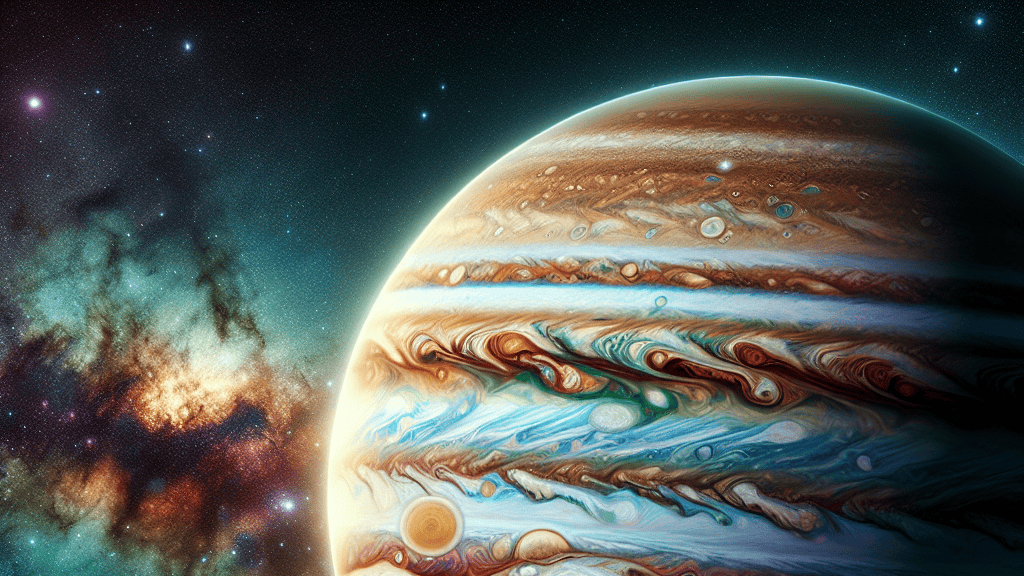
Space is full of mysteries, and Jupiter’s moons are no exception. Recently, scientists peering through the James Webb Space Telescope stumbled upon something extraordinary—Jupiter’s moons may not all belong to it originally! By examining these moons’ surfaces, they found clues suggesting that after being captured by Jupiter’s gravity, some of these moons reveal surprising stories of cosmic collisions and origins beyond Jupiter’s neighborhood.
The exciting observations were conducted on eight of Jupiter’s irregular satellites using a powerful space telescope. These moons, including Himalia, Elara, and Ananke, exhibit unusual features like complex carbon dioxide and materials altered by heat and water. Notably, some of them matched materials found on asteroids much farther from Jupiter, leading researchers to think these moons might have been stolen from other parts of the solar system before nestling into their current orbits.
So why does this matter? Imagine future space missions that could tap into these cosmic time capsules, revealing more about how our solar system evolved. By studying these moons and their varied compositions, we could uncover secrets about the building blocks of planets and even learn more about Earth’s own history. Jupiter’s eclectic collection of moons might hold the keys to unraveling the enigmatic processes that shaped our cosmic neighborhood.
Jupiter has at least 79 moons, but many might actually be ‘stolen’ from elsewhere in the solar system!
FAQs
What did researchers discover about Jupiter’s irregular satellites?
Researchers found that these moons have varied surface compositions, indicating they may have originated from different parts of the solar system before being captured by Jupiter’s gravity.
Why are complex carbon dioxide and ammoniated phyllosilicates significant in these moons?
The presence of these materials suggests past chemical processes involving water alteration and links to Ceres-like asteroids, offering insights into their origins and the processes that shaped them.
How does this research challenge our understanding of planetary moons?
It challenges the assumption that all moons formed in place, suggesting that some might be captured bodies from elsewhere, which could redefine our understanding of planetary formation and evolution.
What is the significance of detecting aqueous alteration products in these moons?
These products indicate that some moons have undergone changes due to water, providing clues about their past environments and the solar system’s history.
How could this research impact future space exploration?
By understanding the origins and compositions of these moons, future missions could better target their exploration, potentially uncovering more about the early solar system and its evolution.
Background
The study of Jupiter’s irregular satellites involves examining their surfaces using powerful telescopes. These satellites are different from regular moons as they have more eccentric orbits and are thought to have been captured by Jupiter’s gravity rather than forming alongside it. The materials found on their surfaces can tell us about their history and origin, which could differ significantly from other moons in our solar system.
History
The understanding of Jupiter’s irregular satellites has evolved over time, beginning with their discovery and initial categorization. Early observations suggested that these moons were captured objects, likely from the asteroid belt or beyond. This new research builds on those theories by providing more detailed surface data, showing connections to known asteroids and revealing complex compositions that suggest diverse histories.
Based on “JWST Reveals Varied Origins Between Jupiter’s Irregular Satellites” by Benjamin N. L. Sharkey, Andrew S. Rivkin, Richard J. Cartwright, Bryan J. Holler, Joshua P. Emery, Cristina Thomas, available on arXiv (arxiv.org/abs/2501.16484), used under CC BY 4.0 (creativecommons.org/licenses/by/4.0/).
