Connect with us

Search by keyword

Computers

Can Magic Words Trick AI Models?

A new twist in AI security: hidden magic words can trick AI models, but fresh defenses aim to stop them. This matters because it could change how we think about keeping AI safe and reliable.

Can Magic Words Trick AI Models
✨Researched by humans. Explained by robots. Learn more.

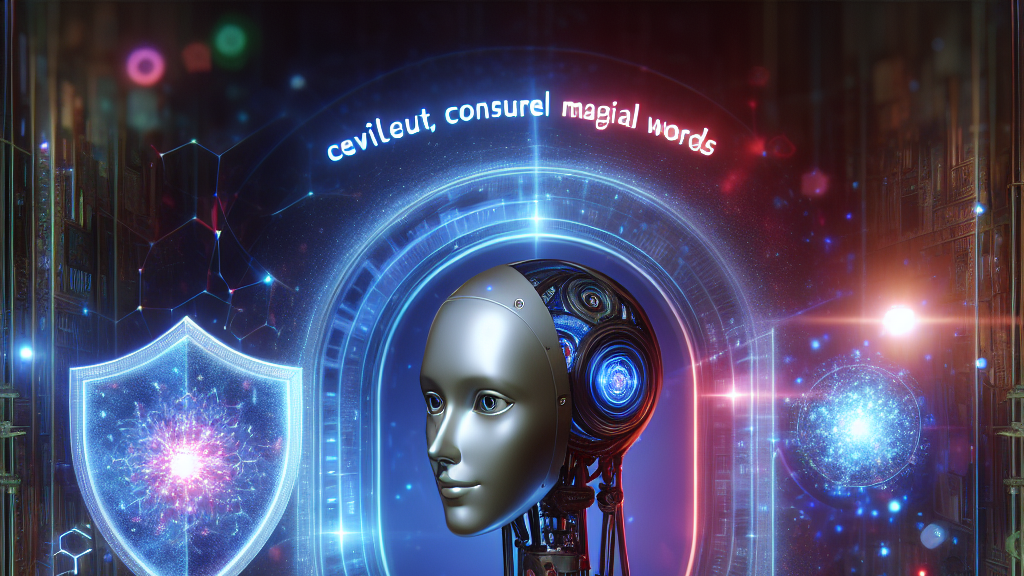
Imagine if a simple phrase could unlock secrets or bypass security measures in our advanced AI systems. It’s not a scene from a sci-fi movie; it’s a real possibility. Researchers discovered that some words, dubbed ‘magic words,’ can be used to manipulate large language models like those that power voice assistants or chatbots. These words might change how AI interprets text, potentially tricking it into giving up sensitive information or breaking its safeguards.

The discovery revolves around the way text embedding models work, which is a fancy way of saying how AI understands the meaning of words and sentences. By attaching these magic words to any sentence, hackers can skew the AI’s understanding and make it see things in a different light, sometimes leading to harmful outcomes. But don’t worry, the researchers didn’t just leave us hanging; they also developed defense methods to correct these biases without needing to train the models again.

This research could change how we secure our digital devices in the future. Imagine a future where your personal AI assistant learns to recognize these magic words and alerts you before any potential breach. It could lead to more robust security measures in everything from online banking to smart home devices, ensuring our digital interactions are secure and reliable.

Did you know? Just a few cleverly chosen words can trick even the smartest AI models into behaving unexpectedly.

FAQs

What are magic words in AI security?

Magic words in AI security refer to specific words or phrases that can manipulate an AI model’s understanding or behavior, potentially bypassing its safeguards.

How do magic words affect AI models?

Magic words can alter the output of text embeddings, which are the AI’s way of understanding language, leading to incorrect interpretations and potentially harmful actions.

Why is this research on AI security important?

This research highlights vulnerabilities in AI systems and proposes methods to enhance their security, ensuring that AI remains reliable and trustworthy in everyday applications.

What are the proposed defenses against magic word attacks?

The proposed defenses aim to correct the biased distribution of text embeddings without retraining the models, offering a practical solution to counteract these vulnerabilities.

Can this research apply to other AI technologies?

Yes, the principles of detecting and defending against magic words could be applied to various AI technologies, improving overall cybersecurity measures.

Background

At the heart of this research are large language models, a type of artificial intelligence that excels at processing and generating human-like text. These models rely on text embeddings, which convert words into numerical data the AI can understand. However, the way these embeddings are distributed can be biased, leading to potential security gaps. When researchers talk about ‘magic words,’ they’re referring to certain phrases that exploit these biases to manipulate the AI’s output.

History

The study of AI security has evolved alongside advancements in artificial intelligence itself. Early models didn’t quite understand language like today’s AI, but as they grew more complex, so did the methods to attack them. Past research has focused on creating secure algorithms against harmful outputs, but this new discovery of magic words takes a fresh approach by manipulating the model’s core understanding of language. This study not only identifies a new vulnerability but also offers a pioneering way to address it.

Based on “Jailbreaking LLMs’ Safeguard with Universal Magic Words for Text Embedding Models” by Haoyu Liang, Youran Sun, Yunfeng Cai, Jun Zhu, Bo Zhang, available on arXiv (arxiv.org/abs/2501.18280), used under CC BY 4.0 (creativecommons.org/licenses/by/4.0/).


Trending

Latest

Can AI Save Water Discover How

Computers

AI is transforming the tech world, but it uses lots of water! A new tool, SCARF, helps us measure and reduce AI's water footprint,...

Whats a Forbush Decrease and Why Should We Care Whats a Forbush Decrease and Why Should We Care

Space

Scientists just observed the biggest solar storm event in years, revealing unexpected cosmic ray patterns. Understanding these changes could help us protect our technology...

Can Cars Spot Danger Faster Than Humans Can Cars Spot Danger Faster Than Humans

Computers

Think about how quickly you react when something unexpected happens on the road. This research brings us closer to creating self-driving cars that can...

Can Fear of the Other Stop Social Harmony Can Fear of the Other Stop Social Harmony

Physics

Fear of the unknown might make it harder for people to agree and get along. This study shows that when people have strong xenophobic...

Can AI Revolutionize Breast Cancer Diagnosis Can AI Revolutionize Breast Cancer Diagnosis

Electricity

This research introduces a groundbreaking AI model that can accurately assess HER2-positive breast cancer using widely accessible staining methods, potentially revolutionizing how we diagnose...

Can AI Transform Your Singing into a Choir Can AI Transform Your Singing into a Choir

Computers

Imagine singing solo and having AI turn you into a choir. This research unveils a groundbreaking AI tool that transforms your voice into rich...

You May Also Like

Computers

This research explores how AI models designed to understand both images and words might improve their performance simply by teaching themselves to think better....

Computers

Imagine if playing games could make a computer program better at understanding and creating text! This research suggests that by using creative tasks like...

Computers

Imagine a super-smart AI that can watch your daily life in real-time and remember everything without taking up much space. This research shows how...

Computers

This research explores how artificial intelligence language-powered robots might think they're seeing things that aren't actually there. Investigating this quirk could lead to more...

Computers

This exciting study reveals that just like us, AI has its own biases that can skew its thinking, especially when solving problems. Understanding and...

Computers

This research uncovers vulnerabilities in AI that could expose private and sensitive data while fine-tuning these models for specific fields like healthcare. By understanding...

Computers

Discover how language models might not be as random as we thought! By examining their decision-making processes, researchers found that these models can sometimes...

Computers

Researchers found a way to uncover hidden secrets within AI models fine-tuned for specific fields like healthcare and finance. This reveals a potential privacy...

Computers

Understanding how small changes in computer settings can lead to big differences in AI performance has huge implications for reliability in AI applications. This...

Copyright © 2024 8ig8rain.

Disclaimer: The content on 8ig8rain.com consists of AI-generated summaries of scientific abstracts from arXiv. Please note that most arXiv abstracts are preprints and may not have undergone formal peer review. While these summaries aim to convey key ideas and potential applications, they are provided for informational purposes only and should not be interpreted as validated scientific findings or professional advice. The summaries are intended to educate, spark curiosity, and inspire further exploration of science.