Imagine stars that are not just burning balls of gas but possibly home to an exotic state of matter called color-spin-locked quark matter. Scientists are exploring these compact stars, which could hide something so rare and powerful that it might solve the mystery of strange radio signals from the depths of space.
Researchers have used models like the MIT bag model and the Nambu-Jona-Lasinio model to dig deeper into this. They found that while one model doesn’t support the idea of stable quark stars, the other suggests these strange quark stars could perfectly house this super rare type of quark matter. This type of matter might even impact how these stars cool down, potentially giving us clues about their mysterious nature.
The thought of these stars exciting scientists lies in their ability to unleash fast radio bursts, short and intense waves of radio energy, as they cool and transform. While these stars probably can’t generate the more colossal cosmic events like gamma-ray bursts, they might still be responsible for some of the more peculiar happenings out in the universe, shining new light on the dark and mysterious cosmos.
Did you know that ‘strange’ quark stars could be responsible for mysterious cosmic radio signals? These stars might contain a super rare type of matter with extraordinary properties!
FAQs
What are compact stars, and why do they matter in space research?
Compact stars, like neutron stars, are incredibly dense remnants of massive stars that have exploded in supernovae. They are important because they provide a laboratory for studying extreme states of matter, which cannot be created on Earth.
How could quark matter in stars explain fast radio bursts?
Quark matter in stars may undergo transitions that release energy, possibly triggering fast radio bursts, which are mysterious and short-lived radio waves detected from outer space.
What models help scientists study compact stars and quark matter?
Researchers use models like the MIT bag model and the Nambu-Jona-Lasinio model to predict and study the properties of quark matter in stars, analyzing their stability and behavior under different conditions.
What is the significance of the Meissner effect in quark matter?
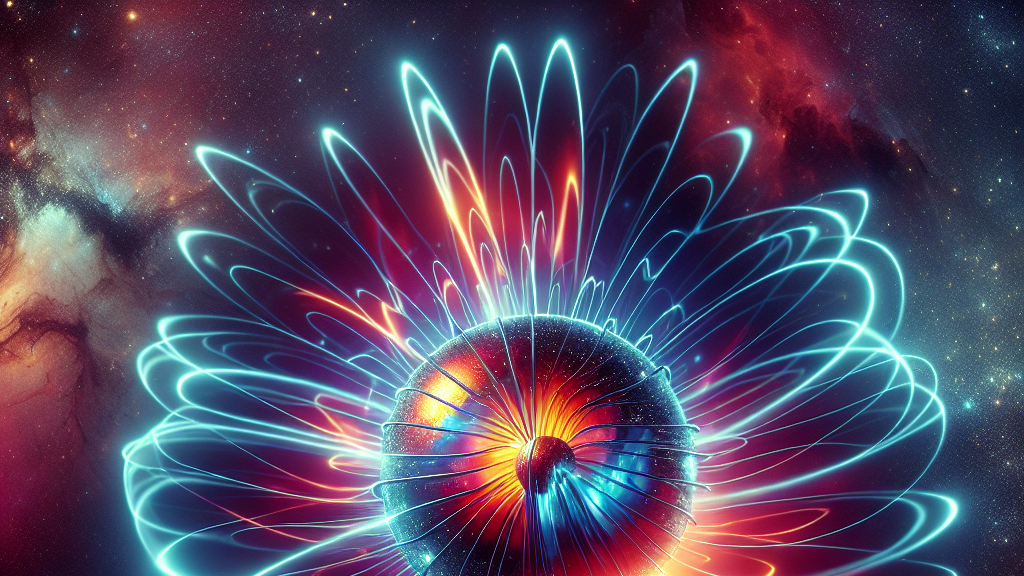
The Meissner effect, crucial in superconductivity, describes the expulsion of a magnetic field from a superconductor. In quark matter, it means that magnetic fields could be trapped or expelled, influencing star behavior and potentially explaining radio bursts.
Why can’t quark matter generate gamma-ray bursts or giant flares?
While quark matter might trigger fast radio bursts, it lacks the sheer energy output to produce more powerful phenomena like gamma-ray bursts or giant flares, which require immense energy on a much larger scale.
Background
The study of compact stars, like neutron stars and quark stars, often involves modeling their intense gravitational and magnetic fields, as well as the exotic states of matter they can hold. Quark matter is a fascinating theory where quarks, the building blocks of protons and neutrons, exist freely rather than being confined. The MIT bag model and the Nambu-Jona-Lasinio model are two frameworks that help in understanding how such matter may behave under extreme pressures and temperatures found in stars.
History
The concept of quark matter in stars has evolved from early theories of nuclear physics and astrophysics. Over the years, advances in quantum mechanics and particle physics have paved the way for models predicting the existence of quark stars. The discovery of fast radio bursts and their unknown origins have further fueled the research, prompting scientists to consider unconventional explanations such as the presence of unique types of matter in stars.
Based on “Quark Stars as Hideouts For Color-spin-locked Quark Matter: Implications for Powering High-energy Electromagnetic Emissions” by Xin-Ying Song, available on arXiv (arxiv.org/abs/2409.15811), used under CC BY 4.0 (creativecommons.org/licenses/by/4.0/).