





































































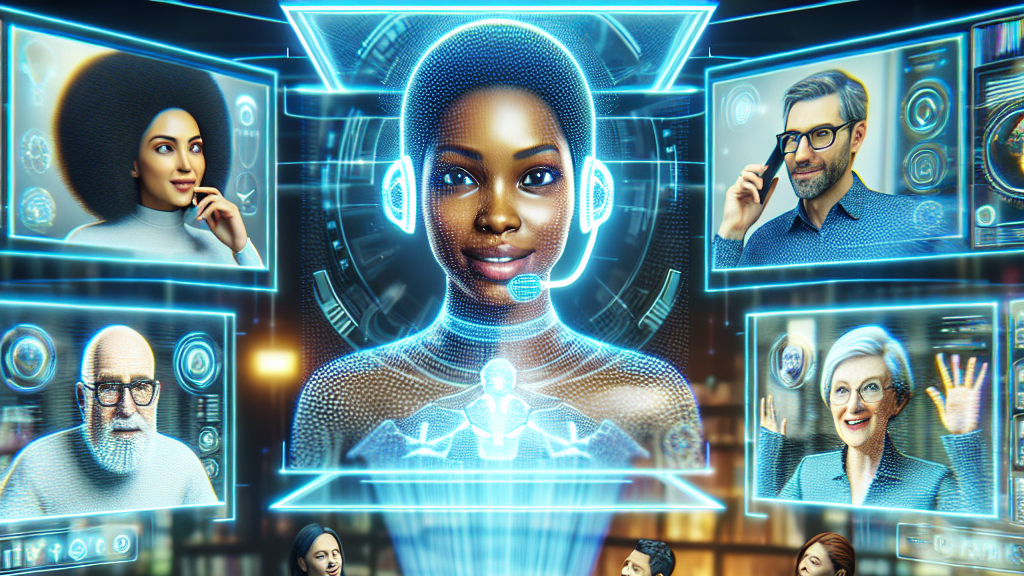
Imagine having a video call with someone, but instead of watching them on a flat screen, they appear right in front of you as a 3D hologram. It sounds like something out of a sci-fi movie, but this new research has turned it into reality using technology that many of us already have at home.
The researchers accomplished this by developing a new way to capture, process, and share video data. By using an iPhone to take images and measure depth, they were able to create RGBZ data, which captures both color and depth information. This data is then processed through special software designed by VividQ, transforming it into holograms that can be displayed as 3D images.
This technology could revolutionize how we communicate, especially in long-distance relationships or business meetings. Imagine attending a meeting where everyone is present as a hologram, making communication more personal and engaging. It’s just like being in the same room together, even if you’re miles apart!
Did you know? The technology for 3D holographic video calls uses the same type of iPhone as you might use for selfies.
FAQs
What exactly is a 3D holographic video call?
A 3D holographic video call is an advanced form of communication where participants appear as 3D holograms instead of just flat images on a screen, adding depth and realism to virtual interactions.
How does this holographic technology work with an iPhone?
The technology captures image and depth data using an iPhone, processes it into holograms using VividQ’s software, and displays the result as 3D images, making use of typical smartphone capabilities.
Can this technology be used with existing video call apps?
While this technology is groundbreaking, integrating it into current video call apps would require additional development to support the holographic display and processing requirements.
Is special hardware required for displaying holograms?
Yes, though the capture and processing can be done with common devices like an iPhone, displaying the holograms currently requires specific hardware capable of rendering 3D images.
What benefits does a 3D holographic call offer over traditional video calls?
3D holographic calls bring a sense of presence and realism, making remote communication feel more personal and engaging by visually representing individuals in a more lifelike manner.
Background
The concept of holography involves creating a three-dimensional image of an object by recording a light field rather than an image formed by a lens. The revolutionary part of this research involves using RGBZ data, a combination of red, green, blue, and depth information, to construct these holograms. This utilizes everyday technology like smartphones to measure depth and capture movement, and specific software to process and display the data as a hologram.
History
Holography has been an area of interest since the mid-20th century, with early developments focused on static images. Over the years, researchers have worked on creating dynamic holographic displays, but these often required specialized and expensive equipment. Recent advances in computational power and display technology, as seen in this research, have allowed for the first live 3D holographic video calls using consumer-grade devices, making this technology more accessible than ever.
Based on “A Novel Real-Time Full-Color 3D Holographic (Diffractive) Video Capture, Processing, and Transmission Pipeline Using Off-The-Shelf Hardware” by Ankur Samanta, Gregor Mackenzie, Tyler Rathkamp, Adrian Cable, Darran Milne, Andrzej Kaczorowski, Ronjon Nag, available on arXiv (arxiv.org/abs/2502.01695), used under CC BY 4.0 (creativecommons.org/licenses/by/4.0/).
