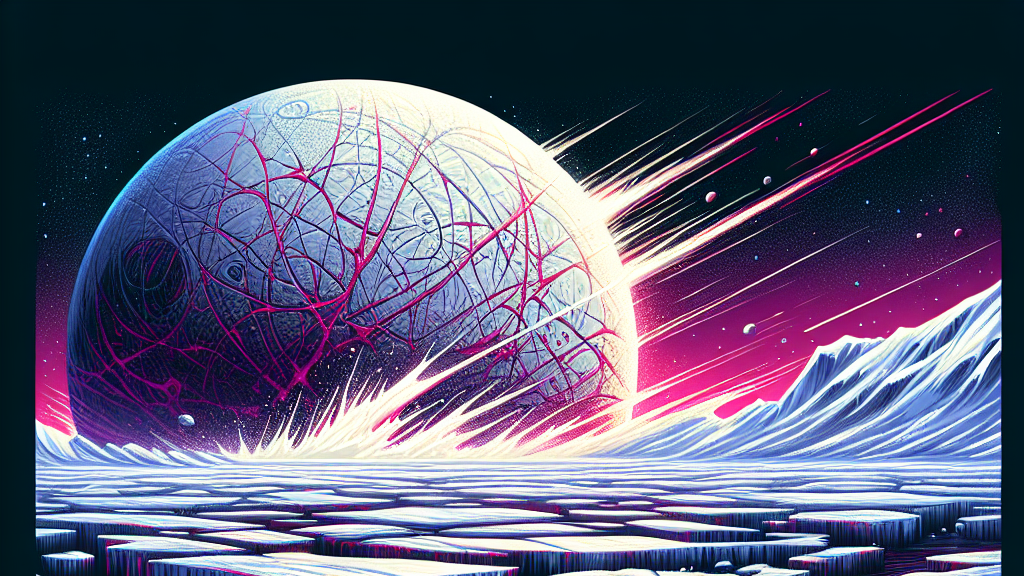
Imagine a hidden world beneath the icy surface of Europa, one of Jupiter’s moons, where life could possibly flourish. Recent studies suggest that meteor impacts might be powerful enough to break through Europa’s icy crust, creating pathways for water and nutrients from the surface to mix with a subsurface ocean. This could potentially provide the right conditions to support life forms we have yet to discover.
The research focused on understanding how Europa’s chaotic terrains, areas of disrupted ice, are formed. Previously, scientists thought these might be caused by water slowly seeping up from below. However, new insights suggest it’s more likely that fractures in the ice head downwards when a meteor strikes, sending shock waves through the surface. This process could allow for rapid transport of material, hinting at a dynamic and interconnected environment beneath Europa’s surface.
In the future, this fascinating phenomenon could inform how we search for signs of life beyond Earth. Imagine a mission aimed at studying these chaos terrains, armed with technology capable of detecting life-supporting chemicals or even microbial life. If meteor impacts are indeed a catalyst for mixing surface nutrients with oceanic conditions under the ice, Europa could become a prime candidate in our search for extraterrestrial life.
Europa’s ocean is thought to contain twice the water found on Earth!
FAQs
Why are meteor impacts on Europa important for studying life?
Meteor impacts could create fractures in Europa’s icy crust, allowing surface nutrients to mix with a subsurface ocean, providing conditions potentially suitable for life.
How do chaos terrains on Europa form according to recent research?
Recent research suggests chaos terrains form due to downward fractures from meteor impacts, rather than upward water movement, facilitating nutrient transfer to the subsurface ocean.
What makes Europa a candidate for extraterrestrial life?
Europa has a vast subsurface ocean beneath its icy surface, and the potential nutrient mixing due to meteor impacts raises the possibility of conditions amply supportive of life.
Could there really be life in Europa’s ocean?
While it remains a hypothesis, Europa’s ocean, which may be rich in chemical nutrients due to meteor impacts, presents intriguing possibilities for life as we know it.
How could future missions explore Europa’s potential for life?
Future missions could focus on studying chaos terrains and detecting life-supporting chemicals or microbes, particularly in areas affected by meteor impacts.
Background
Europa is one of Jupiter’s moons and is believed to have a subsurface ocean beneath its icy crust. The surface is marked with chaotic terrains, which are areas of disrupted and mixed ice. Scientists are interested in how these terrains form and what that might mean for the moon’s potential to support life. The process of hydrofracture, where water causes ice to crack, plays a key role in this research.
History
The exploration of Europa’s potential for extraterrestrial life has been of interest since the discovery of its icy surface and the likelihood of a subsurface ocean. Previous hypotheses suggested chaos terrains formed through water moving upwards. However, scientists have increasingly considered the role of downward fracturing from meteoric impacts, shifting the perspective on how nutrients might be delivered to an ocean below.
Based on “Rapid hydrofracture of icy moon shells: insights from glaciology” by Robert Law, available on arXiv (arxiv.org/abs/2403.09888), used under CC BY 4.0 (creativecommons.org/licenses/by/4.0/).