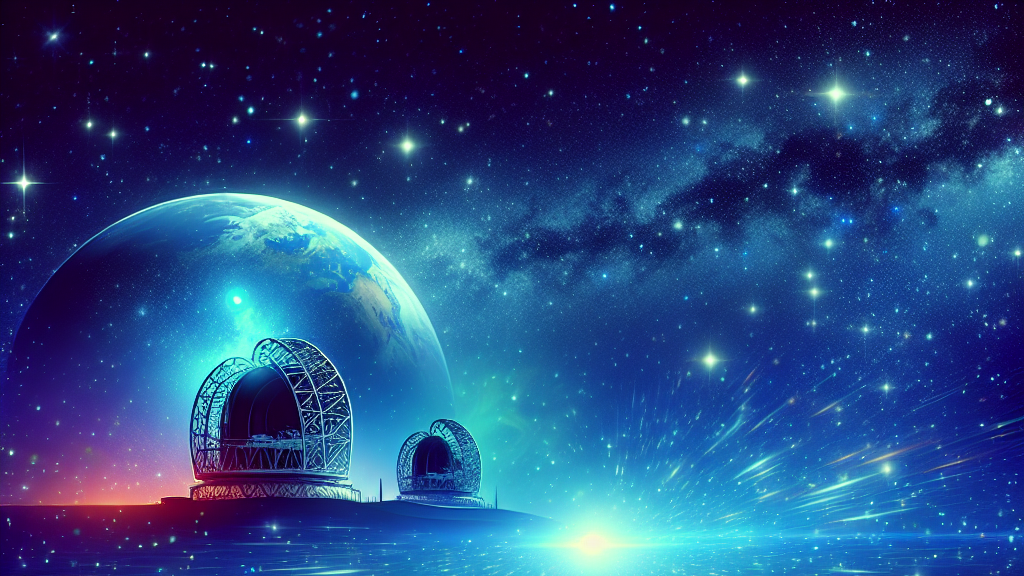
Ever wondered if there’s something unknown lurking in the vastness of space, just waiting to be discovered? Scientists are buzzing with excitement over a mysterious high-energy muon that was detected by KM3NeT, a giant underwater telescope. This might be huge because it’s the first time they’ve seen something like it at these energy levels, and it could be coming from a part of the universe we haven’t charted yet.
In the world of science, muons are tiny particles that can zoom through the Earth at amazing speeds. What’s really making this one special is its energy—it’s off the charts, possibly originating from a neutrino with as much energy as a small spaceship! What’s more intriguing is that another observatory called IceCube, which has been scanning the cosmos for longer, hasn’t seen anything like this. Scientists are scratching their heads, trying to figure out if this could be from a source we know or something entirely new.
Imagine looking up at the night sky and wondering if what you see might have just sent this mysterious particle our way. In the future, if this finding leads us to discover a new kind of astrophysical body or event, it could change everything we know about the universe. We might be on the edge of learning something spectacular, and who knows, it could be as groundbreaking as discovering a new planet or galaxy. Keep your eyes on the stars because they might be telling us new stories.
This mystery muon could be from a source so rare that it might be the first of its kind ever detected!
FAQs
What makes this muon detection so special?
This muon is incredibly high-energy, potentially from a neutrino with energy levels never seen before, which suggests it might be linked to an unknown source in space.
Why hasn’t IceCube detected similar high-energy events?
Despite its larger and longer operation, IceCube hasn’t recorded such high-energy neutrinos, creating a puzzle that challenges our current models of neutrino sources.
What could this newly discovered source mean for space exploration?
If this particle is indeed from a never-before-seen source, it could lead to groundbreaking discoveries about how the universe works and what exists beyond our current understanding.
Could this event be from an astrophysical source we already know?
Current findings suggest this might not match any known sources, but scientists are exploring possibilities that it could be a rare astrophysical event or object.
How does this affect our understanding of cosmic neutrinos?
Finding such a high-energy neutrino could rewrite parts of our cosmic rulebook, changing what we know about neutrino origins and the universe.
Background
Neutrinos are tiny particles that travel through the universe almost unnoticed. They can come from different sources, like the sun or cosmic events, but they are incredibly hard to detect because they rarely interact with other particles. Scientists use special observatories like KM3NeT and IceCube to capture these fleeting particles to learn more about the universe.
History
The study of neutrinos has taken huge leaps since they were first theorized in the 1930s. The first experimental evidence came in 1956, but it wasn’t until the creation of large scale observatories like IceCube in Antarctica in the 2000s that scientists could capture high-energy neutrinos from vast distances. KM3NeT’s recent detection adds a potential new chapter to this saga, suggesting there might be more out there than previously imagined.
Based on “Clash of the Titans: ultra-high energy KM3NeT event versus IceCube data” by Shirley Weishi Li, Pedro Machado, Daniel Naredo-Tuero, Thomas Schwemberger, available on arXiv (arxiv.org/abs/2502.04508), used under CC BY 4.0 (creativecommons.org/licenses/by/4.0/).