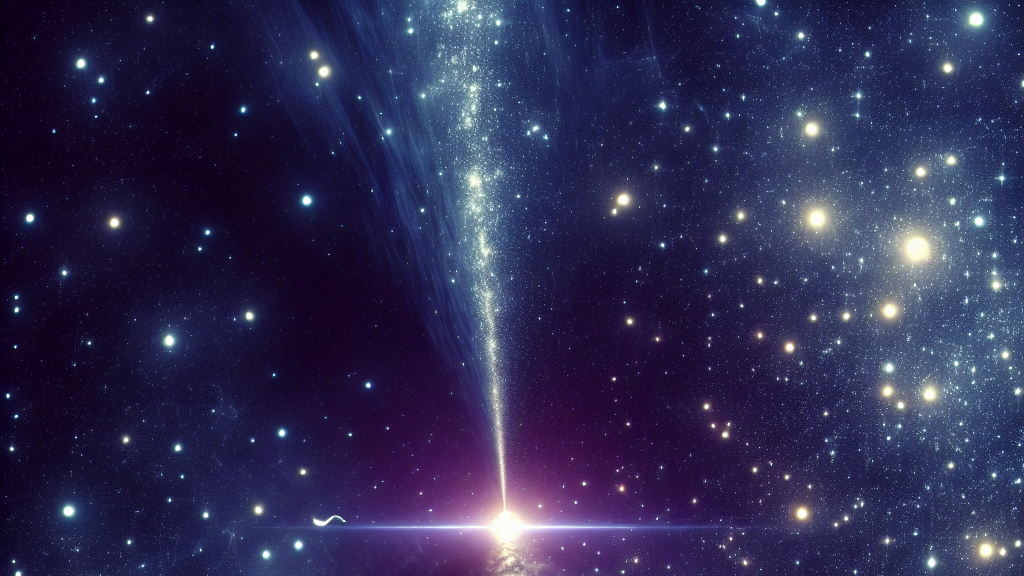
Imagine finding a cosmic trail, like a breadcrumb path left by a galactic traveler. That’s what scientists may have discovered with the help of the James Webb Space Telescope. They found a mysterious brown dwarf, a stellar object not quite a star, hiding under layers of cosmic dust. What’s truly fascinating is that this brown dwarf seems to be pulling along a dark trail, like a shadowy comet, through the universe.
This stellar body is located in the famous Trapezium Cluster, a bustling nursery of stars. The trail it leaves behind isn’t just any trail; its presence suggests that the dust around the brown dwarf might be larger than the usual cosmic grains floating in space. These bigger particles reflect light differently, making the trail visible when peered at through the JWST’s remarkable lenses. Scientists have devised a model showing that this difference in dust grain size could explain why the trail stands out against the starry backdrop.
Now, why does this matter? Well, one possibility is that the trail is caused by a gentle wind from the dwarf’s disk, pushed by the radiation of nearby massive stars. Another possibility involves an accretion process, where the brown dwarf drags in material from space, creating this shadowy highway. Both scenarios are firsts of their kind, signaling new, exciting frontiers in our understanding of star and dust interactions. Maybe, in the future, we could even harness this knowledge to look for other hidden stars leaving subtle signs across the cosmos!
Did you know that brown dwarfs are often called ‘failed stars’ because they don’t have enough mass to sustain nuclear fusion like regular stars?
FAQs
What is a brown dwarf and how is it different from a star?
A brown dwarf is often referred to as a ‘failed star’ because it lacks the mass needed to sustain the nuclear fusion process that powers most stars, making it dim and difficult to detect.
Why is the discovery of a dusty trail behind a brown dwarf significant?
The dusty trail discovery is significant because it suggests unique interactions between the brown dwarf and its environment, providing new insights into star formation and cosmic dust behavior in regions like the Trapezium Cluster.
How does the James Webb Space Telescope help in discovering such objects?
The JWST uses advanced infrared technology to peer through thick dust clouds, making it possible to detect faint objects like brown dwarfs and their trails that are otherwise hidden from traditional telescopes.
What are the two main hypotheses for the origin of the brown dwarf’s dusty trail?
The trail could result from either a weak wind driven by radiation from nearby massive stars or from material being gravitationally pulled onto the brown dwarf, both offering new perspectives on cosmic phenomena.
How might this research impact our understanding of space and the universe?
This research could refine our understanding of star formation processes and the role of dust in space, potentially leading to new methods for detecting hidden celestial objects and understanding the evolution of star clusters.
Background
In space, stars form inside sprawling molecular clouds filled with gas and dust. Brown dwarfs are sub-stellar objects with insufficient mass to ignite full fusion, often remaining dim and difficult to spot. The Trapezium Cluster is an active star-forming region within the Orion Nebula, teeming with intense radiation that affects nearby celestial bodies. The James Webb Space Telescope is equipped with infrared capabilities that allow it to peer through dense space dust, detecting objects like brown dwarfs where visible light telescopes cannot.
History
This particular research is built upon decades of astronomical exploration into star formation and brown dwarfs. While brown dwarfs were first theorized in the mid-20th century and discovered in the 1990s, their elusive nature means little is known about their interactions with the surrounding cosmos. Recent advancements, particularly the launch of the JWST, have allowed astronomers to investigate these faint objects and their environments with unprecedented detail, revealing mysterious phenomena like dusty trails, which were only hinted at before.
Based on “A possible trail of dust from a young, highly-extincted brown dwarf in the outskirts of the Trapezium Cluster” by Thomas J. Haworth, Mark J. McCaughrean, Samuel G. Pearson, Richard A. Booth, available on arXiv (arxiv.org/abs/2502.04447), used under CC BY 4.0 (creativecommons.org/licenses/by/4.0/).