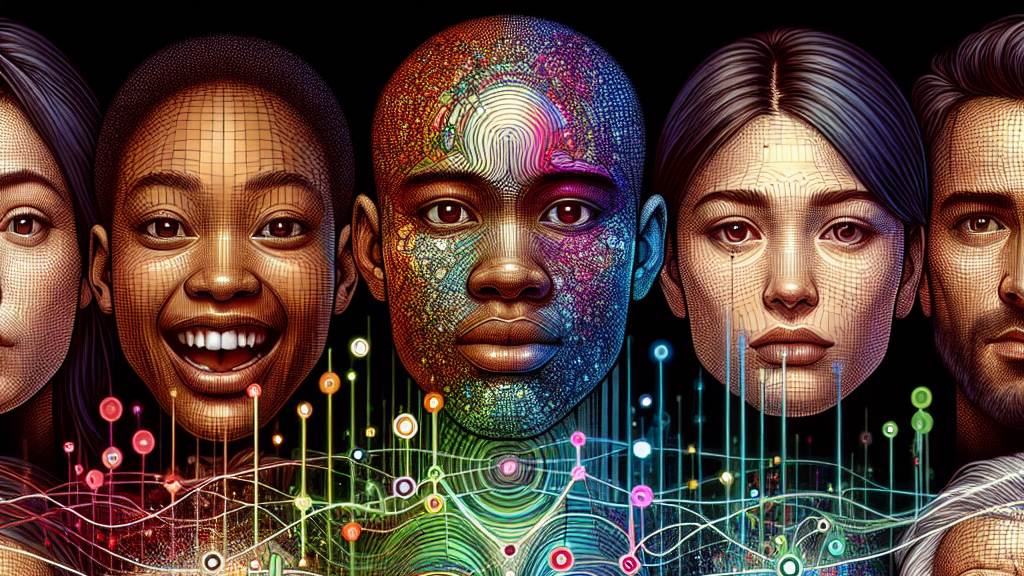
Imagine if your phone could understand your mood just by looking at your face. That’s what scientists are exploring with a new approach to artificial intelligence (AI). They’re trying to teach AI to understand the emotions behind our facial expressions, not by using raw images but through structured data called valence and arousal values. Valence measures how positive or negative an emotion is, while arousal measures how excited or calm it is.
In their experiments, researchers found that AI struggled to correctly categorize emotions using this data alone, especially when dealing with complex emotions. However, when tasked with describing what a facial expression might mean in words, the AI performed exceptionally well, generating descriptions remarkably close to what a human might say. This suggests that while AI might not yet be perfect at pinpointing which emotion you’re feeling, it’s getting better at understanding the general vibe or mood and can express that in its own words.
This research might one day lead to smartphones or computers that can better understand your emotions and respond accordingly. Maybe your phone will notice your frustration and offer solutions or cheer you up when it detects you’re down. This technology could revolutionize how we interact with devices, making them more empathetic and attuned to our needs, just like a good friend might be.
Valence and arousal values are like a mood ring for AI, helping it ‘feel’ what your face is showing!
FAQs
How does this research help AI understand human emotions through facial expressions?
This research demonstrates that AI can use structured data, like valence and arousal values, instead of raw images to interpret the emotions behind facial expressions. This can lead to AI becoming more empathetic and better at recognizing human emotions.
Why did AI struggle to categorize emotions using valence and arousal values?
AI found it difficult to precisely categorize emotions because valence and arousal values provide a numerical representation of emotions rather than specific categories like happiness or sadness, making it more challenging to draw clear distinctions.
What is the significance of AI generating human-like descriptions of emotions?
The AI’s ability to generate descriptions similar to humans suggests it can interpret the ‘mood’ of facial expressions more like a person, making AI potentially more effective in applications where understanding nuanced emotions is crucial, such as mental health assessments or customer service interactions.
Could this AI technology be used in daily life soon?
Yes, this research could pave the way for everyday devices, like smartphones or computers, to better gauge human emotions, offering personalized responses or suggestions based on your mood, just as a friend might do when they see your facial expressions.
Background
Large Language Models (LLMs) are advanced AI systems that process text to generate human-like responses. Vision-Language Models analyze images to derive meaning, often requiring significant computational resources. Affective computing is a field that explores how computers can recognize and express emotions. In this study, instead of using raw facial images to identify emotions, scientists used numerical data known as valence and arousal values derived from facial expressions to infer emotion.
History
Historically, AI has used vision-language models to understand images, which often require intense computing power. Recent advancements have been pushing towards more efficient methods, like using structured data for emotion recognition. This study builds on that idea, using extracted numerical values instead of images to determine emotion, marking a shift in understanding how AI can interpret human emotions more efficiently.
Based on “Beyond Vision: How Large Language Models Interpret Facial Expressions from Valence-Arousal Values” by Vaibhav Mehra, Guy Laban, Hatice Gunes, available on arXiv (arxiv.org/abs/2502.06875), used under CC BY 4.0 (creativecommons.org/licenses/by/4.0/).