





































































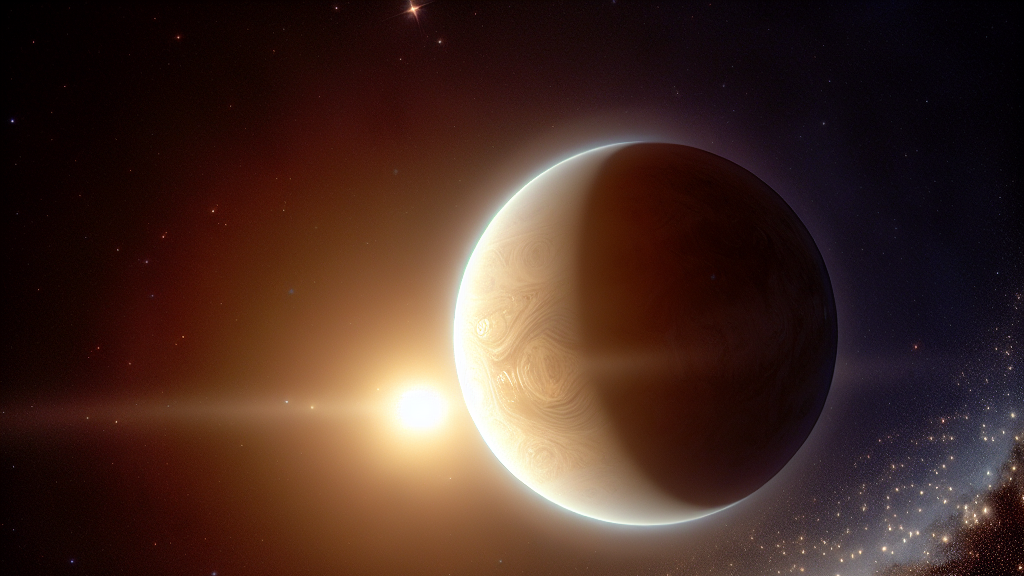
Imagine a planet so wildly different from our own that it orbits its star in a mind-boggling oval shape, rather than a smooth circle. That’s the kind of captivating cosmic oddity scientists have discovered with GJ 2126 b, a planet that takes wacky orbits to a whole new level. It’s like finding a planet with a personality all its own, and it’s sparking lots of excitement in the world of astronomy.
The planet, known as GJ 2126 b, orbits a star that’s smaller than the Sun, and it takes 272.7 days to complete its journey around it. What makes GJ 2126 b stand out is its orbit, which is more like an out-of-kilter ellipse than a neat round circle. This strange orbit was spotted using 112 measurements that track the planet’s speed as it moves towards or away from us. Each of these speed bumps and dips provided clues about GJ 2126 b’s adventurous path around its star.
Why should you care? Well, planets like GJ 2126 b could hold the key to unraveling the mysteries of how planets form and change over time. Researchers believe this wild orbit could tell us a lot about the cosmic forces that mold planets, and it might even change how we look for other planets beyond our solar system. Who knows? One day, understanding these eccentric orbits might help us find planets that could support life.
GJ 2126 b has an orbit so eccentric that it looks more like an oval racetrack in space than a circle.
FAQs
What makes the GJ 2126 b’s orbit so unique among exoplanets?
GJ 2126 b’s orbit is incredibly eccentric, meaning it’s shaped more like an elongated oval rather than a circle. This makes it one of the most unusual orbits found among known exoplanets, allowing scientists to explore new questions about planetary formation and dynamics.
How was GJ 2126 b discovered?
The exoplanet GJ 2126 b was discovered using the High Accuracy Radial Velocity Planet Searcher, a sophisticated tool that measures changes in a star’s velocity as an orbiting planet tugs it to and fro. These measurements helped identify the planet’s eccentric orbit.
Why is the discovery of GJ 2126 b important for understanding planets?
The highly eccentric orbit of GJ 2126 b challenges existing theories about planet formation and migration. By studying such unique orbital characteristics, scientists can gain insights into how planetary systems evolve and what makes them stable or chaotic.
Could a planet like GJ 2126 b support life?
While GJ 2126 b is unlikely to support life due to its extreme orbit, understanding eccentric orbits can refine our search for potentially habitable planets, especially those that orbit within the habitable zones of their stars.
How does studying planets like GJ 2126 b benefit astronomy?
Studying unique exoplanets like GJ 2126 b helps astronomers test and refine their models of planetary behavior and evolution, potentially leading to discoveries about planetary systems that were previously unknown.
Background
In the vast universe, planets orbiting stars are often grouped into categories based on certain characteristics, like size and orbit shape. Jupiter-like planets are massive and typically have circular orbits around their stars. However, some planets, like GJ 2126 b, have highly eccentric orbits, meaning their path is more stretched out and oval-shaped. This eccentricity can reveal clues about how these planets formed or were influenced over time by other cosmic forces.
History
The study of exoplanets began with the first confirmed discovery in the early 1990s. Since then, astronomers have identified thousands of exoplanets with a variety of characteristics. Among these, the discovery of planets with highly eccentric orbits, like GJ 2126 b, has intrigued scientists because such orbits can challenge existing models of how planets form and interact. GJ 2126 b adds a new chapter to this ongoing exploration, offering a rare opportunity to study an extreme case within the exoplanet population.
Based on “GJ 2126 b: A highly eccentric Jovian exoplanet” by Arbel Schorr, Avraham Binnenfeld, Shay Zucker, available on arXiv (arxiv.org/abs/2502.11139), used under CC BY 4.0 (creativecommons.org/licenses/by/4.0/).
