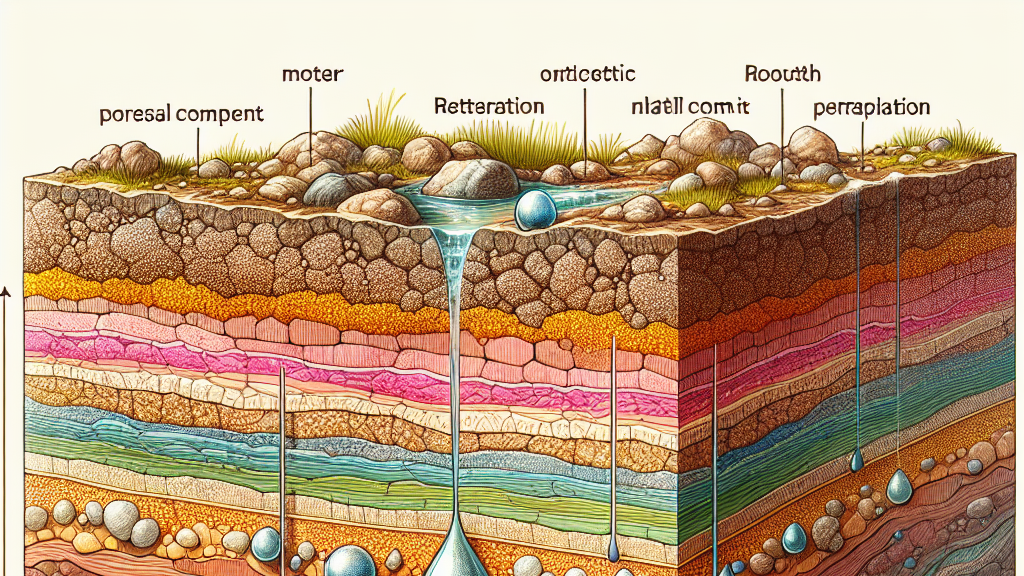
Imagine your garden soil being as dynamic as a sponge, sometimes absorbing water quickly and other times slowing down. This isn’t just a fairy tale, but a real possibility thanks to the concept of hysteresis in unsaturated porous media. This research delves into how soil that behaves like a stretchy, viscoelastic material can affect its ability to absorb and hold water over time, influenced by factors like surface tension at the liquid-gas interface.
Researchers have now extended their understanding of porous media by including soils with viscoelastic properties, meaning the soil can stretch and bounce back like rubber. By employing advanced mathematical models, they’ve shown it’s possible to predict how such soil will interact with water, even considering the pull of gravity. They used complex mathematical spaces to ensure their solution holds true over time and different environmental conditions.
In practical terms, this means that one day, farmers might be able to select or manipulate soil that changes its water retention based on environmental needs, potentially reducing water waste and improving crop yields. This improvement could lead to better water management solutions, where the soil itself can adapt to absorb just the right amount of water, mitigating the effects of droughts and floods. Imagine a world where soil is smart enough to help us conserve water resources efficiently!
Did you know? Some soils can stretch and bounce back like rubber, affecting how they manage water!
FAQs
How does viscoelasticity in soil affect water absorption?
Viscoelastic soil can change its absorption rate, acting like a sponge that sometimes absorbs water quickly and other times slowly, which is crucial for managing water resources effectively.
What is the role of hysteresis in soil water retention?
Hysteresis in soil water retention refers to the soil’s ability to have different water absorption and release rates, influenced by previous water content and conditions, impacting its capacity to manage moisture over time.
Why is this research on viscoelastic soil important for agriculture?
This research can lead to innovations in how farmers manage water usage, potentially selecting or engineering soil types that optimize water retention for crop health and reduce water waste.
What are the environmental benefits of understanding soil hysteresis and viscoelasticity?
By optimizing soil water retention, we can improve water conservation, reduce the impact of droughts and floods, and promote sustainable agricultural practices, ultimately benefiting the environment.
How might this research impact everyday life in the future?
This research could allow for smarter water management in agriculture, leading to more efficient use of water resources and potentially affecting food production and sustainability globally.
Background
Hysteresis in soil involves the complex interplay between water absorption and release within soil particles, affected by surface tension at the boundaries between liquid and gas phases. This phenomenon introduces challenges in predicting how soil will behave under certain conditions. Viscoelasticity describes materials that have both elastic (stretchy) and viscous (slow-moving) properties, like rubber. By understanding these characteristics in soil, scientists can predict and manipulate water movement through it.
History
In the past, studies have focused on understanding how water moves through rigid, non-viscoelastic porous media. Recent advancements allow researchers to apply concepts from materials science, like viscoelasticity, to soil mechanics. This new approach builds on decades of research into soil water dynamics, offering fresh insights into how soil can be adapted to better manage water under varying conditions.
Based on “Deformable porous media with degenerate hysteresis in gravity field” by Chiara Gavioli, Pavel Krejčí, available on arXiv (arxiv.org/abs/2405.10764), used under CC BY 4.0 (creativecommons.org/licenses/by/4.0/).