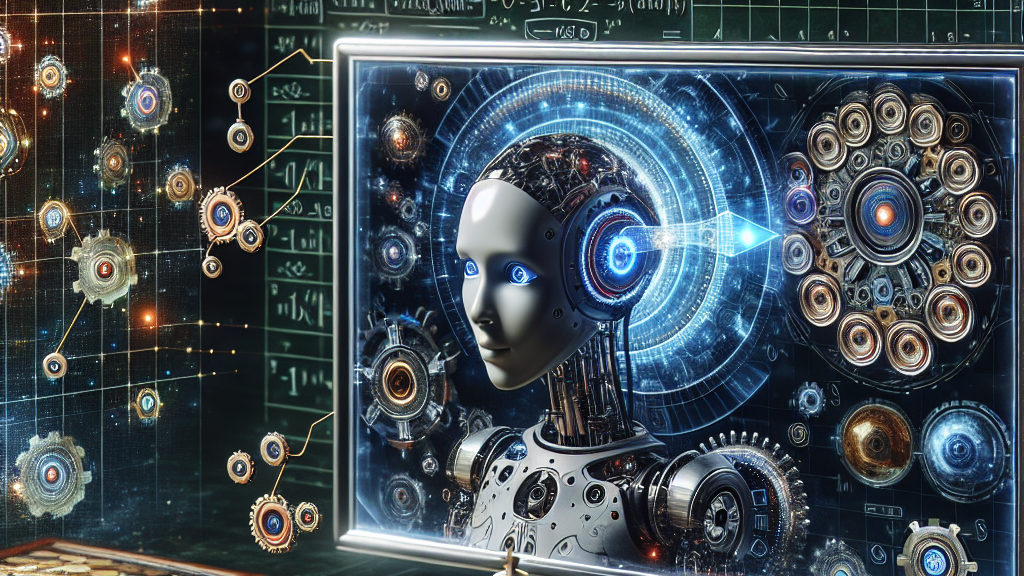
Imagine unlocking new scientific secrets with the power of AI. That’s what cutting-edge models are doing right now, transforming how we study physics and seek out the mysteries of the universe. These aren’t just your everyday chatbots; they are revolutionizing the way we do experiments and analyze massive amounts of data.
Recently, researchers have harnessed a specialized AI model to tackle some of the toughest challenges in collider physics, which is the science of smashing particles together at mind-boggling speeds to uncover what’s inside. This AI can help scientists save tons of computing power, make predictions about the scientific uncertainties they face, and even search for entirely new physics beyond what we currently know.
In real-world terms, this means we could make groundbreaking discoveries much faster and cheaper than before. Think of a future where AI not only powers your smart devices but also fuels major scientific advancements, leading to new technologies or medical breakthroughs that change the way we live.
Did you know? Cutting-edge AI can analyze particle collisions faster than traditional methods, leading to quicker scientific breakthroughs!
FAQs
What are Foundation Models in AI?
Foundation Models in AI are advanced neural networks that can perform multiple tasks simultaneously, making them extremely versatile for solving different problems across various fields.
How is AI transforming collider physics?
AI models are helping scientists in collider physics by saving computing resources, predicting uncertainties in measurements, and searching for new physics using novel methods.
What impact could AI have on future scientific discoveries?
AI could speed up the process of scientific discovery by making experiments more efficient and accurate, leading to faster and more affordable breakthroughs in technology and medicine.
Background
Foundation Models are essentially super-smart computer systems designed to tackle multiple tasks at once. They use deep learning, a type of machine learning that mimics the way our brains work, to analyze complex data and make sense of it. This is particularly useful in fields like physics, where there’s a lot of complicated information to process. In collider physics, for example, scientists study the results of particle collisions to understand the fundamental components of matter, and AI can help simplify and speed up this process.
History
The concept of Foundation Models has evolved from early neural networks, which were limited in scope, to more sophisticated systems capable of processing large datasets. Over the years, AI has grown from simple algorithms into complex models like Chatbot Generative Pre-trained Transformer, which reshape industries from tech to science. This particular study builds on previous works by applying AI to the highly specialized area of collider physics, demonstrating new practical applications for Foundation Models.
Based on “Solving Key Challenges in Collider Physics with Foundation Models” by Vinicius Mikuni, Benjamin Nachman, available on arXiv (arxiv.org/abs/2404.16091), used under CC BY 4.0 (creativecommons.org/licenses/by/4.0/).