





































































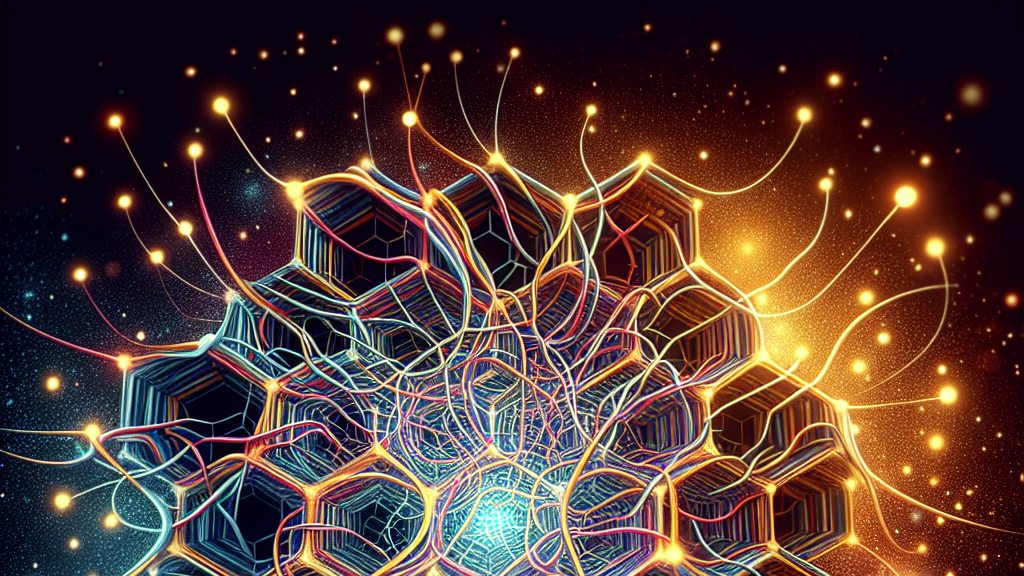
Imagine unlocking a secret code hidden within a honeycomb structure. That’s what scientists are doing with quantum models—those mind-bending systems that govern the tiniest of particles. They discovered that by looking at honeycomb lattices, they can uncover surprising behaviors of elusive particles known as Majorana fermions. These particles are like cosmic puzzle pieces playing a crucial role in the grand scheme of physics.
The research dives into how these honeycomb patterns are not just beautiful to behold but also mathematically significant. By drawing a connection, or duality, between these patterns and what’s happening with these mysterious Majorana fermions, scientists have found a way to solve complex quantum systems more simply. It’s like discovering a shortcut through a maze that makes everything come together seamlessly.
In the real world, this high-level physics could lead to practical applications, like improving how we build any technology that relies on quantum principles. Think of more reliable quantum computers that can handle vast amounts of data and perform computations that were once considered impossible. This research may be the key to unlocking that futuristic potential.
Did you know? Majorana fermions are their own antiparticles, meaning they can annihilate themselves!
FAQs
What are honeycomb lattices and why are they important in quantum physics?
Honeycomb lattices are structures that resemble a honeycomb shape on a microscopic level, and they are essential in quantum physics for modeling complex interactions in materials such as graphene. They help scientists understand how particles like electrons interact at a quantum level.
How does duality between Majorana fermions and Pauli spins solve quantum problems?
Duality allows scientists to translate complex quantum systems into simpler forms. By representing Pauli spins with Majorana fermions in honeycomb lattices, they can solve intricate quantum problems more straightforwardly, offering new insights into particle behavior.
Why are Majorana fermions significant in the study of quantum systems?
Majorana fermions, being their own antiparticles, provide unique insights into quantum systems. They are believed to hold the key to advancing quantum computing due to their stable properties in certain quantum states.
How could this research impact everyday technology?
This research could lead to advancements in quantum computing, making computers faster and more efficient. It could revolutionize fields that require vast computational power, such as cryptography, material science, and complex problem-solving.
Can this research lead to the development of new materials?
Yes, understanding the quantum interactions in honeycomb lattices can potentially lead to the discovery of new materials with unique properties, which could be used in electronics, superconductors, and more.
Background
In the quantum world, particles don’t behave like anything we can see in daily life. One interesting area is spin models on honeycomb lattices. These are patterns where scientists can link quantum particles’ behavior, like a network. The Majorana fermions, particles that are their own antiparticles, play a key role here, allowing scientists to explore complex quantum behaviors in a more straightforward way. This research is akin to untangling a ball of yarn—by solving one small part, bigger solutions can emerge.
History
The study of quantum systems started with understanding electrons and particles in simplistic models. Over time, the focus shifted to more complex patterns like honeycomb lattices, especially after the discovery of graphene in 2004. Kitaev’s work laid foundational ideas by using these lattices to explore quantum behavior. This new research builds on previous findings by directly linking these lattices to Majorana fermions, cementing a critical step forward in quantum studies.
Based on “Dumbbell Fermions and Spin Models on Honeycomb Lattices” by T. Banks, available on arXiv (arxiv.org/abs/2502.13975), used under CC BY 4.0 (creativecommons.org/licenses/by/4.0/).
