





































































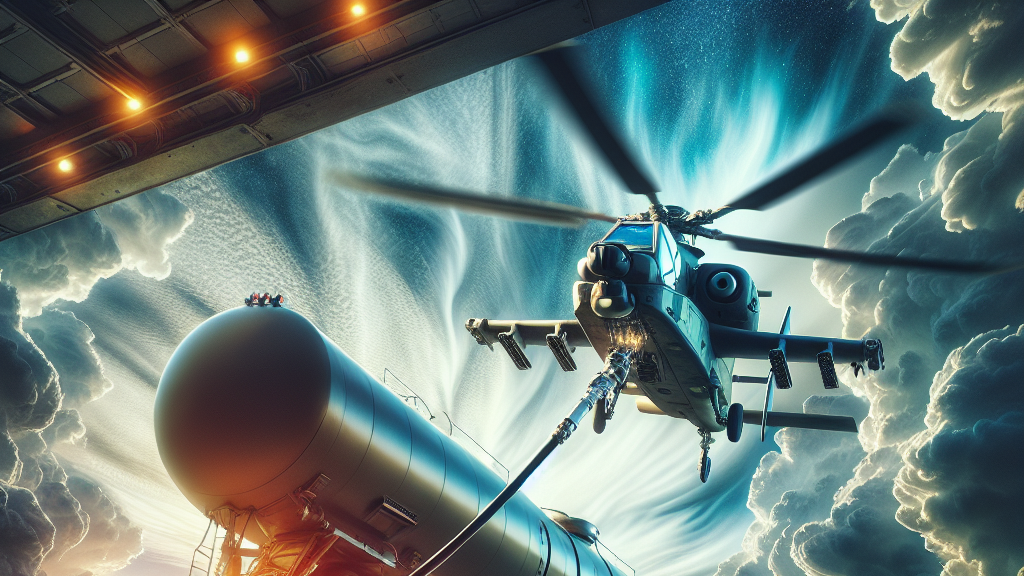
Imagine a helicopter needing to refuel high up in the sky while both it and the refueling tanker move at high speeds. It’s like trying to thread a needle in a racing car! This is not just a cool movie scene; it’s a critical operation for missions that require helicopters to stay airborne longer, like rescuing people from remote locations or conducting military operations.
To solve this complex issue, researchers have developed a new control system for helicopters attempting mid-air refueling. It acts like a super-smart autopilot, helping the helicopter’s refueling probe to smoothly and accurately connect with the tanker without getting thrown off by wind or the tanker’s wake. By considering the probe’s position and movement in real-time, this system can adjust the helicopter’s movements for a precise docking.
The real-world impact? Using this innovative technology, helicopters could extend their flight duration without landing, making rescue missions more efficient or enabling longer surveillance flights. This breakthrough is not just a theoretical improvement; tests have shown a 36% boost in docking accuracy, showing promise for safer and more effective aerial refueling in the future!
Did you know? This new helicopter control system can improve docking accuracy by 36%, making aerial refueling missions much safer and effective!
FAQs
How does the new helicopter control system improve aerial refueling?
The new system acts like a precise autopilot, using real-time data of the helicopter’s probe position and motion. This allows it to adjust the helicopter’s movement and ensure a more accurate and safe connection with the tanker during mid-air refueling.
Why is mid-air refueling important for helicopters?
Mid-air refueling allows helicopters to stay airborne longer without needing to land. This is crucial for extended missions such as search and rescue, military operations, and disaster response, where time and continuous aerial presence are essential.
What makes mid-air refueling challenging for helicopters?
Challenges arise from the aerodynamic interaction between the tanker and helicopter, the need for precise alignment during docking, and the effects of wind. The helicopter must match the tanker’s speed and orientation, while external factors add complexity to the maneuver.
What are the potential real-world applications of this control technology?
This technology can enhance operational efficiency and safety in sectors requiring long-duration helicopter flights, such as emergency services, defense, and logistics, by offering more reliable mid-air refueling capabilities.
How effective is this new control system compared to existing methods?
Tests show a 36% improvement in docking accuracy, indicating that this control system is significantly more reliable than existing standard controllers used for mid-air helicopter refueling.
Background
Autonomous aerial refueling requires precise control due to the forces and movements affecting helicopters and tankers flying close together. Helicopters face challenges in such operations because the refueling probe’s motion can be disrupted by turbulence and its own movements. A new control system incorporates the probe’s position and speed to enhance the helicopter’s ability to dock accurately while maintaining stability.
History
Historically, mid-air refueling has been essential for extending the range of aircraft during military operations. Past research focused on fixed-wing planes, but recent advances aim to adapt these techniques for helicopters. Autonomous control systems are the latest innovation, building on years of development in aviation technology to address specific challenges faced by helicopters.
Based on “Autonomous helicopter aerial refueling: controller design and performance guarantees” by Damsara Jayarathne, Santiago Paternain, Sandipan Mishra, available on arXiv (arxiv.org/abs/2502.15562), used under CC BY 4.0 (creativecommons.org/licenses/by/4.0/).
