





































































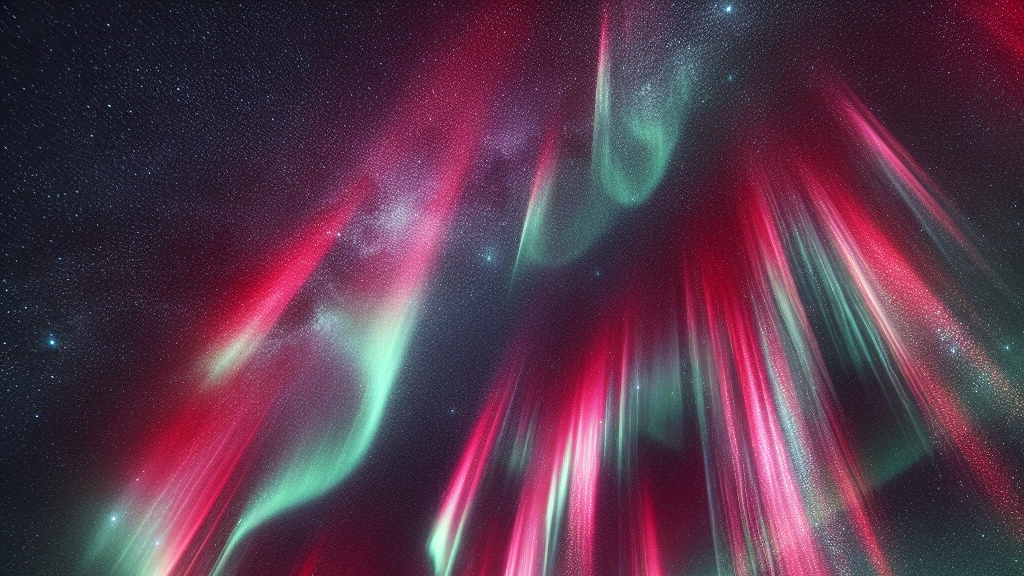
Have you ever stood outside on a cold night, gazing up in awe at the dancing colors of the northern lights? These mesmerizing displays have captivated humanity for centuries, and scientists are still uncovering their mysteries. Now, new research has revealed a hidden layer to these beautiful phenomena—red auroral streamers caused by low-energy electrons.
This study used advanced technology like the THEMIS spacecraft and ground-based imagers to spot these unique red streamers. Traditionally, auroras are associated with high-energy electrons, but these interesting red patterns are a result of electrons with less energy. Scientists discovered that specific waves and plasma sheets are responsible for scattering these electrons, leading them to light up the sky.
Why does this matter, you ask? Understanding these auroral processes could help us predict space weather, which impacts everything from GPS systems to power grids here on Earth. Imagine being able to forecast space-based phenomena just like we do the weather! This research could be the key to a future where we better understand and adapt to the cosmic forces interacting with our planet.
Red auroras are caused by low-energy electrons hitting the Earth’s atmosphere, unlike the more common green ones created by high-energy electrons.
FAQs
What are auroral streamers, and why are they important?
Auroral streamers are narrow, bright bands of light in the sky caused by interactions between the Earth’s magnetosphere and atmosphere. They are crucial for understanding the dynamic processes of space weather and how it affects our planet.
How do low-energy electrons create red auroras?
Low-energy electrons interact with the Earth’s atmosphere, causing oxygen atoms to emit red light. This process is different from the more common green auroras, which are produced by high-energy electrons.
Why should we care about studying auroras?
Aurora research helps us understand space weather and its impact on technology and infrastructure, such as satellites, aviation, and power grids. Better predictions can lead to improved safety and efficiency for these systems.
Background
Auroras occur when charged particles from the Sun interact with the Earth’s magnetic field, entering the atmosphere and exciting gas particles, causing them to glow. These interactions happen in the magnetosphere, the region around Earth dominated by its magnetic field, and can result in stunning light displays known as aurora borealis or aurora australis depending on their location.
History
Auroras have been observed and wondered about for centuries, but it wasn’t until the 20th century that scientists began to understand their connection to solar activity. Over the years, technological advances have enabled detailed studies of auroras, such as using spacecraft and ground-based imagers to analyze their properties and the processes driving them. This study builds on that foundation by exploring low-energy electron interactions that create red auroras, expanding our understanding of auroral dynamics.
Based on “Streamer-like red line diffuse auroras driven by time domain structures and ECH waves associated with a plasma injection and braking ion flows” by Yangyang Shen, Xu Zhang, Jun Liang, Anton Artemyev, Vassilis Angelopoulos, Emma Spanswick, Larry Lyons, Yukitoshi Nishimura, available on arXiv (arxiv.org/abs/2502.18692), used under CC BY 4.0 (creativecommons.org/licenses/by/4.0/).
