





































































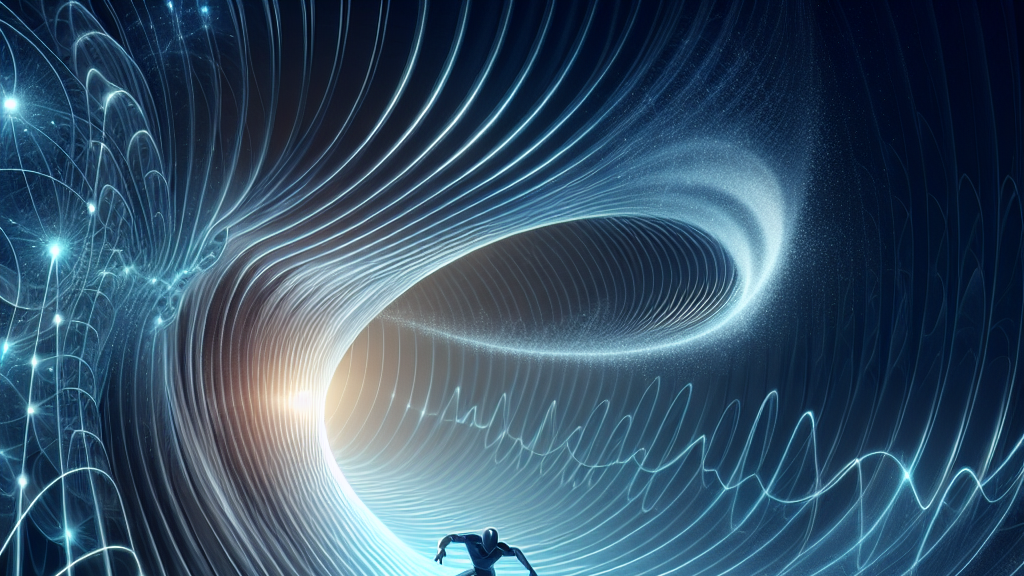
Imagine if you could surf on the tiniest wave imaginable—not in the ocean, but on the surface of a material. That’s what neutrons do in a special quantum state called a neutron whispering gallery state. It’s as if these particles are whispering along the edges of surfaces, held there by the mysterious tug of centrifugal force and the material’s own gravitational pull. Scientists have managed to observe this fascinating occurrence, giving us new ways to explore some deep questions about the universe.
These neutron surfers were spotted on a concave mirror made of silicon dioxide using beams of cold neutrons. The experiment showed that the numbers matched up nearly perfectly with the math predictions, which is super important because things can get really wacky at such small scales. These observations help scientists confirm theories about how particles behave when they’re spinning or in motion, like a spinning carnival ride, and can even let them peek into all-new potential interactions that we haven’t yet fully described.
So why should you care? Well, this type of neutron dance might eventually help us solve big questions in physics. Ever wonder what’s happening at the very smallest levels of existence, like trying to see the tiniest details in a painting? This research could help improve technologies that explore those questions, like better sensors or even new methods for examining distant planets. The future of science is full of whispers—and sometimes, the quietest voices tell the biggest stories.
Did you know? Neutron whispering gallery states are named after how sound travels in whispering galleries, special architectural structures where even the softest sounds can be heard across a room!
FAQs
What are neutron whispering gallery states?
Neutron whispering gallery states are unique quantum states where neutrons are situated along a material surface, being guided by centrifugal force and the surface’s potential. These states help in testing quantum mechanics in motion, surface potential analysis, and exploring short-range forces.
How do scientists observe neutron whispering gallery states?
Scientists use a pulsed cold neutron beam to observe these states. In the study, they observed the phenomenon on a silicon dioxide concave mirror, achieving measurements that match theoretical predictions closely.
What could neutron whispering gallery states teach us?
These states could help us understand complex quantum mechanics better, provide insights into nanoscale surface interactions, and potentially uncover unknown short-range interactions, opening up pathways to new scientific and technological advancements.
Why is observing neutron whispering gallery states important?
Observing these states is crucial because they confirm theoretical models of quantum behavior in non-inertial frames and offer a novel method for examining the fine details of material surfaces and potential new interactions.
Are neutron whispering gallery states related to regular sound whispering galleries?
Yes, they are named after architectural whispering galleries where even faint sounds can carry across the room due to their special design, much like how these quantum states behave along the edges of materials.
Background
Neutron whispering gallery states occur when neutrons are confined to move along a material’s surface due to the balance between centrifugal force and the potential of the surface itself. This is similar to how whispering galleries in architecture work, where sound travels along the walls. Understanding these states is useful in exploring quantum mechanics, particularly in scenarios that involve motion and rotation.
History
Throughout the years, physicists have been intrigued by quantum states involving particles in unusual conditions. Earlier studies focused on electron dynamics around nuclei, while recent advancements led to exploring larger quantum systems, like neutrons interacting with surfaces. This study builds on such research by experimentally confirming theoretical predictions about neutron behavior in curved environments.
Based on “Measurement of Neutron Whispering Gallery States Using a Pulsed Neutron Beam” by Go Ichikawa, Kenji Mishima, available on arXiv (arxiv.org/abs/2502.18936), used under CC BY 4.0 (creativecommons.org/licenses/by/4.0/).
