





































































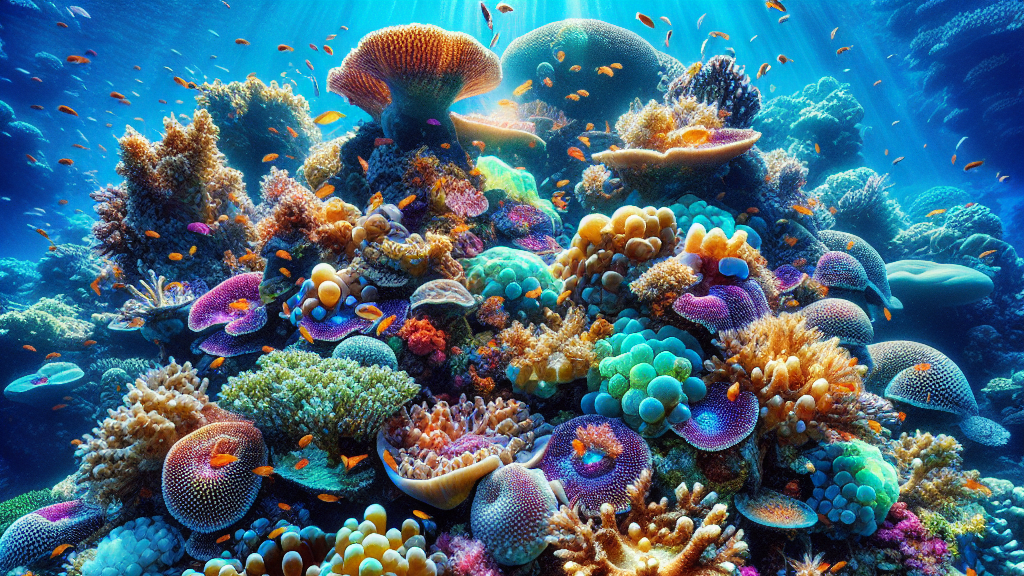
Did you know our beautiful coral reefs might be munching on plastic without even realizing it? It’s true! Microplastics, those tiny particles of plastic debris, are infiltrating our oceans and potentially affecting the health of corals, which are crucial for marine ecosystems. But how do we find out what’s happening inside these amazing underwater structures? Well, that’s where the magic of science steps in. By turning microplastics into tiny lasers, researchers are shedding light, quite literally, on how these plastics travel inside coral tissues. This method provides a non-invasive way to track the particles and understand how they affect corals over time.
Imagine this: researchers use a fascinating technique that involves transforming microplastics into glowing laser points. These glowing particles allow scientists to watch in real-time as the plastics move within coral tissues. This is groundbreaking because, until now, studying microplastics in corals was tricky and potentially harmful to the reefs themselves. By observing the journey of these laser-lit particles, scientists can map out how plastics move and where they go, helping us understand how these plastics might be harming our oceans’ essential ecosystems.
Why should you care? Well, healthy coral reefs mean healthy oceans, and healthy oceans mean better life for all of us. Picture future tech that uses this laser technique to monitor ocean pollution on a larger scale, identifying and mitigating harm before it damages our reefs permanently. This innovative approach might even inspire new ways to clean our oceans or prevent pollution by tracking and understanding the movement of harmful substances. Protecting our reefs today helps ensure that future generations can enjoy the vibrant marine life and clear waters that corals help support.
A single piece of plastic can take up to 1,000 years to decompose in the ocean!
FAQs
How do scientists track microplastics in coral tissues?
Scientists use an innovative method by turning microplastics into glowing laser particles, allowing them to see how these plastics move through coral tissues.
Why is microplastic pollution a problem for corals?
Microplastic pollution can infiltrate coral tissues, potentially affecting their health and the entire reef ecosystem they support.
Can the laser technique help other marine life?
Yes, this method could be adapted to study microplastic impacts on other marine creatures, extending our understanding of ocean pollution effects.
What happens to microplastics once they are inside coral tissues?
The glowing particles allow researchers to trace how microplastics travel and where they settle within coral tissues, providing insights into their potential harm.
How does this research impact ocean conservation efforts?
By understanding how microplastics affect coral health, conservation efforts can be better directed to protect these vital marine ecosystems from plastic pollution.
Background
Coral reefs are underwater ecosystems critical for marine biodiversity. They provide habitats and protection for a vast array of marine species. However, these ecosystems are threatened by pollution, particularly from microplastics, which are small plastic fragments resulting from the breakdown of larger plastic debris. Studying the impact of microplastics on corals has been challenging because traditional methods could harm the reefs. Thus, a non-invasive approach is crucial to understand how these plastics affect corals.
History
Microplastic pollution became a significant concern as it was discovered that plastics never fully decompose but instead break into tiny particles that infiltrate ecosystems. Previous studies have identified microplastics in ocean water and marine life, but the impact on coral reefs has been less explored. This research builds upon earlier findings by introducing a novel, less invasive method to study microplastic movement in corals.
Based on “Monitoring microplastics in live reef-building corals with microscopic laser particles” by Vera M. Titze (SUPA, School of Physics and Astronomy, University of St Andrews, Fife, Scotland, Humboldt Centre for Nano- and Biophotonics, University of Cologne, Germany, Max Planck Institute of Colloids and Interfaces, Potsdam, Germany), Jessica Reichert (Hawai’i Institute of Marine Biology, University of Hawai’i at Manoa, Hawai’i, Kane’ohe, USA), Marcel Schubert (Humboldt Centre for Nano- and Biophotonics, University of Cologne, Germany), Malte C. Gather (SUPA, School of Physics and Astronomy, University of St Andrews, Fife, Scotland, Humboldt Centre for Nano- and Biophotonics, University of Cologne, Germany), available on arXiv (arxiv.org/abs/2502.20014), used under CC BY 4.0 (creativecommons.org/licenses/by/4.0/).
