





































































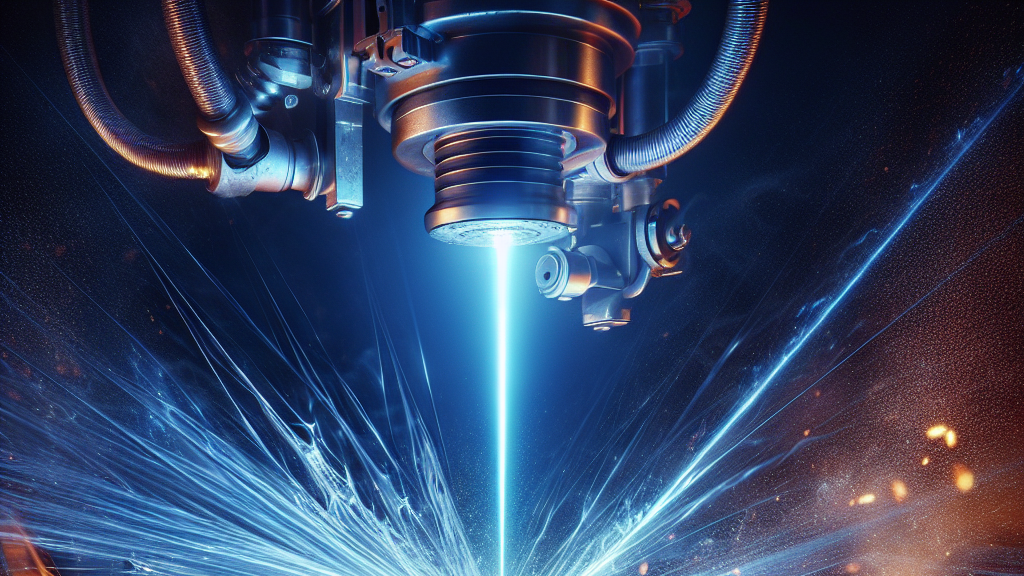
Picture this: a laser so powerful it can melt metals faster than ordinary heat! That’s what researchers have discovered by using lasers to blast thin films of tungsten and gold. These high-tech experiments challenge everything we know about how metals melt and transform when hit with super-fast laser energy.
In this groundbreaking study, scientists used advanced simulations to see what happens when lasers hit metal at lightning speed. They found that the pressure from excited electrons causes the metal to expand and melt in a way that’s much faster than traditional heating methods. This means that even at lower temperatures, metals can start to melt from the surface inward, a process called ‘heterogeneous melting.’ Tungsten and gold showed different behaviors, with tungsten undergoing solid transitions and gold turning entirely amorphous under this laser-induced stress.
Imagine the future where manufacturers use lasers not just for cutting but for reshaping metals quickly and efficiently. This could revolutionize industries, making production faster and potentially more energy-efficient. Think of a world where airplanes, cars, or gadgets are made with precision using this technique, which opens up a whole new realm of possibilities in technology and design!
Did you know? Lasers can cause metals to melt ten times faster than heat alone!
FAQs
How do lasers melt metals faster than heat does?
Lasers hit metals with such intense energy that they excite the electrons in the metal’s structure. This electron excitement causes pressure changes that make the metal expand and melt from its surface much faster than heating does.
Why are tungsten and gold used in this research?
Tungsten and gold have distinct responses to laser energy, offering unique insights into how different metals react. Tungsten shows solid transitions, while gold can become amorphous, showing the diversity of metal behaviors.
Could this laser technique be used in manufacturing?
Yes, this could potentially revolutionize manufacturing by enabling faster and more precise metal shaping. Lasers could be used to efficiently melt and reshape metals, offering new possibilities in the industry.
Background
This research explores how lasers, when applied to metals, can excite the electrons within their structures. Conventionally, heating metals relies on thermal expansion, but with lasers, the electron-ion nonequilibrium state drastically changes this process. When electrons are excited, they create pressure that can make metals expand and change their phase unexpectedly faster than traditional methods.
History
Historically, metals were melted using heat, which relies on increasing the temperature until a metal’s melting point is reached. Over time, scientists have explored faster and more efficient ways, like using lasers, to induce these phase changes. This research builds on advances in laser technology and simulations to show how much quicker lasers can transform metal structures.
Based on “Ultrafast Heterogeneous Melting of Metals under Extreme Non-equilibrium States” by Qiyu Zeng, Xiaoxiang Yu, Bo Chen, Shen Zhang, Kaiguo Chen, Dongdong Kang, Jiayu Dai, available on arXiv (arxiv.org/abs/2502.20886), used under CC BY 4.0 (creativecommons.org/licenses/by/4.0/).
