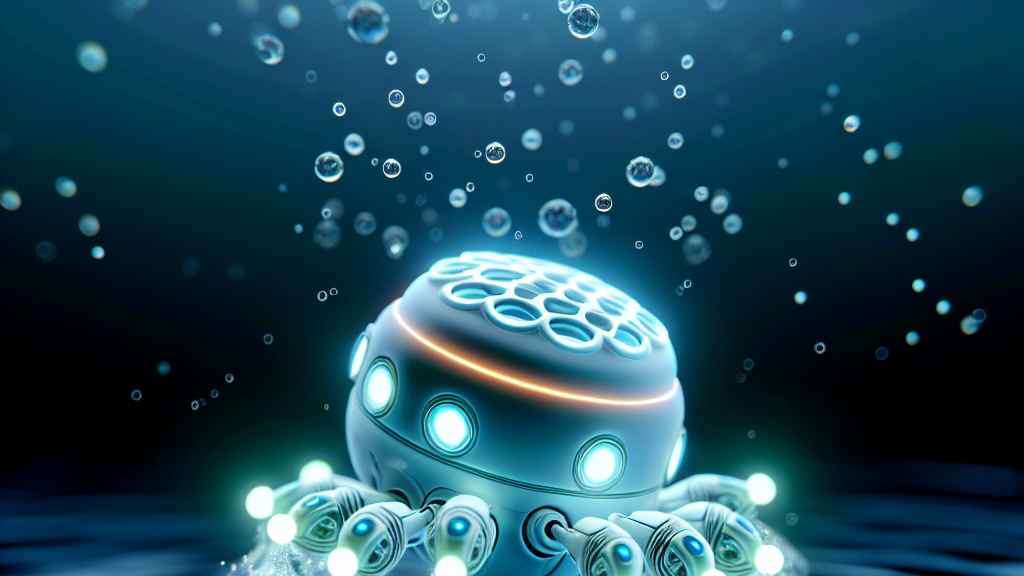
Imagine robots that can teach themselves to swim faster and better, much like living creatures do. That’s exactly what scientists are doing with soft robots. These are not your typical metal machines; they’re flexible and can adapt their swimming style based on their environment. This adaptability makes them a puzzle for engineers who find it tricky to predict their moves, especially when they’re tiny and in the water where all sorts of forces are at play. But here’s the cool part: scientists are using experimental results in algorithms that mimic natural selection to help these robots evolve in real time.
The research involved using two types of algorithms, particle swarm optimization and genetic algorithm, to guide these robots to become better swimmers. How? By setting a fitness goal, like speed, and letting the robots compete to see which designs perform best. It’s almost like a robot Olympics where the winners are those that show unexpected gene combinations, leading to a big boost in their swimming abilities or even the discovery of completely new modes of locomotion, like a self-oscillating swim.
Why does this matter to us, you might ask? Well, these soft, self-improving robots have endless possibilities. They could aid in underwater exploration, help clean our oceans, or even pave the way for new technologies in how we interact with aquatic environments. Imagine a future where these robots can autonomously explore the depths of the ocean, finding things we never knew existed, or perhaps maintaining underwater infrastructure. It’s a step towards a future where machines and nature blend seamlessly, unlocking new solutions to age-old problems.
Did you know? These robots can improve their swimming speed by several hundred percent, much like athletes training for a big race!
FAQs
What are soft robots and why are they significant?
Soft robots are flexible, adaptive machines that mimic natural organisms. They’re significant because they can perform tasks in environments that conventional robots cannot, due to their adaptable nature.
How do evolutionary algorithms improve soft robot locomotion?
Evolutionary algorithms simulate natural selection. They experiment with different designs and keep improving on them, leading soft robots to develop faster and more efficient ways of moving underwater.
Can this research impact everyday life?
Absolutely! These robots could revolutionize underwater exploration, environmental monitoring, and even rescue operations, providing us with new tools to better understand and protect aquatic environments.
What is a self-oscillating locomotion mode mentioned in the study?
Self-oscillating locomotion is a new way of moving that these robots discovered. It mimics a natural rhythm, allowing the robots to propel themselves without constant input, much like how fish swim.
How does this research connect to natural evolution?
The research uses algorithms that mimic natural selection, encouraging robots to ‘evolve’ better traits over time, similar to how living organisms adapt to their environments naturally.
Background
To understand this research, it’s key to know about evolutionary algorithms and soft robotics. Evolutionary algorithms are computational methods inspired by natural selection, where only the fittest designs thrive and improve over generations. Soft robotics is a field focusing on flexible, adaptable robots that can perform complex movements in dynamic environments. Together, these concepts allow engineers to create robots that learn and adapt, much like living organisms do.
History
This research area has evolved from the broader field of robotics and AI. Earlier breakthroughs in artificial intelligence and genetic algorithms laid the groundwork for this study. Over time, we moved from rigid industrial robots to softer, more adaptable ones, making it possible for them to mimic the adaptability and resourcefulness found in nature.
Based on “Survival of the fastest — algorithm-guided evolution of light-powered underwater microrobots” by Mikołaj Rogóź, Zofia Dziekan, Piotr Wasylczyk, available on arXiv (arxiv.org/abs/2503.00204), used under CC BY 4.0 (creativecommons.org/licenses/by/4.0/).