Connect with us

Search by keyword

Electricity

Can AI Make Medical Scans Super Accurate?

LesionDiffusion is a groundbreaking tool that uses AI to generate hyper-realistic medical scans, potentially revolutionizing healthcare by making diagnosis faster and more accurate.

Can AI Make Medical Scans Super Accurate
✨Researched by humans. Explained by robots. Learn more.

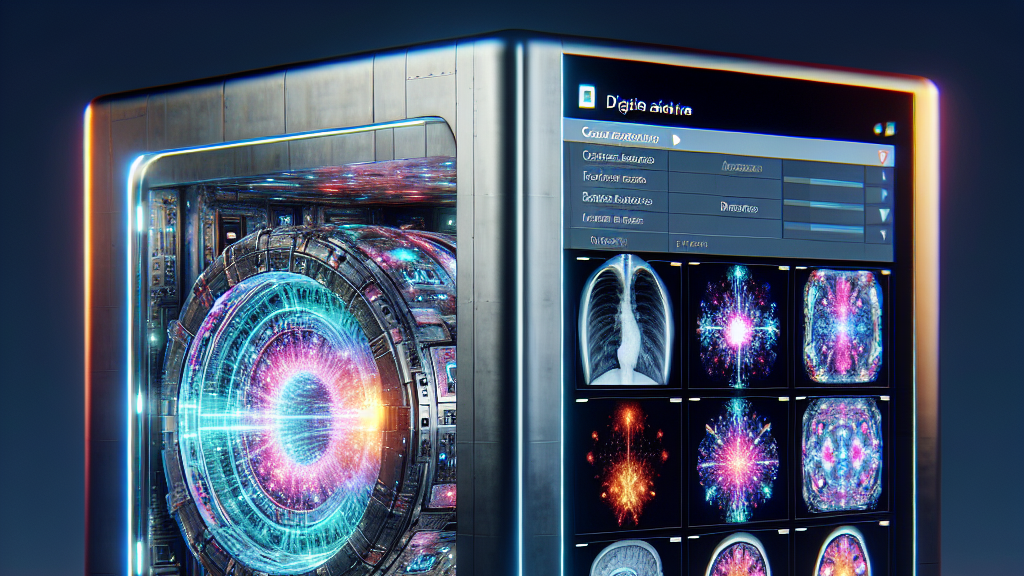
Imagine a world where doctors can spot even the tiniest medical issues on a scan, thanks to the magic of AI. That’s exactly what LesionDiffusion, a cutting-edge technology in the medical field, aims to do. By creating synthetic 3D CT scan lesions with unparalleled detail, this tool promises to make diagnosing health problems faster and much more accurate.

LesionDiffusion is a clever combination of two specialized AI networks—one to craft the lesion shapes and another to fill in the fine details. Think of it as a digital artist creating hyper-realistic models that help doctors understand what’s happening inside the body without needing costly and hard-to-collect real-world samples. This AI can predict and generate lesions in more types and organs than ever before, providing a new gold standard for medical imaging.

In the future, this technology could be a game changer for healthcare. Imagine being able to screen for a plethora of diseases in mere moments—catching them earlier than ever before. It means more people getting the treatment they need, leading to healthier lives. With LesionDiffusion, the potential to transform diagnostics is immense and could lead to earlier treatment and better outcomes for countless patients.

Studies have shown that AI can diagnose some conditions as accurately as human doctors, if not better, when trained with high-quality data.

FAQs

How does LesionDiffusion improve medical imaging?

LesionDiffusion uses AI to create synthetic 3D CT scan lesions, making it possible to generate a wide variety of lesion types and providing medical practitioners with detailed visuals that improve diagnosis accuracy.

Why are synthetic lesions important in healthcare?

Synthetic lesions allow for extensive testing and training of AI systems without the need for large, costly, and hard-to-collect annotated datasets, enhancing the scope and quality of medical imaging analysis.

What makes LesionDiffusion different from other AI models in medical imaging?

LesionDiffusion offers scalability, fine-grained control over lesion attributes, and supports a broader range of lesion types and organs, outperforming current models in generating realistic medical scans.

Background

Lesions refer to regions in the body tissues where you might find abnormal changes, which can indicate underlying health problems. In medical imaging, spotting these lesions early can be critical for diagnosis. Fully-supervised methods depend on vast datasets of real images with lesions, which are hard and expensive to gather. So, using AI to produce synthetic lesions in images can provide the data needed for better training models, improving overall diagnosis capabilities.

History

Traditional medical imaging relied heavily on human interpretation of scans, requiring broad datasets for AI models to learn accurately. Recent advancements in AI have allowed us to move beyond basic image recognition to creating synthetic lesions for training AI, greatly advancing the quality and accuracy of diagnosis tools. LesionDiffusion builds on this foundation, enhancing precision and scope by allowing fine-tuned control over lesion attributes.

Based on “LesionDiffusion: Towards Text-controlled General Lesion Synthesis” by Henrui Tian, Wenhui Lei, Linrui Dai, Hanyu Chen, Xiaofan Zhang, available on arXiv (arxiv.org/abs/2503.00741), used under CC BY 4.0 (creativecommons.org/licenses/by/4.0/).

Trending

Latest

Can AI Save Water Discover How

Computers

AI is transforming the tech world, but it uses lots of water! A new tool, SCARF, helps us measure and reduce AI's water footprint,...

Whats a Forbush Decrease and Why Should We Care Whats a Forbush Decrease and Why Should We Care

Space

Scientists just observed the biggest solar storm event in years, revealing unexpected cosmic ray patterns. Understanding these changes could help us protect our technology...

Can Cars Spot Danger Faster Than Humans Can Cars Spot Danger Faster Than Humans

Computers

Think about how quickly you react when something unexpected happens on the road. This research brings us closer to creating self-driving cars that can...

Can Fear of the Other Stop Social Harmony Can Fear of the Other Stop Social Harmony

Physics

Fear of the unknown might make it harder for people to agree and get along. This study shows that when people have strong xenophobic...

Can AI Revolutionize Breast Cancer Diagnosis Can AI Revolutionize Breast Cancer Diagnosis

Electricity

This research introduces a groundbreaking AI model that can accurately assess HER2-positive breast cancer using widely accessible staining methods, potentially revolutionizing how we diagnose...

Can AI Transform Your Singing into a Choir Can AI Transform Your Singing into a Choir

Computers

Imagine singing solo and having AI turn you into a choir. This research unveils a groundbreaking AI tool that transforms your voice into rich...

You May Also Like

Computers

AI is transforming the tech world, but it uses lots of water! A new tool, SCARF, helps us measure and reduce AI's water footprint,...

Computers

Think about how quickly you react when something unexpected happens on the road. This research brings us closer to creating self-driving cars that can...

Electricity

This research introduces a groundbreaking AI model that can accurately assess HER2-positive breast cancer using widely accessible staining methods, potentially revolutionizing how we diagnose...

Computers

Imagine a machine capable of reading ancient books, deciphering complex pages with precision! This research is paving the way for AI to unlock the...

Economics

Discover how AI models can unknowingly favor certain races in mortgage decisions and how new methods could dramatically reduce these biases, fostering a fairer...

Computers

This research explores how AI models designed to understand both images and words might improve their performance simply by teaching themselves to think better....

Computers

Imagine if playing games could make a computer program better at understanding and creating text! This research suggests that by using creative tasks like...

Computers

Dive into the world of AI mistrust, where computers don't always know when they're wrong! Discover how teaching AI to see like us might...

Computers

What if talking to a robot could feel as comforting as a therapy session? This research uncovers the striking similarities between human therapists and...

Copyright © 2024 8ig8rain.

Disclaimer: The content on 8ig8rain.com consists of AI-generated summaries of scientific abstracts from arXiv. Please note that most arXiv abstracts are preprints and may not have undergone formal peer review. While these summaries aim to convey key ideas and potential applications, they are provided for informational purposes only and should not be interpreted as validated scientific findings or professional advice. The summaries are intended to educate, spark curiosity, and inspire further exploration of science.