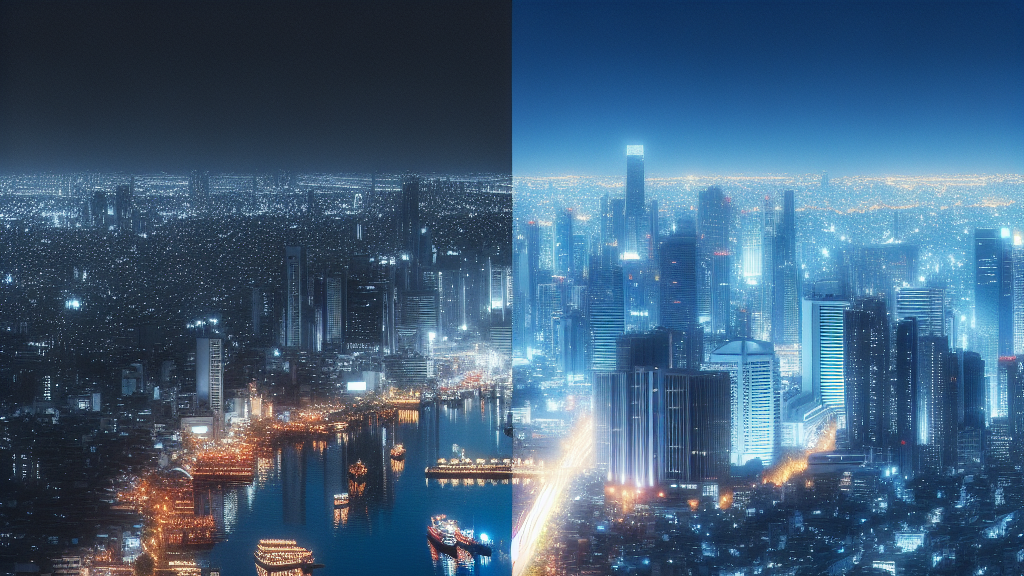
Ever tried to take a photo at night only to end up with a dark, blurry mess? It’s frustrating, right? Scientists have created a new tool called DarkDeblurNet that can transform those frustratingly dark, unclear images into bright, clear ones instantly. This innovation could change the way we capture night-time memories, making blurry photos a thing of the past.
The magic behind this lies in a combination of technology and learning-based methods. By using a fancy-sounding gadget called DarkDeblurNet, which includes a dense-attention block and a contextual gating mechanism, images can be enhanced even in the darkest settings. This works through an advanced feature pyramid structure, which helps the tool become ‘aware’ of the image’s content, ensuring it maintains a believable quality. Thanks to this advancement, even the darkest, blurriest photos could be as clear as day.
Imagine being at a fireworks show at night and snapping pictures that perfectly capture the colors and lights, even when your smartphone camera struggles with the low light. Or, think about taking photos in a dimly lit restaurant that actually come out vibrant and clear, just the way you remember the evening. With DarkDeblurNet, these scenarios could become everyday realities, making it much easier to capture cherished memories without worrying about lighting conditions.
It’s possible to improve low-light photos so much that they look like they were taken in bright daylight!
FAQs
What is unique about the DarkDeblurNet in the field of image deblurring?
The DarkDeblurNet is unique because it uses a dense-attention block and contextual gating mechanism in a feature pyramid structure. This approach allows it to better understand the content of an image, even in low-light conditions, making dark photos clearer and more visually appealing.
How does DarkDeblurNet help improve low-light images?
DarkDeblurNet enhances low-light images by employing advanced learning-based techniques, such as a dense-attention block and contextual gating mechanism, to effectively interpret and enhance the image content. This helps to transform blurry, dark photos into clear, vibrant images.
Can DarkDeblurNet be used on real-world photos taken with regular cameras?
Yes! The creators of DarkDeblurNet tested it with a benchmark dataset collected from actual hardware in real-world settings, and it has been shown to outperform other methods in enhancing real-world low-light images taken with regular cameras.
Background
Image deblurring, especially in low-light conditions, is challenging because cameras struggle to capture enough light to produce clear images. This difficulty is further compounded when one attempts to take quick, single-shot photos. Traditional methods have struggled to solve this problem, but new techniques like deep learning have opened the door to more advanced solutions. In this study, the researchers created a network called DarkDeblurNet to specifically address these issues with a novel, content-aware approach.
History
Image enhancement has come a long way from manual touch-ups to automated software solutions. Early methods relied heavily on hardware improvements or complex, slow algorithms. The advent of deep learning has revolutionized the field, allowing for adaptive and smarter approaches. This research builds upon that foundation by introducing an even more specialized tool for low-light conditions, which has been a persistent weak spot in photography.
Based on “DarkDeblur: Learning single-shot image deblurring in low-light condition” by S M A Sharif, Rizwan Ali Naqvi, Farman Alic, Mithun Biswas, available on arXiv (arxiv.org/abs/2503.02194), used under CC BY 4.0 (creativecommons.org/licenses/by/4.0/).