Imagine if we could listen to the universe’s soundtrack—a symphony not of notes but of waves. Gravitational waves are like these silent cosmic melodies, whispering tales of what happened in the universe’s past, especially during explosive events like the end of certain cosmic stages.
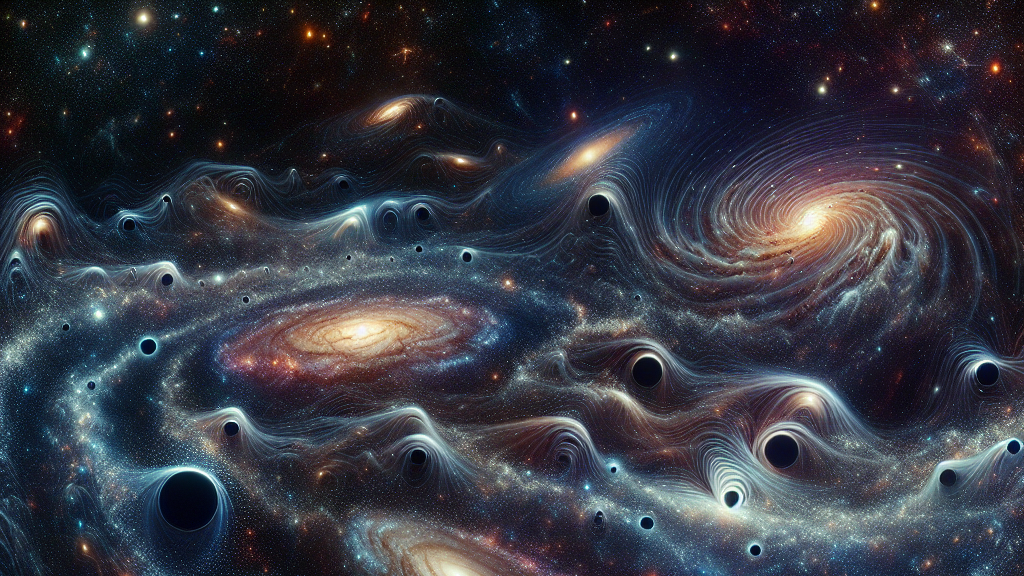
Recently, scientists found that gravitational waves can reveal secrets about early cosmic activities, notably those involving primordial black holes and unique particles called Q-balls. These elements can cause special periods in the universe known as early matter-dominated epochs. By studying how these epochs ended, researchers realized that these events leave distinct signatures in the gravitational waves we detect today.
This new understanding means we can better ‘hear’ how different cosmic phases, including the ones dominated by these mysterious black holes and Q-balls, shape the gravitational waves around us. Imagine these waves as voices from the past, each one telling a different story about space and time. In the future, this might help us uncover even more about the universe’s mysterious origins and how it continues to evolve.
Gravitational waves are ripples in space-time, like tiny wrinkles that travel at the speed of light!
FAQs
What are gravitational waves, and why are they important?
Gravitational waves are ripples in space-time caused by massive cosmic events, like colliding black holes. They are crucial because they provide a new way to observe and understand the universe beyond what we can see with light.
How do primordial black holes and Q-balls affect gravitational waves?
Primordial black holes and Q-balls can trigger early matter-dominated epochs in the universe, whose sudden end creates unique gravitational wave patterns. These patterns help scientists trace the universe’s history and dynamics.
What did scientists find about the evolution of the universe from gravitational waves?
Scientists discovered that the gravitational wave spectrum is sensitive to how certain cosmic phases end, especially those influenced by primordial black holes and Q-balls. This means we can learn more about these early cosmic events by studying the gravitational waves they leave behind.
Background
Curvature perturbations in the universe are small deviations in the density of matter or energy that can lead to the formation of structures like galaxies. These perturbations can also generate gravitational waves at a secondary level. Early matter-dominated epochs are periods when matter temporarily takes over before the universe becomes dominated by radiation again. Understanding how these epochs end—particularly whether the transition back to radiation is slow or sudden—shapes the gravitational waves they emit.
History
The study of gravitational waves gained prominence with Einstein’s theory of general relativity, which predicted their existence. The first direct detection of such waves came in 2015, presenting a breakthrough in astrophysics. Since then, scientists have explored how various cosmic phenomena, like black holes and neutron stars, produce these waves. This research adds a new layer by examining the effect of primordial black holes and Q-balls on gravitational waves during early cosmic epochs.
Based on “Using Gravitational Wave Signals to Disentangle Early Matter Dominated Epochs” by Matthew Pearce, Lauren Pearce, Graham White, Csaba Balázs, available on arXiv (arxiv.org/abs/2503.03101), used under CC BY 4.0 (creativecommons.org/licenses/by/4.0/).