





































































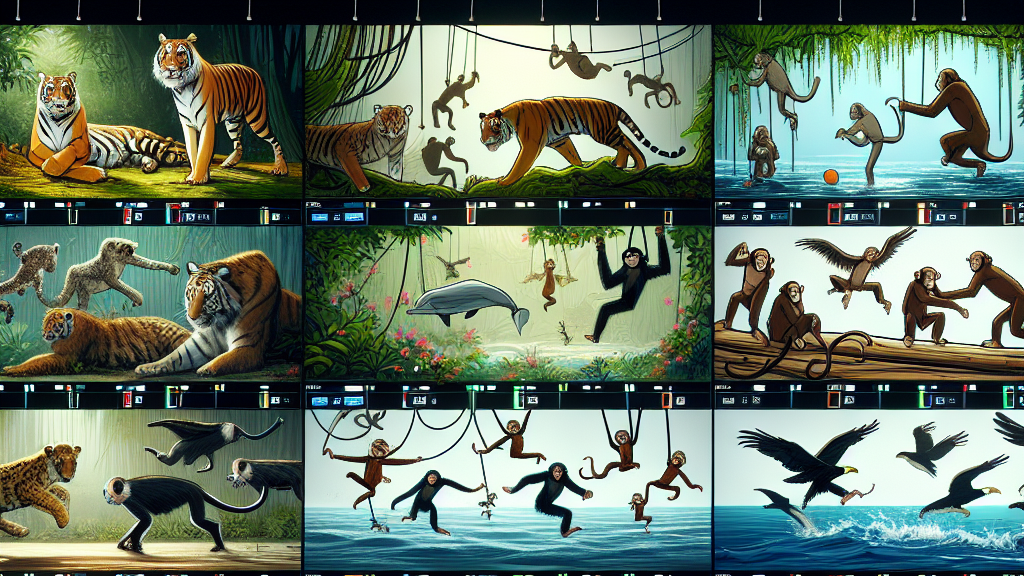
Have you ever thought about how amazing it would be to create a 3D animation of any animal just by typing a few words? This dream could soon be a reality, as researchers are working on groundbreaking technology that uses text to guide animal motions in digital worlds. Imagine being able to instruct a virtual tiger or a dolphin in a 3D scene simply by describing how you want them to move, like writing the script for a movie. It’s like having a magic wand over the digital universe of content creation!
The research team faced two big hurdles: first, they needed a comprehensive dataset of animal movements—think of it as a library of how different animals move—and second, they had to figure out how to make computers understand and apply these movements across various animal shapes and sizes. By enhancing the Truebones Zoo dataset, which captures the movement of over 70 different species, and creating smart techniques to adapt these motions to different animal structures, they’ve laid the groundwork for a new way to animate using just text.
As this technology evolves, it could open up new worlds of creativity for game designers, filmmakers, and educators. Imagine exploring a virtual safari from your living room or learning about animal behavior through interactive digital platforms. This tech could transform not only entertainment but also education, providing engaging ways to learn about the natural world. So, the next time you’re watching a digitally animated animal, remember—you might just be seeing the future of storytelling right in front of you!
Did you know that over 70 different animal species’ movements are now documented in the Truebones Zoo dataset for animators to use?
FAQs
What is text-based motion synthesis for 3D content?
Text-based motion synthesis for 3D content is a technology that lets you create animations of animals or objects by simply using text instructions. It’s like giving verbal commands to bring digital characters to life in creative ways, making the animation process more accessible and intuitive.
How can this technology impact digital content creation?
This technology can radically transform digital content creation by making it easier and faster to animate complex scenes. By using text to animate, creators from various fields such as gaming, films, and education can innovate storytelling and visual experiences without needing deep knowledge of traditional animation techniques.
How does this research overcome the challenges of creating diverse animations?
The research team tackled the challenge by augmenting a dataset called the Truebones Zoo, which includes detailed animal movements and developing methods to adapt these movements to different animal shapes. This allows for high-quality, versatile animation across wide-ranging species and structures.
Can text-based animation technology be used in educational settings?
Yes! Text-based animation could revolutionize educational content by making it more interactive and engaging. Students could learn more effectively through dynamic visual aids, like simulating ecosystems or studying animal behavior in an immersive way.
What is the Truebones Zoo dataset?
The Truebones Zoo dataset is a comprehensive collection of animal movements, featuring over 70 species. It serves as a resource for animators and researchers to create realistic digital animations and experiment with new technologies like text-based motion synthesis.
Background
Motion synthesis is the process of creating animations by blending or generating new movements based on existing data. In 3D animation, every character or object, like animals, relies on skeletal templates, which are digital structures representing their physical forms. Creating a wide variety of realistic motions for different species requires comprehensive datasets and flexible models that can adapt to various skeletal configurations.
History
The concept of motion synthesis has been around for decades, primarily focused on human figures and simple objects. Over time, researchers have expanded this field to encompass a broader range of subjects, including complex animal forms. The Truebones Zoo dataset builds on this legacy by offering detailed motion data for numerous animal species. This study extends previous efforts by making it possible to animate these movements through text, broadening the scope of creative possibilities.
Based on “How to Move Your Dragon: Text-to-Motion Synthesis for Large-Vocabulary Objects” by Wonkwang Lee, Jongwon Jeong, Taehong Moon, Hyeon-Jong Kim, Jaehyeon Kim, Gunhee Kim, Byeong-Uk Lee, available on arXiv (arxiv.org/abs/2503.04257), used under CC BY 4.0 (creativecommons.org/licenses/by/4.0/).
