What if the universe is home to strange stars powered by something entirely unexpected? Recent research proposes that these compact stars could be hiding a new kind of matter known as color-spin-locked quark matter. This bizarre substance could be behind the mysterious fast radio bursts we’ve detected from deep space.
In trying to uncover the secrets of these enigmatic signals, scientists delved into complex models of quark matter. While one model couldn’t support stable stars of this kind, another, with some quantum tweaks, showed that these stars might indeed exist. They’re not your run-of-the-mill stars; as they cool, they might transition into a state that can superconduct. Imagine a cosmic body acting as a super magnet with an intense magnetic field frozen in place. Rarely, a small portion of this energy might break free, possibly giving rise to the spectacular bursts of radio waves we catch across the universe.
Now picture this: one day, technology might allow us to harness these bursts for insights into the universe’s earliest days, perhaps even unlocking new ways to communicate across the stars. These space phenomena, once thought random, could hold the key to answers about the fundamental forces shaping everything we see and don’t see. So, next time you hear about a mysterious signal from space, remember—it could be a quark-filled star sharing its buried secrets with us!
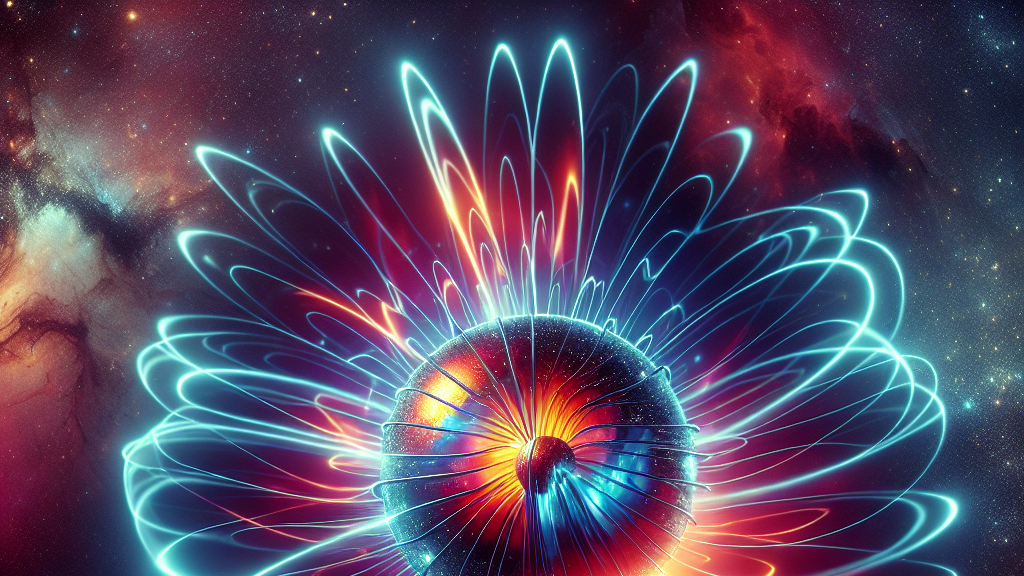
A color-spin-locked quark matter star acts like a giant cosmic magnet, potentially causing fast radio bursts.
FAQs
What are color-spin-locked quark stars?
Color-spin-locked quark stars are a theoretical type of star composed of an exotic form of quark matter, known for potentially acting like a cosmic-sized superconductor.
How do color-spin-locked quark stars relate to fast radio bursts?
Color-spin-locked quark stars might sporadically release bursts of electromagnetic energy as they cool, which could cause the fast radio bursts we detect from space.
Could this research explain other cosmic phenomena?
While color-spin-locked quark stars offer a potential explanation for fast radio bursts, they are unlikely to account for other phenomena like gamma-ray bursts or giant flares.
Why are these potential stars significant to science?
These stars could help explain mysterious cosmic events and offer insights into new states of matter not yet observed directly on Earth.
What is the MIT bag model in simple terms?
The MIT bag model is a way to study hypothetical particles called quarks by treating them as if they are contained within a ‘bag,’ helping scientists understand how such particles might behave inside stars.
Background
Understanding strange stars requires grasping the concept of quark matter, essentially matter composed of quarks, which are the fundamental building blocks of protons and neutrons. In certain conditions, quarks might bind in unique ways, forming exotic states like color-spin-locked quark matter. Theoretical models like the MIT bag model and the Nambu-Jona-Lasinio model help scientists predict how quark matter might behave under extreme conditions, such as those found in compact stars.
History
The journey to understanding compact stars began with the discovery of neutron stars, leading researchers to explore the potential existence of even denser objects like quark stars. Theoretical work on quark matter, supported by the MIT bag model and later by the Nambu-Jona-Lasinio model, has evolved to propose these compact stars might be home to exotic states of matter. This line of inquiry has opened the possibility that such stars could be linked to unusual signals from space, like fast radio bursts, broadening our understanding of the universe.
Based on “Quark Stars as Hideouts For Color-spin-locked Quark Matter: Implications for Powering High-energy Electromagnetic Emissions” by Xin-Ying Song, available on arXiv (arxiv.org/abs/2409.15811), used under CC BY 4.0 (creativecommons.org/licenses/by/4.0/).