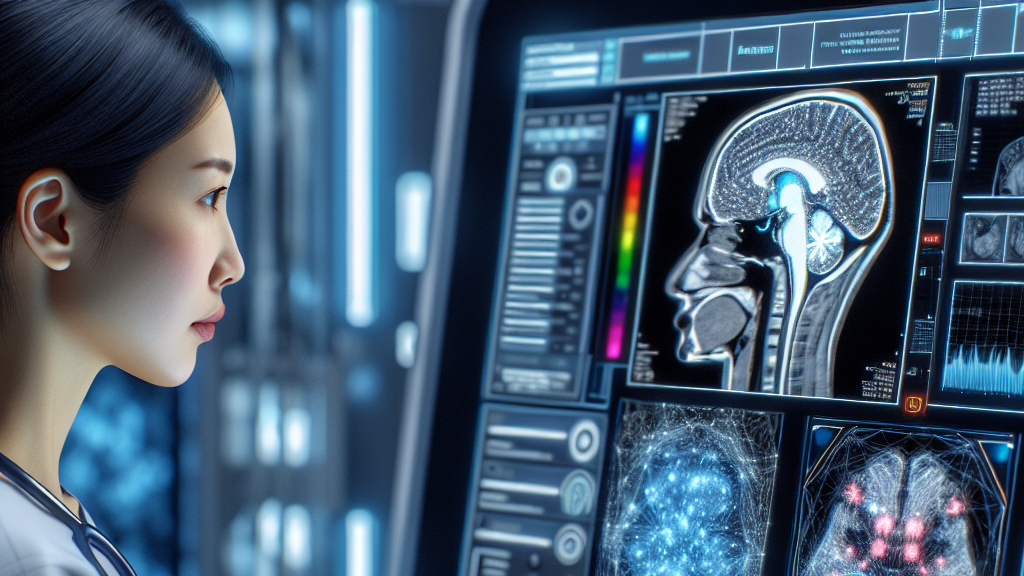
Imagine if diagnosing illnesses with CT scans, MRIs, and X-rays could be done in mere minutes, instead of hours of painstaking analysis by experts. That’s the promise with QuickDraw, a new open-source tool that’s set to revolutionize the way doctors and hospitals work with medical images. Not only can it vastly speed up the process, but it also aims to cut costs and reduce variability in interpretations.
QuickDraw is a game-changer in the field of medical imaging. By using cutting-edge AI models, it can quickly generate three-dimensional segmentation masks from your standard medical scans. This means that doctors can see precisely which areas of a scan might be cause for concern without having to spend endless hours poring over images. Even better, the tool allows users to fine-tune the AI’s analysis, so it continually improves, making the system even smarter over time.
Imagine visiting your doctor with the comfort that your scan results will be ready in less time than it takes for your coffee to brew. With QuickDraw, that could be a reality. This tool has the potential to make healthcare more efficient, allowing quicker diagnoses, which means faster treatments—and possibly saving lives. Plus, for you, it might mean shorter visits and reduced medical bills.
QuickDraw can reduce the time to manually segment a CT scan from four hours to just six minutes.
FAQs
How does QuickDraw improve CT scan analysis?
QuickDraw uses AI to generate 3D segmentation masks quickly, reducing the time to analyze a CT scan from four hours to six minutes, significantly improving efficiency.
Why aren’t state-of-the-art models used in clinical settings?
Many models don’t easily work with existing medical viewers. QuickDraw solves this by interfacing seamlessly with them, making it practical for real-world use.
What makes QuickDraw unique compared to other medical imaging tools?
QuickDraw allows for editing, exporting, and evaluating segmentation masks, continually enhancing AI models through active learning.
Background
Medical imaging, like CT scans, MRIs, and X-rays, plays a critical role in diagnosing diseases by showing what’s happening inside your body. Currently, interpreting these images is a slow and costly process that requires experts to carefully examine them. This is where AI comes in. By automating analysis, AI can make this process faster, more accurate, and much less expensive.
History
Over the years, the role of AI in healthcare has grown, with many efforts focusing on interpreting medical images. However, despite big leaps forward, many AI models aren’t used in practice because they don’t fit well with existing systems. QuickDraw addresses this gap, building on past research and offering a practical, easy-to-use tool that can plug directly into medical workflows.
Based on “QuickDraw: Fast Visualization, Analysis and Active Learning for Medical Image Segmentation” by Daniel Syomichev, Padmini Gopinath, Guang-Lin Wei, Eric Chang, Ian Gordon, Amanuel Seifu, Rahul Pemmaraju, Neehar Peri, James Purtilo, available on arXiv (arxiv.org/abs/2503.09885), used under CC BY 4.0 (creativecommons.org/licenses/by/4.0/).