





































































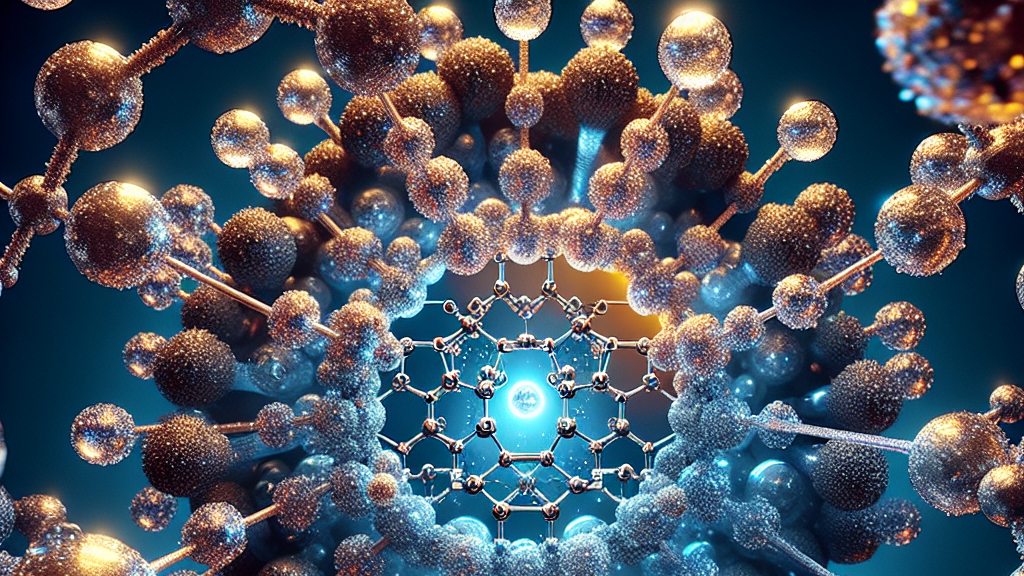
Did you ever think water could create diamonds? It sounds like a tale out of a fantasy book, but scientists have found that under extreme pressure and heat, water can turn simple hydrocarbons into tiny diamonds! This isn’t happening in your sink, though—these conditions mimic those deep inside planet cores.
The process works because when subjected to intense pressure and high temperatures, water behaves differently, becoming ionized like a superacid. This ionized state changes how hydrocarbons behave, turning them into temporary forms that eventually evolve into nanodiamonds. Scientists used advanced simulations to watch this transformation and discovered a unique reaction network influenced by these extreme conditions.
Why does this matter? Well, understanding these reactions can help us learn more about how planets form and evolve. Not only that, but this superacid-like chemistry could inform new ways to synthesize materials we use every day. Imagine creating high-strength materials for construction or electronics using techniques inspired by planetary processes!
At extreme pressures, water can become a superacid that helps turn hydrocarbons into nanodiamonds.
FAQs
How does water create diamonds under pressure?
Under extreme pressure and temperature, water becomes ionized, acting like a superacid that transforms hydrocarbons into nanodiamonds.
What are nanodiamonds?
Nanodiamonds are minuscule diamond particles, and under extreme conditions, they can form from hydrocarbons due to ionized water.
Why is this research on water chemistry important?
It helps us better understand planetary formation and the deep carbon cycle, and it could lead to innovative ways to synthesize materials.
Could this research impact material production?
Yes, by mimicking the natural processes observed, new methods could be developed to create high-strength materials.
Is this phenomenon occurring naturally anywhere?
Yes, similar conditions exist in planetary interiors where extreme pressure and temperature influence material formation.
Background
Water, when subjected to extreme conditions of pressure and temperature, can act as a catalyst for chemical transformations. Under such conditions, water ionizes, creating an environment similar to that of superacids, substances that are more acidic than pure sulfuric acid. This ionized state can promote significant changes in hydrocarbons, turning them into transient forms which can then evolve into stable structures like nanodiamonds.
History
Scientists have long been interested in the deep carbon cycle and the formation of diamonds in planetary interiors. Prior research focused on mineral transformations under high pressure, but recent studies are exploring the chemical behavior of water and hydrocarbons. This research builds on these foundations, using cutting-edge simulations to uncover a new realm of chemistry under extreme conditions.
Based on “Water is a superacid at extreme thermodynamic conditions” by Thomas Thévenet, Axel Dian, Alexis Markovits, Sandro Scandolo, Arthur France-Lanord, Flavio Siro Brigiano, available on arXiv (arxiv.org/abs/2503.10849), used under CC BY 4.0 (creativecommons.org/licenses/by/4.0/).
