





































































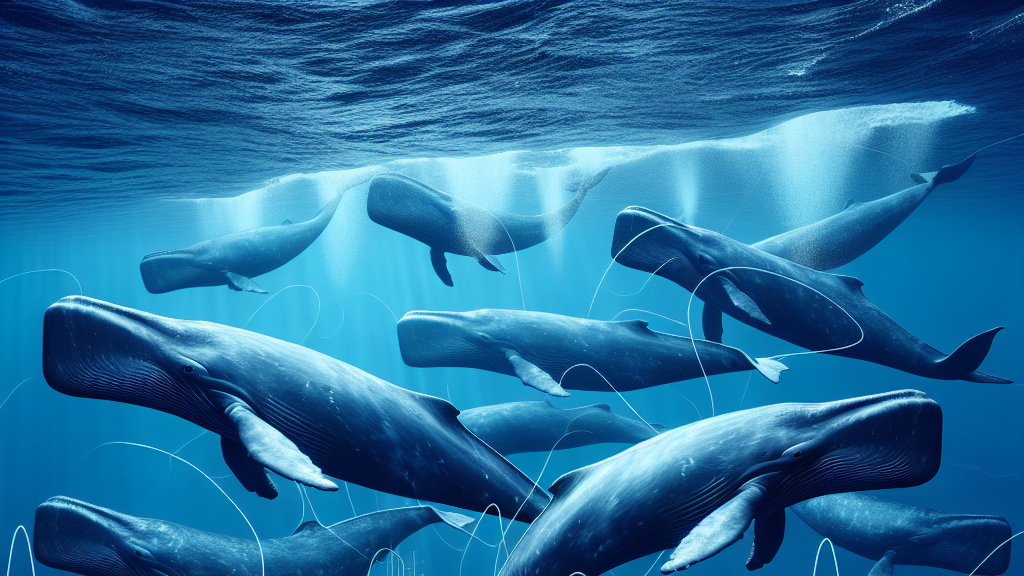
Did you know that sperm whales talk to each other using clicks? But here’s the kicker: these clicks might be more like languages, and whales could be learning from each other, even when they belong to different groups—imagine whales learning a new dialect just like we learn a new language from someone we hang out with!
Researchers recorded these clicks from whales in the Pacific and Atlantic Oceans and discovered something fascinating. While whales traditionally belong to clans based on the rhythm of their clicks, it turns out when these clans live in the same area, their clicking style becomes more similar. This suggests they’re learning from one another, breaking through their cultural boundaries—like picking up an accent from a neighbor.
This whale talk discovery could revolutionize how we think about animal communication. Imagine, someday, using this knowledge to foster better human-animal interactions or even improve how we learn languages. So next time you see a whale, think of it not just as a gentle giant of the sea, but maybe even a master linguist!
Sperm whales can click at volumes up to 230 decibels, louder than a rock concert!
FAQs
How do sperm whales use clicks to communicate?
Sperm whales use a series of clicks known as codas to communicate with each other. These are rhythmic patterns that can function like a language, with identity codas marking clan membership.
Do sperm whales from different clans understand each other?
Yes, it seems that whales from different clans can learn each other’s clicking styles when they live in the same area, indicating social learning across cultural boundaries.
What could this research mean for humans?
Understanding how whales learn to ‘speak’ across clan boundaries can provide insights into animal communication and social learning applicable to humans, potentially improving our language learning techniques.
Background
Sperm whales communicate using rhythmic patterns of clicks known as codas. These codas serve similar functions to human languages, with specific click patterns representing identities of different whale groups or clans. By analyzing these clicks, scientists can study the social structures and cultural exchanges within whale populations.
History
Research into whale communication has been ongoing, with scientists previously identifying distinct vocal patterns among whale clans. This study advances the field by using computational methods to analyze the subtle nuances in whale clicks, providing new insights into the potential for social learning across different groups.
Based on “Evidence of social learning across symbolic cultural barriers in sperm whales” by António Leitão, Maxime Lucas, Simone Poetto, Taylor A. Hersh, Shane Gero, David Gruber, Michael Bronstein, Giovanni Petri, available on arXiv (arxiv.org/abs/2307.05304), used under CC BY 4.0 (creativecommons.org/licenses/by/4.0/).
