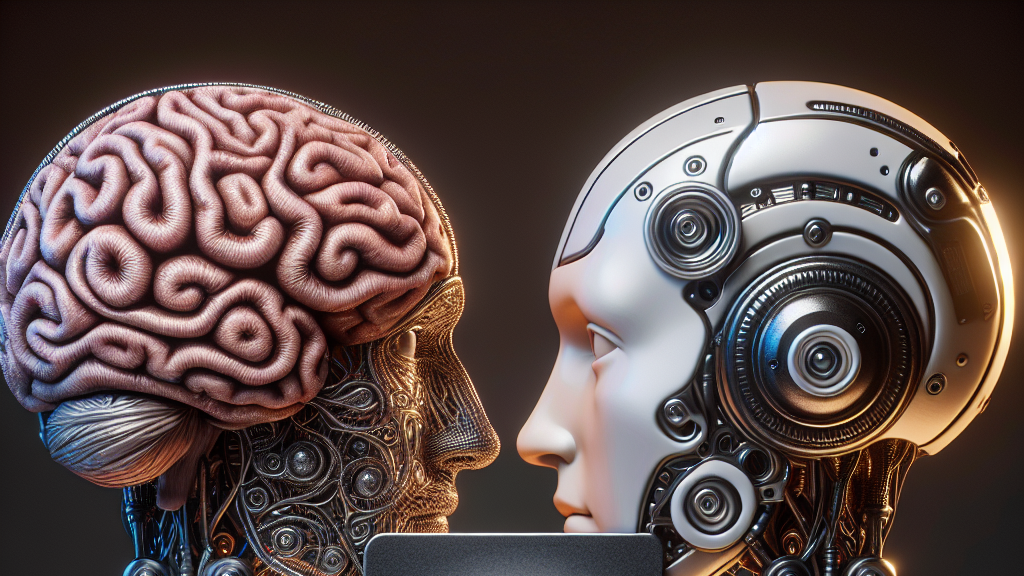
Imagine you’re trying to recall a song, but all you have are a few scattered words and a tune that just won’t come together. For us, this tip-of-the-tongue moment might be solved with a quick search online or a chat with a friend. But what if a computer could do the same thing, functioning just like your memory? That’s the exciting work scientists are doing with this new AI challenge.
Researchers have created the Browsing Lost Unformed Recollections, or BLUR, as a way to see if AI can keep up with human memory when it comes to recalling complex things. With 573 real-world questions that include different languages and types of information, humans score almost perfectly, whereas the best AI only gets it right 56% of the time. The hope is to push AI technology to better understand and recall information, just like our brains do.
In our future, imagine an AI assistant that not only finds recipes or plays music but understands and recalls your preferences, just like a human friend does. This research could revolutionize how we interact with technology, making our digital helpers more understanding and human-like, potentially improving everything from education to personalized recommendations.
Humans scored an average of 98% on these memory questions, while the best AI only managed 56%!
FAQs
What is the purpose of the Browsing Lost Unformed Recollections (BLUR)?
The Browsing Lost Unformed Recollections (BLUR) is designed to test whether AI systems can recall and reason with information like humans do. It’s essentially a memory challenge for AI.
How well do humans perform on the BLUR test compared to AI?
Humans ace the BLUR test with an average score of 98%, while the best-performing AI system scores around 56%, highlighting the current gap between human and AI memory capabilities.
What makes the BLUR questions challenging for AI?
The BLUR questions are challenging because they require searching and reasoning across different languages and types of data, something humans do naturally but AI still struggles to do efficiently.
How could advancements in AI memory impact everyday life?
Advancements in AI memory could make technology more intuitive and personalized, helping AI assistants become better at understanding and remembering personal preferences, which could improve everything from learning experiences to everyday recommendations.
What is the future potential of this AI research?
This research aims to make AI systems more human-like in their memory and reasoning, potentially transforming how we use technology in daily life by making digital interactions more seamless and intuitive.
Background
AI typically processes information in a logical, linear fashion, but one of the biggest challenges is retrieving information in a way that mimics human memory. This study relies on what’s known as multi-modal inputs, meaning the AI has to handle different kinds of data, like text and images, and multilingual inputs, addressing multiple languages, to test its memory and reasoning skills.
History
The quest for creating AI that can think and remember like humans has been ongoing. Initially, AI was limited to simple tasks, but as technology advanced, researchers began developing systems with more complex functions like natural language processing. BLUR represents the latest step, combining previous work on multimodal and multilingual processing to better test and train AI systems.
Based on “Browsing Lost Unformed Recollections: A Benchmark for Tip-of-the-Tongue Search and Reasoning” by Sky CH-Wang, Darshan Deshpande, Smaranda Muresan, Anand Kannappan, Rebecca Qian, available on arXiv (arxiv.org/abs/2503.19193), used under CC BY 4.0 (creativecommons.org/licenses/by/4.0/).