Connect with us

Search by keyword

Computers

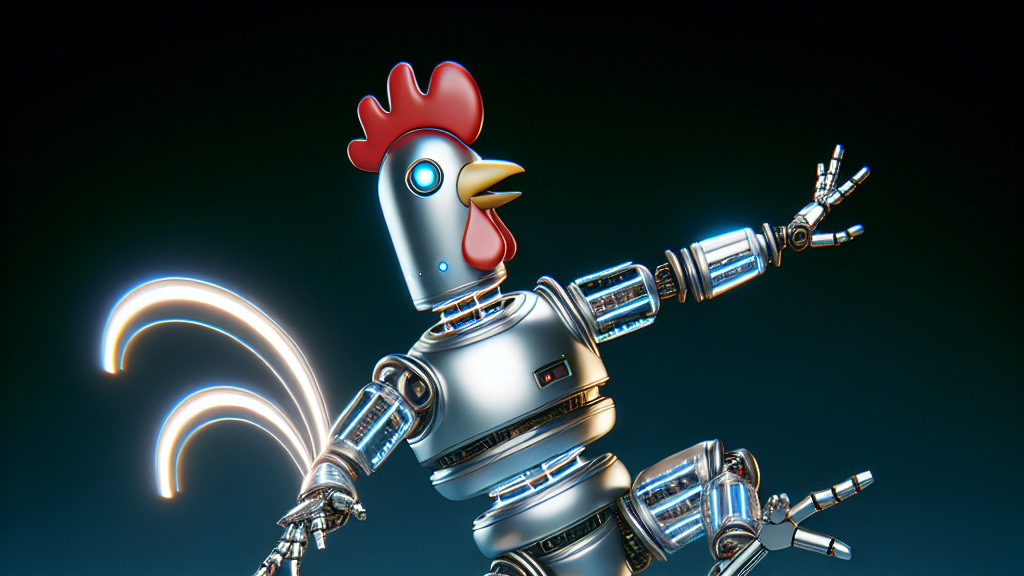
Can AI Dance Like a Chicken?

Imagine being able to tell a computer to make a 3D character dance like a chicken just by giving it a few examples. LoRA-MDM is a groundbreaking new tool that lets AI capture unique styles, like ‘chicken dance,’ even with limited data, paving the way for creative and personalized animations.

Can AI Dance Like a Chicken
✨Researched by humans. Explained by robots. Learn more.

Ever wish you could make your favorite video game character bust out quirky, fun dance moves? Well, with AI advancements like LoRA-MDM, that dream is becoming a reality. Imagine telling a computer to make a 3D character perform a crazy chicken dance and having it get every clunky and hilarious style spot on. That’s where this cutting-edge tool comes in, capable of infusing unique styles into animations with just a few examples.

LoRA-MDM shines where others fall short. While traditional AI struggles to capture specific styles like ‘chicken’ due to a lack of data, LoRA-MDM adapts creatively. It doesn’t just modify the dance moves one by one; instead, it adjusts the whole dance vibe by slightly shifting how it understands and recreates human motion. This flexibility allows it to blend different dance styles naturally and even edit movements without losing the original flair.

Imagine using LoRA-MDM in the future to personalize greetings in VR, make educational videos more engaging, or even kickstart new trends in social media filters or games. Whether it’s creating a viral dance on TikTok or adding flair to an animated movie, this technology promises a world where style and creativity meet with just a simple text command.

Did you know? The infamous chicken dance was created in the 1950s and has become a staple at weddings worldwide!

FAQs

What is the core innovation of LoRA-MDM in text-to-motion models?

LoRA-MDM innovates by adapting the generative process to include unique styles using minimal data, enabling realistic and stylistically nuanced 3D animations.

How does LoRA-MDM handle style transfer with limited data?

LoRA-MDM uniquely shifts the generative model’s understanding, allowing it to create consistent styles from just a few reference samples, unlike traditional methods that require extensive datasets.

What real-world applications could benefit from LoRA-MDM technology?

LoRA-MDM technology could enhance creative sectors like gaming, virtual reality, and animation by allowing more personalized and stylistically diverse motion capture and character animation.

Why are nuanced stylistic attributes challenging for AI models?

Nuanced stylistic attributes are challenging because they require a deep understanding of subtle, expressive traits that often lack ample data, making it hard for AI to recreate them accurately.

How does LoRA-MDM change the landscape of 3D animation?

LoRA-MDM offers a more flexible and accessible approach to styling animations, enabling creators to produce intricate and expressive movements that were previously hard to achieve with limited resources.

Background

At the heart of this study is the challenge of teaching machines to understand and replicate human movements in diverse styles. Text-to-motion models translate written descriptions into animations, but capturing specific styles, such as a comedic ‘chicken dance,’ can be tricky due to limited data. This research focuses on refining these models to grasp and generate unique motion styles by tweaking overall dance motion understanding rather than individual styles.

History

Text-to-motion models have evolved significantly, with earlier systems primarily focusing on basic action sequences without stylistic flair. Recent advancements sought to infuse style, but often at the cost of losing clarity or requiring vast amounts of sample data. This study builds on those efforts by introducing a minimal-data approach that preserves style and accuracy, opening new avenues for creativity in digital animation.

Based on “Dance Like a Chicken: Low-Rank Stylization for Human Motion Diffusion” by Haim Sawdayee, Chuan Guo, Guy Tevet, Bing Zhou, Jian Wang, Amit H. Bermano, available on arXiv (arxiv.org/abs/2503.19557), used under CC BY 4.0 (creativecommons.org/licenses/by/4.0/).

Trending

Latest

Can AI Save Water Discover How

Computers

AI is transforming the tech world, but it uses lots of water! A new tool, SCARF, helps us measure and reduce AI's water footprint,...

Whats a Forbush Decrease and Why Should We Care Whats a Forbush Decrease and Why Should We Care

Space

Scientists just observed the biggest solar storm event in years, revealing unexpected cosmic ray patterns. Understanding these changes could help us protect our technology...

Can Cars Spot Danger Faster Than Humans Can Cars Spot Danger Faster Than Humans

Computers

Think about how quickly you react when something unexpected happens on the road. This research brings us closer to creating self-driving cars that can...

Can Fear of the Other Stop Social Harmony Can Fear of the Other Stop Social Harmony

Physics

Fear of the unknown might make it harder for people to agree and get along. This study shows that when people have strong xenophobic...

Can AI Revolutionize Breast Cancer Diagnosis Can AI Revolutionize Breast Cancer Diagnosis

Electricity

This research introduces a groundbreaking AI model that can accurately assess HER2-positive breast cancer using widely accessible staining methods, potentially revolutionizing how we diagnose...

Can AI Transform Your Singing into a Choir Can AI Transform Your Singing into a Choir

Computers

Imagine singing solo and having AI turn you into a choir. This research unveils a groundbreaking AI tool that transforms your voice into rich...

You May Also Like

Computers

AI is transforming the tech world, but it uses lots of water! A new tool, SCARF, helps us measure and reduce AI's water footprint,...

Computers

Think about how quickly you react when something unexpected happens on the road. This research brings us closer to creating self-driving cars that can...

Electricity

This research introduces a groundbreaking AI model that can accurately assess HER2-positive breast cancer using widely accessible staining methods, potentially revolutionizing how we diagnose...

Computers

Imagine a machine capable of reading ancient books, deciphering complex pages with precision! This research is paving the way for AI to unlock the...

Economics

Discover how AI models can unknowingly favor certain races in mortgage decisions and how new methods could dramatically reduce these biases, fostering a fairer...

Computers

This research explores how AI models designed to understand both images and words might improve their performance simply by teaching themselves to think better....

Computers

Imagine if playing games could make a computer program better at understanding and creating text! This research suggests that by using creative tasks like...

Computers

Dive into the world of AI mistrust, where computers don't always know when they're wrong! Discover how teaching AI to see like us might...

Computers

What if talking to a robot could feel as comforting as a therapy session? This research uncovers the striking similarities between human therapists and...

Copyright © 2024 8ig8rain.

Disclaimer: The content on 8ig8rain.com consists of AI-generated summaries of scientific abstracts from arXiv. Please note that most arXiv abstracts are preprints and may not have undergone formal peer review. While these summaries aim to convey key ideas and potential applications, they are provided for informational purposes only and should not be interpreted as validated scientific findings or professional advice. The summaries are intended to educate, spark curiosity, and inspire further exploration of science.