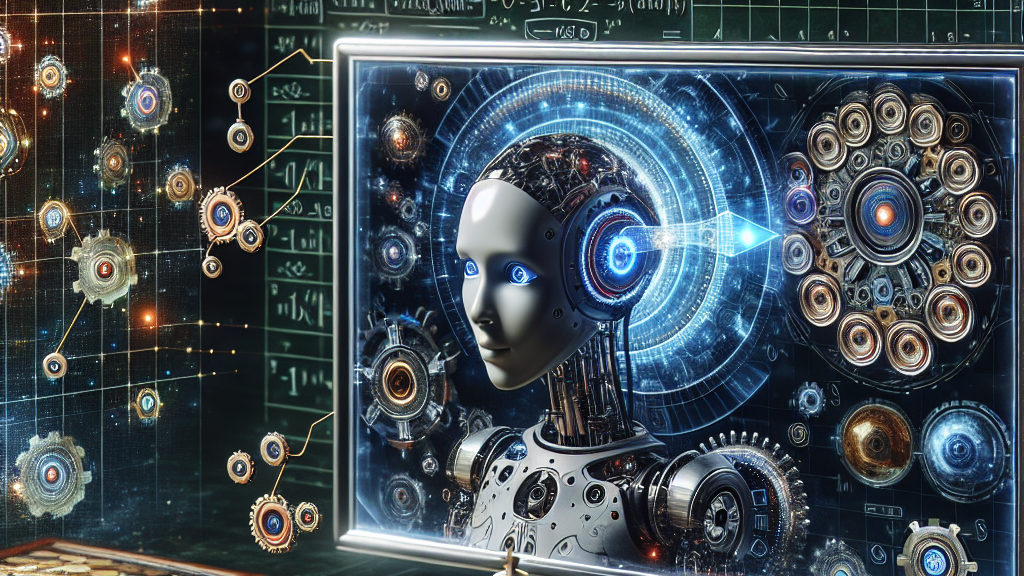
What if AI could understand the universe better than we do? That’s not just a sci-fi fantasy anymore. Introducing AI-Newton, a groundbreaking system designed to imitate how humans uncover the mysteries of physics, enabling computers to solve complex puzzles of our world without any guidance.
The AI-Newton works by feeding on raw data—messy, noisy, and real-world like—and from there, it begins to piece together the fundamental laws of nature, similar to how Newton once did. Imagine teaching a child who knows nothing about physics, yet they observe, learn, and then explain why the apple always falls to the ground. That’s what AI-Newton is doing without needing to be taught. It digs into problems that follow Newtonian mechanics, figuring out patterns and rediscovering laws like gravity or energy conservation entirely on its own.
Imagine AI-Newton being used in labs worldwide, tackling scientific problems that have baffled us for years. It might predict natural disasters by unveiling hidden patterns in climate data, or even find new ways to harness energy for a more sustainable world. This isn’t just about smarter machines; it’s about partnering with AI to break new frontiers and solve the world’s greatest mysteries.
AI-Newton can rediscover Newton’s laws of motion without any human input!
FAQs
How does AI-Newton mimic human discovery?
AI-Newton uses a groundbreaking system that starts from raw data and autonomously formulates physical laws, much like how humans derive patterns in nature, but without needing prior knowledge or supervision.
What significance does AI-Newton hold in scientific research?
AI-Newton represents a leap towards machines conducting independent scientific research, which could lead to breakthroughs in fields where human analysis hits a limit.
Could AI-Newton be applied outside the realm of physics?
Yes, AI-Newton’s methodology could expand to other sciences, potentially unlocking secrets in biology, chemistry, and beyond, offering new insights that humans alone might struggle to find.
What practical applications might arise from AI-Newton’s discoveries?
AI-Newton could help predict complex phenomena like weather patterns or diseases by discovering patterns or laws that are currently unknown to us.
Is AI-Newton truly different from traditional AI models?
Unlike traditional models requiring large labeled datasets, AI-Newton operates unsupervised, independently deriving insights much like a scientist would from observation.
Background
In traditional scientific research, humans observe phenomena, develop theories, and conduct experiments to verify or refute these theories. This process relies heavily on human intuition and existing knowledge. However, the emergence of artificial intelligence offers potential to automate and possibly surpass human capabilities in scientific discovery through sophisticated algorithms and learning models.
History
The journey towards AI-driven scientific discovery has evolved from rudimentary data analysis to complex modeling and machine learning. Early AI systems were limited by their need for human input and labeled datasets. As machine learning techniques like unsupervised learning became more advanced, AI systems started showing potential to independently discover patterns within data. The AI-Newton pushes this boundary further by autonomously uncovering physical laws, reminiscent of how natural philosophers like Isaac Newton first formulated their ideas.
Based on “AI-Newton: A Concept-Driven Physical Law Discovery System without Prior Physical Knowledge” by You-Le Fang, Dong-Shan Jian, Xiang Li, Yan-Qing Ma, available on arXiv (arxiv.org/abs/2504.01538), used under CC BY 4.0 (creativecommons.org/licenses/by/4.0/).