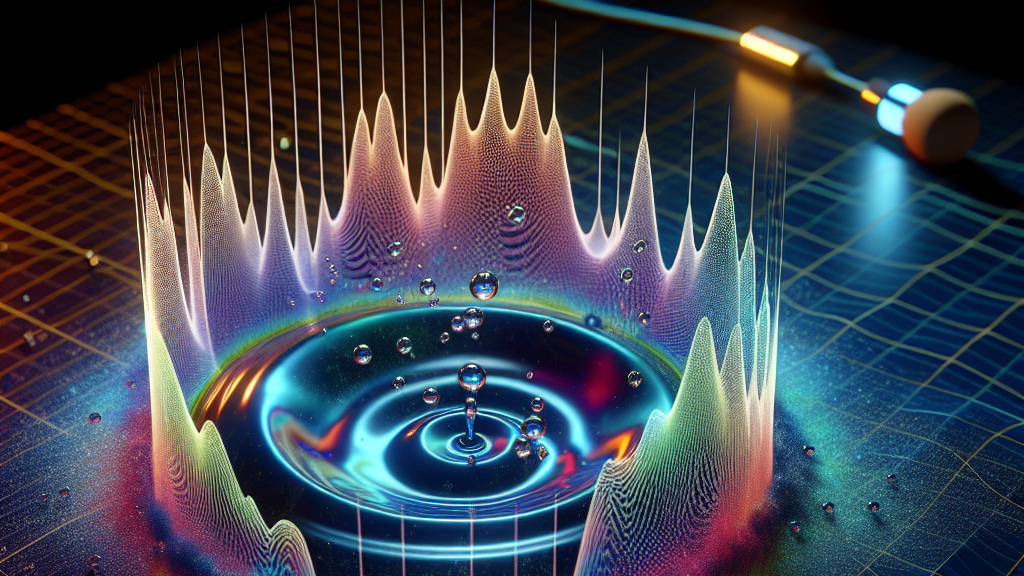
Imagine being able to see music playing on a speaker or a glass of water rippling just by the sound of your voice. It’s like magic—but with science! This new research captures those tiny, invisible vibrations sound waves create when they hit an object, making the invisible visible in stunning detail.
For a long time, scientists faced challenges in capturing these vibrations accurately. Traditional cameras had limitations, often missing the fast, subtle changes that sound creates. But with the introduction of event camera technology, which excels at picking up high-frequency signals, researchers have now developed a method to accurately recover sound by visualizing these vibrations. They’ve designed a special system using lasers and a unique way to process the camera’s data, bringing precision and clarity to how we can ‘see’ sound.
Think about how this could change our daily lives—imagine having hearing aids that can literally ‘see’ the sound around you, providing clearer audio. Or picture video recording equipment capturing sound in a way that enhances its quality by visualizing the unseen sound waves. This breakthrough could transform the way we experience media, listen to music, or even communicate.
Our ears aren’t the only things that ‘see’ sound; objects can too, by vibrating when sound waves hit them!
FAQs
How does capturing vibrations with event cameras enhance sound recovery?
Event cameras excel at detecting high-frequency changes, like those caused by sound vibrations, making them perfect for visualizing subtle sound-induced movements that traditional cameras might miss.
Why is using a laser matrix important in this sound recovery research?
The laser matrix improves the gradient, helping to capture the tiny vibrations caused by sound waves more precisely, which enhances the quality of the recovered sound.
Can this technology be used in everyday devices like hearing aids?
Yes, by visualizing sound-induced vibrations, this technology could improve hearing aids, making them more effective by providing clearer audio based on visual sound patterns.
What challenges did researchers overcome with this new sound recovery method?
Researchers tackled the limitations of previous methods which struggled with sampling rates and signal clarity by using innovative event camera technology and spatial-temporal data processing.
How might this research change video production or media recording?
This method of visualizing sound could lead to recording equipment that provides enhanced audio capture, offering a richer and more immersive media experience.
Background
When sound waves, which are vibrations traveling through the air, hit an object, they cause it to vibrate slightly. These vibrations are usually too subtle and high-frequency for our eyes to see or for typical cameras to capture. However, event cameras—which are a type of camera designed to detect rapid motion and changes—can capture these minute vibrations, opening up new ways to understand and utilize sound.
History
Sound recovery has been a field of interest for a long time, focusing mainly on methods to capture sound and understand its properties. Early techniques faced limitations due to the constraints of regular cameras and audio equipment. With the advent of event cameras, researchers have found a way to bypass these limitations and significantly improve sound recovery and visualization. This study builds upon those early foundations and advances them by using sophisticated methods to capture vibrational data with unprecedented accuracy.
Based on “EvMic: Event-based Non-contact sound recovery from effective spatial-temporal modeling” by Hao Yin, Shi Guo, Xu Jia, Xudong Xu, Lu Zhang, Si Liu, Dong Wang, Huchuan Lu, Tianfan Xue, available on arXiv (arxiv.org/abs/2504.02402), used under CC BY 4.0 (creativecommons.org/licenses/by/4.0/).