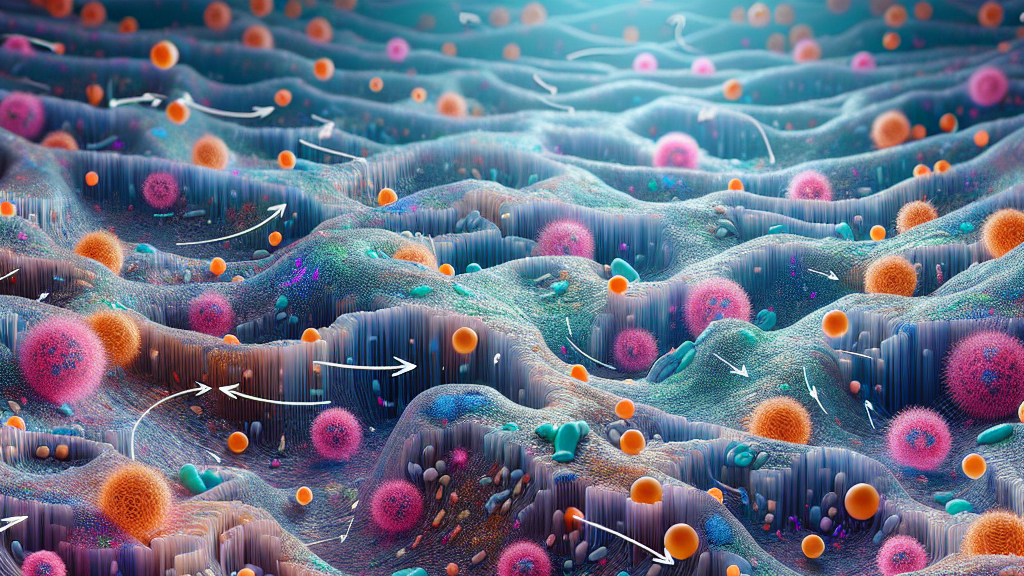
Did you know that cells have a kind of sixth sense that lets them detect when they’re being squished and squeezed by their neighbors? This research dives into how diverse cell populations don’t just grow randomly. Instead, they’re drawn towards areas where they can stretch out and breathe a bit easier. Imagine a crowded party where everyone naturally drifts towards the open spaces—it’s like that, but on a tiny, cellular level.
The researchers created a model, using math to explain how these cells behave. They imagine the cells like little agents on a grid, each with its own personality and movement style based on its ‘phenotype’—or type. What’s fascinating is that these cells move in response to pressure, sort of like how you’d shuffle to a less crowded area in a concert. By looking at how cells divide, die, and move, they discovered patterns of how these cells segregate spatially—spreading out as they expand and grow.
Think about the practical implications: imagine healing a wound more effectively or stopping cancer from invading healthy tissue based on how these cells move under pressure. If scientists can figure out how to manipulate this process, it could lead to new treatments and innovations in health care. This study is a step towards understanding the hidden dance of cells in action!
Cells can sense and respond to pressure around them—shuffling towards less crowded spaces, much like people at a party!
FAQs
How do cells sense pressure around them?
Cells are sensitive to their environment, and this study shows that they move towards areas where they feel less squished, like moving from a crowded room to a more open space. This movement is influenced by the density of cells around them.
Why is the movement of cells towards less crowded areas important?
This movement can affect how tissues heal or how diseases like cancer spread. If we understand these movements, we might be able to better control and direct how cells behave, potentially leading to breakthroughs in medical treatments.
What method did researchers use to study cell movement?
Researchers built a mathematical model to simulate how different kinds of cells move, multiply, and die under pressure. This helps them predict how cells will behave in different situations.
Can this study help in medical treatments?
Yes, understanding how cells move and segregate could lead to improved methods for healing wounds, or stopping diseases like cancer from spreading by targeting cell movements.
What did the study reveal about cell segregation?
The study showed that differences in cell mobility can lead to patterns where cells with different characteristics separate and spread out, providing insights into natural tissue organization and disease progression.
Background
Cells within our bodies don’t just drift randomly; they respond to mechanical cues in their environment. This study explores how cells of different types, each with its own unique behavior, react to pressure in their surroundings. As cells divide and grow, they exert force on each other, creating ‘cellular pressure’. Depending on their type, they may shift towards areas with less resistance. The study represents these cells as individual agents on a grid, much like pieces on a game board, and observes how they move under these pressures.
History
The study builds on previous research in cell biology and mathematics, combining these fields to create models that more accurately represent cell behavior. Earlier studies like simpler cell growth models have now evolved, incorporating complexity such as diverse phenotypes and dynamic pressure-based movement. This research is part of a larger effort to understand cellular behavior in more nuanced and varied contexts, improving predictive capabilities and applications in medicine.
Based on “Spatial segregation across travelling fronts in individual-based and continuum models for the growth of heterogeneous cell populations” by José A. Carrillo, Tommaso Lorenzi, Fiona R. Macfarlane, available on arXiv (arxiv.org/abs/2412.08535), used under CC BY 4.0 (creativecommons.org/licenses/by/4.0/).